Paul McKellips - Jericho 3
Здесь есть возможность читать онлайн «Paul McKellips - Jericho 3» весь текст электронной книги совершенно бесплатно (целиком полную версию без сокращений). В некоторых случаях можно слушать аудио, скачать через торрент в формате fb2 и присутствует краткое содержание. Город: Washington, DC, Год выпуска: 2012, ISBN: 2012, Издательство: FBR Press, Жанр: Триллер, на английском языке. Описание произведения, (предисловие) а так же отзывы посетителей доступны на портале библиотеки ЛибКат.
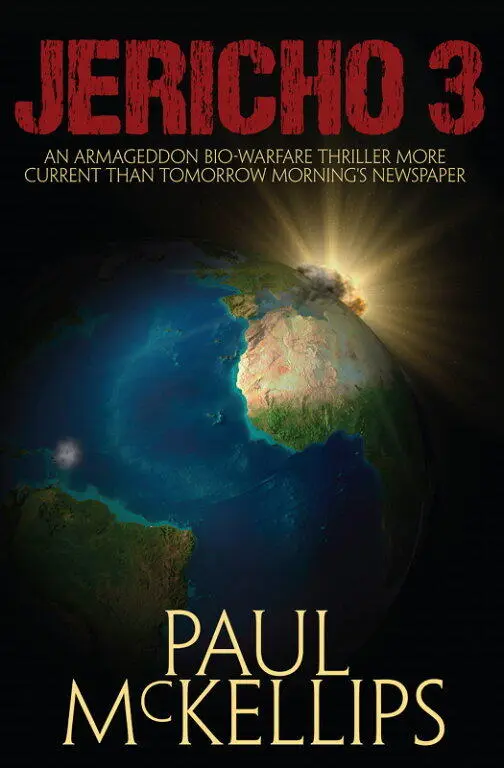
- Название:Jericho 3
- Автор:
- Издательство:FBR Press
- Жанр:
- Год:2012
- Город:Washington, DC
- ISBN:978-0-9853322-0-4
- Рейтинг книги:5 / 5. Голосов: 1
-
Избранное:Добавить в избранное
- Отзывы:
-
Ваша оценка:
Jericho 3: краткое содержание, описание и аннотация
Предлагаем к чтению аннотацию, описание, краткое содержание или предисловие (зависит от того, что написал сам автор книги «Jericho 3»). Если вы не нашли необходимую информацию о книге — напишите в комментариях, мы постараемся отыскать её.
In a remote corner of Afghanistan, three members of the Taliban are diagnosed with a rare, incredibly infectious disease. At a U.S. base just outside Pakistan, an American army doctor is kidnapped by a local tribe to perform an unlikely surgical procedure on the wife of a powerful leader. And back in the U.S., Camp is handed his most challenging assignment ever, which leaves the normally confident hero desperate for answers. All the while, Camp must hold back his secret desire for Leslie Raines, his beautiful cohort, as they are sent off on two sides of the same mission… only to reunite when the stakes get deadly.
With his trademark grit and a globe-racing plot, Paul McKellips takes readers deep into the Middle East conflict, raising timely questions of radicalism, faith, and honor. As the clock ticks down toward Armageddon, Camp and Raines must do everything it takes to stop the total annihilation of two countries.
Timely, gripping, and frighteningly real, JERICHO 3 is a one-of-a-kcenter thriller that will open eyes long after the final page has been turned.
JERICHO 3 Infectious disease. Bio-warfare. Nuclear weapons. WAR JUST GOT PERSONAL.
Ambassador John Bolton writes: “
is a gripping novel… an urgent message… about an Iranian bio threat that should wake us up to the range of horror that could be visited on America and its friends and allies by our sworn enemies.”
Jericho 3 — читать онлайн бесплатно полную книгу (весь текст) целиком
Ниже представлен текст книги, разбитый по страницам. Система сохранения места последней прочитанной страницы, позволяет с удобством читать онлайн бесплатно книгу «Jericho 3», без необходимости каждый раз заново искать на чём Вы остановились. Поставьте закладку, и сможете в любой момент перейти на страницу, на которой закончили чтение.
Интервал:
Закладка:
General Wilbur “Bill” Creech was a trailblazer. During the Cold War era it was Creech who encouraged the military to pursue a new era of modern weapons and tactics coupled with decentralized authority and responsibility.
Captain Kenton was about as decentralized as any Air Force combat pilot could possibly be. Kenton moved quickly into the main gaming room where third shift aviators were more than thrilled to see their replacement crews.
“Good morning, Jack. Kill any bad guys last night?” Kenton asked as he moved into the 17th Reconnaissance Squadron’s large brown leather swivel chair in front of the video screens, computer monitors, keyboard and flight throttle.
“Not much going on, Brady. Late afternoon Kandahar time we had an MRAP pinned down on patrol with small arms fire. They got ground back-up within minutes, so no hellfire’s from ‘Kate.’ She’s back sun-tanning on the ground and waiting for you.”
Captain Brady Kenton was a drone pilot. Since these modern day, remote Air Force pilots couldn’t paint traditional naming signs on their UAVs, Captain Kenton had affectionately named his drone after the latest swimsuit model sensation, Kate Upton.
More than 7,000 drones were in use during the height of the wars in Iraq and Afghanistan. Every one of them were given unofficial nicknames, depending on the shift and the pilot. As Iraq wound down, many of those drones and the MQ-1 Predators were transferred to joint Air Force / CIA control over the lawless regions of North Waziristan, Pakistan.
But Kate was different. She was wearing hardly anything at all and was practically naked, at least on a radar screen. Built by Lockheed Martin, Kate was a bat-winged RQ-170 Sentinel, a sophisticated stealth spy drone.
Shift Commander Lieutenant Colonel Abrams walked in and took the seat next to Captain Kenton briefly.
“Brady, we just received a special joint mission request from the SECDEF and Langley.”
“Pakistan?” Kenton asked eagerly hoping to get some heat drops on a special Al Qaeda target or two.
“Negative. Kate’s going over Iran.”
“Whoa,” Kenton said as he quickly punched up Iranian maps and topography on his computer screens. “Nukes?”
“Bio. Special Ops got a tracking beacon on a machine they think the Iranians might want for aerosolizing a biological weapon. The satellites picked up the device in Damghan.”
Kenton quickly honed in on Damghan.
“North 36, east 54, got it. Chemical and biological weapons production facilities. Bet you didn’t know this, colonel,” Brady Kenton said with schoolyard delight.
“School me.”
“Damghan is the pistachio nut capital of Iran, in the Khorasan Province,” Captain Kenton said as he read from his computer screen.
“One of many nuts in the area I’m sure. I need a flight plan by 0830 and Kate in the skies by 0900.”
“Roger that, sir.”
Kenton developed his flight plan based on the most recent tracking from the birds in orbit. It would take less than 90 minutes for Kate to get to high altitude and beyond Iran’s rather advanced radar systems and reach Damghan where the machine appeared to be stationary and parked in a warehouse. Kenton was excited. He had never flown over Iran before.
Careful not to fly over Turkmenistan, Kenton flew the RQ-170 Sentinel over Herat and Gurian before flying over the Iran-Afghanistan border, up toward Mashhad and then almost directly down over Highway 44 and into Damghan.
Kenton checked his satellite imagery one more time before allowing Kate to track on to the signal. He blinked twice and refreshed his screen. The target was moving.
“Colonel, are you seeing this?” Captain Kenton said into his headset as Colonel Abrams was watching the same thing in the Tactical Operations Center two buildings down on Creech.
“Roger, the target’s moving too fast for ground, looks like she’s getting a lift.”
“Sir, I’ve got it heading south, by southwest at 140 miles per hour.”
“Helicopter,” Abrams confirmed.
“Slowing down now, sir and… stopping. Looks to be a rural area between Khomein and Aligoodarz.”
“Brady, we’ve got an intel officer looking at the area now, stand by…” Abrams said as his computer screen came to life with information from the intelligence officer on duty. “Five small villages… Dehno, Khorzend, Farajabad, Bahmanabad and Sangesfid. The area is called the Bourvari.”
“Anything significant?” Brady asked.
“Maybe, hard to tell, but these are all Persian-Armenian settlements.”
“And that’s somehow important, colonel?”
“They’re Christians, Brady… not a great country to be living as a non-Muslim, if you know what I mean.”
Captain Kenton and Kate circled above the Bourvari for 20 minutes. The video images from Kate were fed to the TOC at Creech for Abrams and his team to watch as Special Agent Daniels and Agent Fallon Jessup watched the same video feed from a CIA command center at Langley.
“Sir, you seeing this?” Brady asked as Abrams, Daniels and Jessup all listened to the anxiety in Brady’s voice. “The machine is on a truck and appears to be driving up and down the village streets.”
“Roger that, looks like the village of Dehno. Can we get the camera in closer?”
“We’re getting a view that feels like 2,000 feet up, sir. Can’t get any better optics unless I take Kate down closer.”
Lieutenant Colonel Abrams stood and took aggressive command in the TOC.
“I need some close range satellite optics. Give me the radar ceiling in the area.”
Abrams reviewed the information on his computer screen seconds after he asked for it.
“Negative Brady, Kate needs to fly high on this first one. We’re just observing today.”
Abrams received a still satellite photo that sucked the wind out of his lungs. The image looked straight down on top of what appeared to be a maintenance truck. The vantage point could have been from the top of an oak tree, if it weren’t for the fact that it was a military camera on a spy satellite.
Three intelligence officers had also gathered in a joint command center at the headquarters of the Directorate of Military Intelligence in Tel Aviv as they watched the same Iranian event unfold through images from their Ofek 9 military spy satellite. The officers were from Agaf Ha Modi’in, otherwise called Aman, as well as Mossad and Shin Bet. Aman was tasked with Israeli military intelligence; Shin Bet handled internal security; and Mossad handled intelligence collection and covert operations. Launched from Palmachim Air Force base on Israel’s coast south of Tel Aviv in 2007, the Ofek 9 had a high resolution camera second to none in the world.
Ofek 9 could clearly see the man in the back of the maintenance vehicle spraying a light mist from a tank of fluid as local children played in the mist and chased the truck passing up and down the dusty roads of the Bourvari villages. The camera resolution on the Ofek 9 was so clear that each of the Israeli intelligence officers wrote down the same word on their paper tablets at the exact same time: SkitoMister.
Lieutenant Colonel Abrams and Captain Brady Kenton sat captivated by the video feed from Kate as Kenton flew the drone.
“Okay captain, let’s take Kate home.”
Kenton pulled back on the stick and took off for Kandahar with intermittent thoughts of Chinese carryout when his combat mission was over. It was, in fact, Tuesday he reminded himself.
U.S. Embassy
Ashgabat, Turkmenistan
The sedan carrying US Navy Captain “Camp” Campbell and Billy Finn pulled up in front of the Embassy at Number 9 1984 Street. Formerly named Pushkin Street when Soviet influence permeated the capital, the American Embassy was understated but efficient.
Читать дальшеИнтервал:
Закладка:
Похожие книги на «Jericho 3»
Представляем Вашему вниманию похожие книги на «Jericho 3» списком для выбора. Мы отобрали схожую по названию и смыслу литературу в надежде предоставить читателям больше вариантов отыскать новые, интересные, ещё непрочитанные произведения.








Обсуждение, отзывы о книге «Jericho 3» и просто собственные мнения читателей. Оставьте ваши комментарии, напишите, что Вы думаете о произведении, его смысле или главных героях. Укажите что конкретно понравилось, а что нет, и почему Вы так считаете.