Paul McKellips - Jericho 3
Здесь есть возможность читать онлайн «Paul McKellips - Jericho 3» весь текст электронной книги совершенно бесплатно (целиком полную версию без сокращений). В некоторых случаях можно слушать аудио, скачать через торрент в формате fb2 и присутствует краткое содержание. Город: Washington, DC, Год выпуска: 2012, ISBN: 2012, Издательство: FBR Press, Жанр: Триллер, на английском языке. Описание произведения, (предисловие) а так же отзывы посетителей доступны на портале библиотеки ЛибКат.
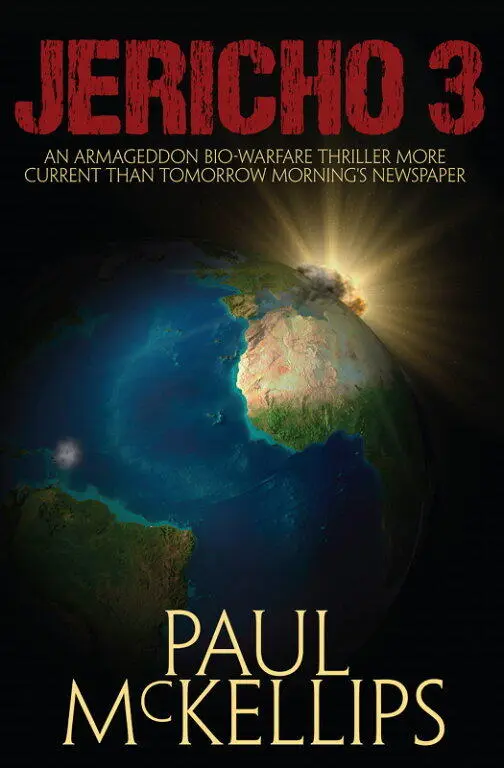
- Название:Jericho 3
- Автор:
- Издательство:FBR Press
- Жанр:
- Год:2012
- Город:Washington, DC
- ISBN:978-0-9853322-0-4
- Рейтинг книги:5 / 5. Голосов: 1
-
Избранное:Добавить в избранное
- Отзывы:
-
Ваша оценка:
Jericho 3: краткое содержание, описание и аннотация
Предлагаем к чтению аннотацию, описание, краткое содержание или предисловие (зависит от того, что написал сам автор книги «Jericho 3»). Если вы не нашли необходимую информацию о книге — напишите в комментариях, мы постараемся отыскать её.
In a remote corner of Afghanistan, three members of the Taliban are diagnosed with a rare, incredibly infectious disease. At a U.S. base just outside Pakistan, an American army doctor is kidnapped by a local tribe to perform an unlikely surgical procedure on the wife of a powerful leader. And back in the U.S., Camp is handed his most challenging assignment ever, which leaves the normally confident hero desperate for answers. All the while, Camp must hold back his secret desire for Leslie Raines, his beautiful cohort, as they are sent off on two sides of the same mission… only to reunite when the stakes get deadly.
With his trademark grit and a globe-racing plot, Paul McKellips takes readers deep into the Middle East conflict, raising timely questions of radicalism, faith, and honor. As the clock ticks down toward Armageddon, Camp and Raines must do everything it takes to stop the total annihilation of two countries.
Timely, gripping, and frighteningly real, JERICHO 3 is a one-of-a-kcenter thriller that will open eyes long after the final page has been turned.
JERICHO 3 Infectious disease. Bio-warfare. Nuclear weapons. WAR JUST GOT PERSONAL.
Ambassador John Bolton writes: “
is a gripping novel… an urgent message… about an Iranian bio threat that should wake us up to the range of horror that could be visited on America and its friends and allies by our sworn enemies.”
Jericho 3 — читать онлайн бесплатно полную книгу (весь текст) целиком
Ниже представлен текст книги, разбитый по страницам. Система сохранения места последней прочитанной страницы, позволяет с удобством читать онлайн бесплатно книгу «Jericho 3», без необходимости каждый раз заново искать на чём Вы остановились. Поставьте закладку, и сможете в любой момент перейти на страницу, на которой закончили чтение.
Интервал:
Закладка:
The Alpha Team started up the Hindu Kush and spread out for Taliban snipers. They were soaked to the bone. Veggie and Lynch carried Major Banks on the second leg of his long journey home. Camp grabbed Omid’s arm as they headed up the trail.
“I want to trust you, Omid.”
“Why?”
“I’m not really sure. Tell me the plan. I want to understand.”
Omid looked deep into Camp’s eyes. “Do you really think that we can ever become friends?”
Camp smiled and extended his hand. “Why not?”
PART TWO
17
ISAF Headquarters
Kabul, Afghanistan
The desk phone in General Ferguson’s office rang. He waved off Major Spann and took the call himself.
“Ferguson.”
“Sir, First Sergeant Morris in the Creech TOC.”
“Go, Sergeant.”
“Sir, we have 18 beacons on the move.”
Ferguson let out one of his very few smiles and fist pumped the air.
“That’s great news, sergeant.”
“Maybe not, sir. The 18th beacon is heading in the opposite direction of Alpha Team. Looks like it’s on the road to Miran Shah.”
“Any comms from Alpha?”
“Negative, sir. What would you like us to do with air support?”
Ferguson put the call on speaker and walked over to his classified wall map.
“Sir?”
“I’m here, sergeant… stay with Alpha Team until safe egress and comms. Maybe hostiles moved Major Banks before Alpha arrived.”
There was silence on the other end of the call. Sergeant Morris at the Creech TAC finally spoke.
“Sir… with all due respect… if hostiles moved Major Banks, then someone had to put a beacon on him. Is there any chance that we have a broken arrow, sir?”
Ferguson sat slowly in his chair and rubbed the fog of war out of his eyes. He thought about Camp’s penchant for going outside mission plan which is why he put Billy Finn on his hip. If Camp went all John Wayne on him then Billy Finn would have been riding shotgun.
“I don’t know, sergeant; I just don’t know.”
National Interagency Biodefense Center
BSL-4 Facility
Fort Detrick, Maryland
The technicians were fully dressed in their BSL-4 body suits, yellow oxygen tubes connected to the ceiling grid, as Lieutenant Colonel Leslie Raines watched from the command center’s video monitors.
A SkitoMister from the manufacturer in Illinois was in the room. Four rhesus monkeys were in their cages nearby as the technicians hooked up the tularemia recipe into the tank on the SkitoMister. Cooking up a toxic rabbit fever blend that was lethal by inhalation was anything but easy. But if it could be simulated in Raines’ BSL-4 lab, then an antibiotic or vaccine could be cooked up too.
Tularemia was a less than glamorous bio-weapon. The world was focused on other leading actors like anthrax, the Black Plague, Marburg’s and smallpox. Even though rabbit fever was a Category A pathogen, the words “rabbit” and “terror” never seemed to go together.
Tularemia was first mentioned as a plague-like disease of rodents in 1911 when it killed a large number of ground squirrels in the area of Tulare Lake in California. The lake gave the name to the disease — tularemia. Scientists determined that tularemia could be dangerous and humans could catch the infection just by touching an infected animal, dead or otherwise. The illness became more frequent among hunters, cooks and agricultural workers. If any of the pathogenic organisms penetrated a body through damaged skin or mucous membranes, then a potentially severe and fatal illness developed for infected people.
It was one of the key reasons why BSL-4 facilities were designed and created, biocontainment labs where epidemics inside could be prevented from escaping outside .
Raines knew that tularemia was one of the fastest sprinters among all infections. It took only 10 microbes of the bacterium to cause an extremely dangerous disease. The disease had a very fast and acute beginning. It was the three-to-five day infection window that caused her the most angst.
A weapon using airborne tularemia might not even be detected within five days. Without treatment, the clinical course could progress to respiratory failure, shock, and death. By the time a true diagnosis was rendered, millions could be ill if not dead.
But the most alarming conclusion for Raines was the status of the vaccination: incomplete. In volunteer studies, the live attenuated vaccine did not protect all recipients against aerosol virulent tularemia.
This was the aspect of animal research that bothered Raines the most. If she and her technicians had cooked up a lethal recipe of inhalation tularemia, all four rhesus monkeys would be sick within three to five days and dead soon thereafter. If not, then they had to go back to the biological pantry of ingredients and try a new recipe.
If the monkeys died, then the research team knew they had achieved sufficiently lethal inhalation tularemia. They could then get busy developing vaccines and antibiotics to protect the next batch of monkeys from dying.
Dr. Groenwald walked into the command center as Raines watched her technicians load the SkitoMister with the fourth recipe they had concocted of inhalation tularemia.
“What’s the plan, colonel?” Groenwald asked.
“We’ve cracked the so-called vaccine-resistant tularemia the Soviets developed in 1982. Now we’re trying to cook a recipe that even we can’t solve. We’re simultaneously working on microbes of bacteria and vaccines.”
“Progress?”
“Not yet, all four NHPs have handled each recipe thanks to their vaccines.”
Groenwald looked out over the TV monitors feeding images of the technicians working with the SkitoMister and the non-human primates.
“Keep me posted, colonel.”
Four rhesus monkeys or four million people? In order to save four million people, Raines needed to make sure four monkeys died.
It was an easy choice, even if she didn’t like to make it.
Combat Outpost Chergotah
Khost Province, Afghanistan
Emerging out of the Hindu Kush, Alpha Team stumbled into the Combat Outpost, deprived of a badly needed, four-hour sleep break and pushed to cover almost a kilometer an hour through the high country, all the while fearing that they were being chased by a hot pursuit.
Dex unpacked the SAT phone as the others stripped out of their frozen snow camo and into warm battle dress uniforms. The soldiers from the 4th Brigade Combat Team, 25th Infantry Division stoked the fires and put some water on the cook stoves for the weary Alpha Team members.
Dex connected with Creech Air Force Base and confirmed that all 17 had indeed made successful egress over the Hindu Kush. The duty sergeant asked him to hold so he could patch in General Ferguson at ISAF headquarters in Kabul.
“Captain, need you here, sir,” Dex yelled. “They’re patching in Command at ISAF.”
Captain “Sonny” Sanchez grabbed the SAT phone as Camp walked over to listen.
“Captain Sanchez.”
“Major Spann here at ISAF, please hold for General Ferguson.”
“Captain, this is not a secure transmission,” Ferguson barked.
“Roger that, sir, all 17 safe and warming up at base camp.”
“Seventeen?”
“Affirmative, sir. We recovered the mission target, sir, that was a KIA, and we have returned with that mission objective.”
“Captain, Creech has been tracking 18 beacons. One went the opposite direction of your team.”
“Affirmative, sir. I’m going to put Camp on the phone.”
Читать дальшеИнтервал:
Закладка:
Похожие книги на «Jericho 3»
Представляем Вашему вниманию похожие книги на «Jericho 3» списком для выбора. Мы отобрали схожую по названию и смыслу литературу в надежде предоставить читателям больше вариантов отыскать новые, интересные, ещё непрочитанные произведения.












Обсуждение, отзывы о книге «Jericho 3» и просто собственные мнения читателей. Оставьте ваши комментарии, напишите, что Вы думаете о произведении, его смысле или главных героях. Укажите что конкретно понравилось, а что нет, и почему Вы так считаете.