Paul McKellips - Jericho 3
Здесь есть возможность читать онлайн «Paul McKellips - Jericho 3» весь текст электронной книги совершенно бесплатно (целиком полную версию без сокращений). В некоторых случаях можно слушать аудио, скачать через торрент в формате fb2 и присутствует краткое содержание. Город: Washington, DC, Год выпуска: 2012, ISBN: 2012, Издательство: FBR Press, Жанр: Триллер, на английском языке. Описание произведения, (предисловие) а так же отзывы посетителей доступны на портале библиотеки ЛибКат.
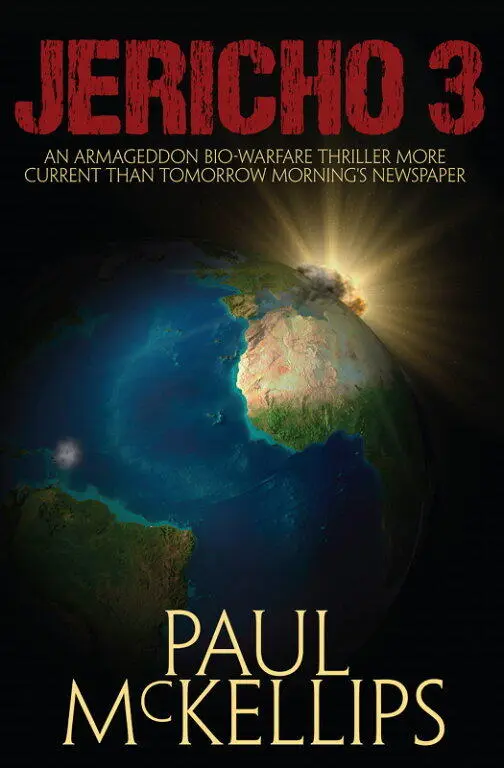
- Название:Jericho 3
- Автор:
- Издательство:FBR Press
- Жанр:
- Год:2012
- Город:Washington, DC
- ISBN:978-0-9853322-0-4
- Рейтинг книги:5 / 5. Голосов: 1
-
Избранное:Добавить в избранное
- Отзывы:
-
Ваша оценка:
Jericho 3: краткое содержание, описание и аннотация
Предлагаем к чтению аннотацию, описание, краткое содержание или предисловие (зависит от того, что написал сам автор книги «Jericho 3»). Если вы не нашли необходимую информацию о книге — напишите в комментариях, мы постараемся отыскать её.
In a remote corner of Afghanistan, three members of the Taliban are diagnosed with a rare, incredibly infectious disease. At a U.S. base just outside Pakistan, an American army doctor is kidnapped by a local tribe to perform an unlikely surgical procedure on the wife of a powerful leader. And back in the U.S., Camp is handed his most challenging assignment ever, which leaves the normally confident hero desperate for answers. All the while, Camp must hold back his secret desire for Leslie Raines, his beautiful cohort, as they are sent off on two sides of the same mission… only to reunite when the stakes get deadly.
With his trademark grit and a globe-racing plot, Paul McKellips takes readers deep into the Middle East conflict, raising timely questions of radicalism, faith, and honor. As the clock ticks down toward Armageddon, Camp and Raines must do everything it takes to stop the total annihilation of two countries.
Timely, gripping, and frighteningly real, JERICHO 3 is a one-of-a-kcenter thriller that will open eyes long after the final page has been turned.
JERICHO 3 Infectious disease. Bio-warfare. Nuclear weapons. WAR JUST GOT PERSONAL.
Ambassador John Bolton writes: “
is a gripping novel… an urgent message… about an Iranian bio threat that should wake us up to the range of horror that could be visited on America and its friends and allies by our sworn enemies.”
Jericho 3 — читать онлайн бесплатно полную книгу (весь текст) целиком
Ниже представлен текст книги, разбитый по страницам. Система сохранения места последней прочитанной страницы, позволяет с удобством читать онлайн бесплатно книгу «Jericho 3», без необходимости каждый раз заново искать на чём Вы остановились. Поставьте закладку, и сможете в любой момент перейти на страницу, на которой закончили чтение.
Интервал:
Закладка:
“Would you like me to perform the surgery by cutting directly through her burka or are you going to take it off?”
Kazi looked over at the woman, now unconscious, and at the two captors who stood guard.
“It’s called a chadri, Dr. Banks. We are not permitted to take it off her. You’ll have to do that.”
“You have got to be -.”
Banks closed his eyes in boiling anger and walked over to the woman. As he started to pull the chadri up and over the woman’s head the guards looked at him in disgust. He was fulfilling their vision of the Great Satan, the infidel. Under the burka the woman was wearing the traditional trousers and black shoes. Banks removed her shirt and her bright blue bra.
Kazi, Ja’far and the two armed men were obviously disturbed by the sight of the bare-breasted woman.
“Sorry guys, but this is the only thing I can think of doing for this particular surgery. Better keep the ether handy, Ja’far.”
Banks poured rubbing alcohol on some Q-Tip swabs and scrubbed the area around each nipple.
“What are you doing, Dr. Banks?” Kazi asked.
“I’m trying to sterilize the area before I cut.”
“I realize that, but why are you going to cut there? Shouldn’t you be under her arm?”
“Transaxillary? In this dirty hellhole shed of a surgical suite? Give me a break. A transaxillary incision under the armpit tissue requires a channel up to the breast. We’d need an endoscope, and I certainly don’t see one here on my table of barbaric Barney Rubble tools.”
“Endoscope?”
“It’s a small tube and inside is a light and a camera that’s embedded in the end of the tube. If I had one, I could watch the movement of the endoscope on a TV monitor so I could position the implants at the exact spot, planted and centered behind each nipple.”
Kazi shook his head as he and Dr. Ja’far traded epiphanies in Pashtu.
“Perhaps that’s what we did wrong?” Kazi said to Ja’far.
Banks kept cleaning the breasts.
“Thought he didn’t speak any English?”
Ja’far moved in closer.
“You make incision on nipple?” Ja’far asked in broken English.
“It’s called a periareolar incision. I’ve never done this myself, Ja’far, but I’ve watched several when I was in school. Can’t be that hard, I guess. Plastic surgeons do this procedure. You cut right at the edge of the areola. We want the incision between the dark areola and surrounding breast skin so it can be hidden. Most women — maybe even this one — would rather not have visible scarring on their breasts.”
“This is better method?” Ja’far asked.
“Yes, for two reasons. First, we can place the implants in a precise pocket formation. They’ll be exactly where we want them to be and, ah, where your commander wants them to be. Second, absolute controlled bleeding. Bleeding is our enemy, especially in here.”
Ja’far smiled. It was all making sense now.
“Unfortunately, we have to get these huge-ass PIP implants in and through a very small incision.”
“How big the cut?”
Banks picked up the number seven beaver scalpel. He pressed the edge of the blade down on her right breast and started to cut.
“Five centimeters, seven at most. Kazi, I don’t have the skills or the tools necessary to do this thing submuscular. I’ve gotta go subglandular.”
“Whatever,” Kazi mumbled as he observed the first incision.
“I can’t put these things behind the pectoralis major muscle. I’m placing them in the retromammary space — subglandular — it’s like a pocket between the gland of the breast tissue and pectoralis muscle.”
“Is that bad?”
“Can be. Can cause capsular contracture of the immune system. Her body might reject the implant.”
“How long, Dr. Banks? How long before she could reject the implants?”
“I don’t know, six months, a year, two years. You need to get her to a hospital if she starts to run a fever, feels pain, or develops hematomas or the settling of blood in her breasts.”
“We’ll let the commander worry about all of that,” Kazi opined.
After an hour with each breast and a couple of doses of ether from Ja’far, Banks sutured the woman up with the Ethicon Prolene cartridge spools. He walked over to his bed and sat down followed closely by his two armed captors.
“There you go, Kazi. Tell the commander that his woman will be good as new in a week or so. He should go easy on her for the first month. She’s gonna be sore to the touch.”
“I will let him know, Dr. Banks.”
“So how ‘bout that ride back to Thunder? When do we leave?”
“Dr. Ja’far… do you have any more questions?” Kazi asked as Ja’far walked away.
Kazi nodded to one of the captors.
“Right now, Dr. Banks.”
Banks sensed the motion and felt the cold steel as a single AK-47 gunshot broke the village calm and jarred the burka-clad woman momentarily from her ether sleep and recovery.
Paktya Regional Hospital
FOB Thunder
Afghanistan
The PA speakers above Thunder and Lightning crackled to life simultaneously, Pashtu on the Afghan base and English on the American base.
“  .”
.”
“Drill, drill, drill.”
Camp was sitting with Billy Finn, Captain Henry and Captain Sylvia Dawkins in the middle dining room of the DFAC when the PA announcement came in.
“Are you kidding me? My omelet is still hot. I thought this thing was gonna happen at 0930,” Camp jawed as he pushed back from the table and stood.
“It’s the first time in history the Afghans have done anything early,” Henry quipped.
Dawkins grabbed her US Air Force-issued Nikon D3S and stood as Finn kept eating.
“I’ll take care of your trays while you three go play disaster triage with your Afghan buddies,” Finn said as he reached over and forked a bite of Camp’s fresh cheese and mushroom omelet.
Miriam was waiting at the gate outside of Terp Village as Camp, Henry and Sylvia Dawkins ran up. Ten medics from Captain Henry’s team rushed through the turnstile one at a time, running down the gravel path between T-walls, past two Nepali Gurkha guards and across the street to the Paktya Regional Hospital.
Barracks building 59 on Thunder opened up as a steady stream of bearded Afghan men in military uniforms ran down the hill between enlisted barracks, and through the open field and over to the hospital. Unlike their American counterparts, the Afghans did not carry weapons.
Miriam was bundled up in a winter parka and stayed her typical 10-foot distance behind Camp and Henry as they jogged over to the front entry doors of the hospital.
Two Ford Ranger ambulances were staged in the parking lot and another five Ford Ranger army trucks were loaded with Afghan men pretending to have various forms of injuries and wounds.
The main lobby of the hospital was quickly converted to a disaster triage center. More seriously wounded “patients” were wheeled down the long fluorescent-lit corridor to the ER or alternatively, over to the sparsely-equipped and seldom sterile operating room. Minor injury patients were treated in the lobby.
American military medics mentored their Afghan counterparts as each team’s Terp translated between Pashtu and English. The scene was chaotic. Aside from occasional laughter from some of the Afghan soldiers who were medics by assignment, rather than by interest or training, the drill unfolded flawlessly.
Miriam retreated to her cubicle behind the lobby wall and desk but close enough and within earshot of Camp if he needed translation services. Unlike Captain Henry, Camp was largely unengaged and somewhat disinterested in the whole training exercise. It came with the new turf, but his main job was to find Major Banks.
Читать дальшеИнтервал:
Закладка:
Похожие книги на «Jericho 3»
Представляем Вашему вниманию похожие книги на «Jericho 3» списком для выбора. Мы отобрали схожую по названию и смыслу литературу в надежде предоставить читателям больше вариантов отыскать новые, интересные, ещё непрочитанные произведения.











Обсуждение, отзывы о книге «Jericho 3» и просто собственные мнения читателей. Оставьте ваши комментарии, напишите, что Вы думаете о произведении, его смысле или главных героях. Укажите что конкретно понравилось, а что нет, и почему Вы так считаете.