Stephanie Barron - Jane and the Man of the Cloth
Здесь есть возможность читать онлайн «Stephanie Barron - Jane and the Man of the Cloth» весь текст электронной книги совершенно бесплатно (целиком полную версию без сокращений). В некоторых случаях можно слушать аудио, скачать через торрент в формате fb2 и присутствует краткое содержание. Жанр: Исторический детектив, Иронический детектив, на английском языке. Описание произведения, (предисловие) а так же отзывы посетителей доступны на портале библиотеки ЛибКат.
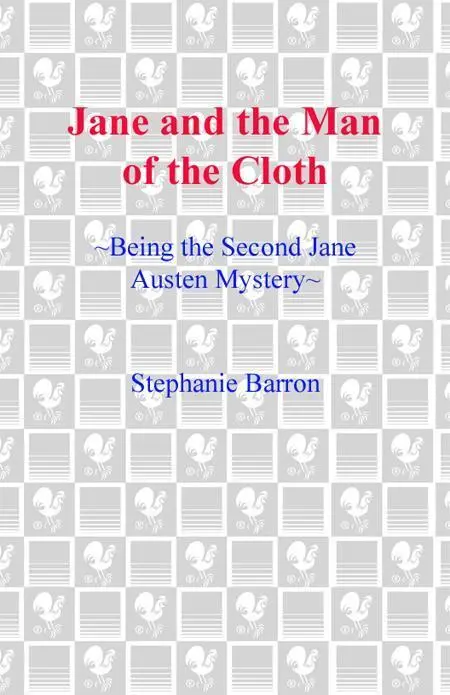
- Название:Jane and the Man of the Cloth
- Автор:
- Жанр:
- Год:неизвестен
- ISBN:нет данных
- Рейтинг книги:3 / 5. Голосов: 1
-
Избранное:Добавить в избранное
- Отзывы:
-
Ваша оценка:
Jane and the Man of the Cloth: краткое содержание, описание и аннотация
Предлагаем к чтению аннотацию, описание, краткое содержание или предисловие (зависит от того, что написал сам автор книги «Jane and the Man of the Cloth»). Если вы не нашли необходимую информацию о книге — напишите в комментариях, мы постараемся отыскать её.
Jane and the Man of the Cloth — читать онлайн бесплатно полную книгу (весь текст) целиком
Ниже представлен текст книги, разбитый по страницам. Система сохранения места последней прочитанной страницы, позволяет с удобством читать онлайн бесплатно книгу «Jane and the Man of the Cloth», без необходимости каждый раз заново искать на чём Вы остановились. Поставьте закладку, и сможете в любой момент перейти на страницу, на которой закончили чтение.
Интервал:
Закладка:
“I care little for that,” I said wearily, brushing his hat aside, “only I should dearly love a proper cloak, and some conveyance home, as I am falling down with fatigue.”
He hastened to swing his greatcoat from his shoulders, and flung it about my own, and without another word, led me to his good dark horse still tethered at the fossil pits; and with the utmost gentleness, he bent to provide a hand for my mounting. I hauled myself onto the horse's back, with less than my usual grace — being anything but a horsewoman in the best of times — and Lord Harold sprang, with something more of lightness, to the saddle before me.
We paused an instant to gaze through the curtain of rain, and out across the waves, where, like a scrap of torn fabric, the sail of a cutter showed against a lightening sky. It moved swiftly, and as we watched, disappeared from view.
“Where, then, do they sail?” I asked, after a moment.
“Not to France, assuredly.” Lord Harold's voice held an unwonted sobriety. “The country is grown too hot for men of their persuasion. The cutter will bear them to Liverpool, 1 believe — and it is their intention there to secure passage on a ship bound for America.”
“America?” I felt the pain of parting redouble with all the swiftness of a blow to my heart. “I shall never see him again.”
“I fear not,” Lord Harold said quietly. He clucked to the horse, and turned its head, and commenced a slow jog towards Lyme.
And so we rode in weary silence for a time, with nothing but the soft patter of raindrops and the first tentative birdsong to cheer our way. My thoughts were torn between exultation at the party's escape and a regret so profound I could hardly speak. Until, with something more akin to his usual raillery, Lord Harold observed that I must take greater care in the forming of my acquaintance.
“For, Miss Austen,” said he, “though I will not say that I disapprove of your predilection for characters such as Sidmouth, or your habit of dining at the home of smugglers, I confess that my nose is quite turned, at finding my success so spoilt, in being dependent upon your penetration. You will quite ruin my reputation, if word of this gets out; and I shall be reduced to offering you employment.”
“—Which I should as readily decline,” I replied. “At this moment, sir, I want nothing more than the safety of my room, and a hot toddy, and a warm brick wrapt in cloths between the sheets. How it does rain! I will never be without my bonnet, in future, no matter how many borrowed greatcoats I may acquire.”
“You have a most vexatious talent for intrigue,” Lord Harold insisted, with utter disregard for my ideas of bricks and toddies. “Most unusual, in a woman. I shall be con-standy looking over my shoulder, in future, from a fear of finding you behind.”
“Then you shall run headlong over my foot, my lord,” I rejoined with spirit, “for I shall assuredly stand before.”
THE END
Примечания
1
For a full account of the journals’ discovery, readers are directed to the Editor's Foreword in the first volume of the Austen collection, published by Bantam Books in May 1995 under the title of Jane and the Unpleasantness at Scargrave Manor.
2
For an excellent survey of the “nameless and dateless” romance theories, as well as a rich portrait of Austen's milieu, see George Holbert Tucker, Jane Austen the Woman, St. Martin's Press, 1994.
3
The Austens had visited Ramsgate during the spring or summer of 1803, prior to their first visit to Lyme that September. Jane disliked Ramsgate intensely; and when she wished to place a fictional charac ter in a compromising position, she often sent her to Ramsgate. Georgiana Darcy was nearly seduced by Wickham there, in Pride and Prejudice, while in Mansfield Park, Maria Bertram endured a loveless Ramsgate honeymoon before her adulterous affair with Henry Crawford. — Editor's note.
4
Jane refers here to Lyme's Marine Parade, known in her day simply as The Walk; it ran along the beach fronting Lyme's harbor, and out along the ancient stone breakwater, both of which are called the Cobb. — Editor's note.
5
Paterson's British Itinerary was the road bible of the traveling gentry from 1785 to 1832. Written by Daniel Paterson and running to seventeen editions, it detailed stage and mail routes between major cities, as well as their tolls, bridges, landmarks, and notable country houses. — Editor's note.
6
In Austen's time, traveling on Sunday was considered disrespectful to the Sabbath. — Editor's note.
7
We may presume Geoffrey Sidmouth to be referring, here, to Chaucer's Canterbury Tales, in which the character of the Wife of Bath figures. Jane's mention of the town must have sparked the allusion. — Editors note.
8
Austen's childhood home, the parsonage at Steventon where she lived until May 1801, would be regretted and missed for most of her life. — Editor's note.
9
It was customary in Austen's time to stay at home on evenings with little moonlight, and accept engagements for those nights when the moon would be full. Travel along unlit roads could otherwise be quite hazardous. — Editor's note.
10
In Austen's day, relations by marriage were generally referred to as relations of blood. Although the term in-law existed, it was more of an affectation than common usage. — Editor's note.
11
The Pump Room was the social center of Bath, where many of the residents and visitors congregated daily to drink the medicinal waters pumped up for their refreshment, and to stroll about in close converse with their acquaintance. To be seen in the Pump Room of a morning, and in the Upper or Lower Assembly Rooms at night, was indispensable to the conduct of one's social life. — Editor's note.
12
Eliza's first husband, the French comte Jean Capot de Feuillide, was guillotined in 1794. Eliza retained her title of Comtesse de Feuillide even after she married Henry Austen, out of habit and a liking for its aristocratic air. — Editor's note.
13
Austen probably refers here to the stairs she later used in her final novel, Persuasion, in which Louisa Musgrove falls in jumping from one level of the Cobb to another. — Editor's note.
14
Francis Austen, born between Cassandra and Jane in the order of the Austens’ eight children, and Charles, the youngest child, were both officers in the Royal Navy. Frank Austen would end his life as Admiral Sir Francis Austen, Admiral of the Fleet. — Editor's note.
15
Eliza refers to the first of Jane Austen's detective memoirs, Jane and the Unpleasantness at Scargrave Manor. — Editor's note.
16
Eliza de Feuillide used words very similar to these to describe her marriage in a surviving letter written from Ipswich in 1798. — Editor's note.
17
Austen probably refers here to the beach that fronted Lyme's harbor, which is also called the Cobb, though not to be confused with the jetty of the same name. — Editor's note.
18
This was a long-handled lorgnette, with a single magnifying lens, that hung about fashionable necks. — Editor's note.
Читать дальшеИнтервал:
Закладка:
Похожие книги на «Jane and the Man of the Cloth»
Представляем Вашему вниманию похожие книги на «Jane and the Man of the Cloth» списком для выбора. Мы отобрали схожую по названию и смыслу литературу в надежде предоставить читателям больше вариантов отыскать новые, интересные, ещё непрочитанные произведения.





Обсуждение, отзывы о книге «Jane and the Man of the Cloth» и просто собственные мнения читателей. Оставьте ваши комментарии, напишите, что Вы думаете о произведении, его смысле или главных героях. Укажите что конкретно понравилось, а что нет, и почему Вы так считаете.