Lauren Haney - The Right Hand of Amon
Здесь есть возможность читать онлайн «Lauren Haney - The Right Hand of Amon» весь текст электронной книги совершенно бесплатно (целиком полную версию без сокращений). В некоторых случаях можно слушать аудио, скачать через торрент в формате fb2 и присутствует краткое содержание. Жанр: Исторический детектив, на английском языке. Описание произведения, (предисловие) а так же отзывы посетителей доступны на портале библиотеки ЛибКат.
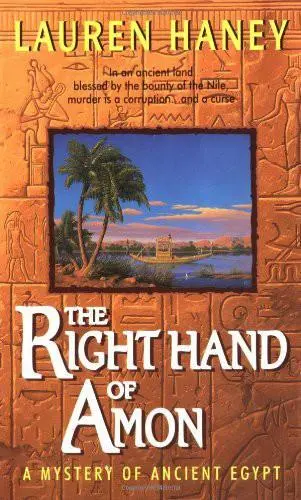
- Название:The Right Hand of Amon
- Автор:
- Жанр:
- Год:неизвестен
- ISBN:нет данных
- Рейтинг книги:5 / 5. Голосов: 1
-
Избранное:Добавить в избранное
- Отзывы:
-
Ваша оценка:
The Right Hand of Amon: краткое содержание, описание и аннотация
Предлагаем к чтению аннотацию, описание, краткое содержание или предисловие (зависит от того, что написал сам автор книги «The Right Hand of Amon»). Если вы не нашли необходимую информацию о книге — напишите в комментариях, мы постараемся отыскать её.
The Right Hand of Amon — читать онлайн бесплатно полную книгу (весь текст) целиком
Ниже представлен текст книги, разбитый по страницам. Система сохранения места последней прочитанной страницы, позволяет с удобством читать онлайн бесплатно книгу «The Right Hand of Amon», без необходимости каждый раз заново искать на чём Вы остановились. Поставьте закладку, и сможете в любой момент перейти на страницу, на которой закончили чтение.
Интервал:
Закладка:
Finished with the interior, he had nothing to show for his effort but a growing sense of failure. When Senu's oldest son arrived with a leaf-wrapped package of grilled fish, a cluster of plump grapes, and two jars of beer, Bak could have hugged the boy. The food and drink, the cheerful voice, and the smile were welcome indeed.
"How far away is the caravan?" he asked, ripping the flesh from the bones, gobbling it like a man starved for a week.
"They'll reach the gate within the hour."
The youth reported that his father had relayed Bak's messages to Imsiba and the others. Extra guards had been assigned to Amon-Psaro's route, and every man who could be spared was searching for Inyotef. As far as anyone knew, he had not been seen all day. Bak, his self-confidence wavering, tried not to think how foolish he would feel if someone other than the pilot attempted to slay the Kushite king.
He could see the boy longed to be on his way, afraid he would miss the upcoming spectacle, so he dismissed him and went out to the courtyard to finish his meal in a sliver of shade beside the wall.
His hunger sated, he searched the court with its round oven, large water jars, and grain silos. He was sweeping up the last of the grain he had spilled when the sounds in the distance changed. The strident call of a single trumpet was lost in the blare of several. Now and then, when the breeze blew from the right direction, the faint sound of the accompanying clappers and flutes wafted across the lower city. A rumble of drums filled in the background. Amon-Psaro's caravan was approaching the fortress gate.
Bak was on the roof, almost finished with his search, when a flourish of drumbeats announced the presentation of arms to Amon-Psaro. Soon, the king would march inside the fortress. He and Woser would lead the slow ceremonial procession down the main thoroughfare to the mansion of the lady Hathor. There they would make obeisance to her guest, the lord Amon, and to the goddess herself. Then, with the priestly contingent and the gods joining the procession, they would march back through the fortress, down the cut in the escarpment, and through the lower city to the harbor.
Bak thought Amon-Psaro fairly safe inside the fortress. It was the latter portion of the march he worried about most. The descent throligh the cut and the streets of the lower city would be lined with hundreds of civilians as well as soldiers. More worrisome yet would be the harbor, the confusion of boarding the rivercraft in a place Inyotef knew better than any other man in Iken.
Tired and discouraged, he walked to the edge of the roof and eyed the low golden dunes outside the wall. Long fingers of sand, drifts deposited through the years by winds blowing in from the desert, reached out to a distant, ruined block of buildings.
His eye was drawn to the base of the serpentine wall and a wedge of golden brown close against the mudbrick. The end of a board, protruding from around a curve. It looked too sturdy to discard in the desert, too valuable. With his senses quickening, he stepped off the roof and, arms spread wide for balance, walked slowly along the top of the wall, following its curve. The board, he soon saw, was the sidepiece of a ladder partly covered with sand. From the way the drift lay around it, he guessed it had been buried there and a recent stiff breeze had uncovered it. Consumed by curiosity, he dropped off the wall, letting the sand cushion his fall.
He shoved his fingers into the soft, warm sand, picked up the ladder, and stood it on end. It was almost new and tall enough to reach the roof of Inyotef's house. Had the pilot hidden it, meaning to return at a later time? Or had he used it to leave the house?
Turning his back to the wall, Bak studied the low dunes. The smooth parallel ridges were marred by the tiny footprints of birds and rodents, but no larger, deeper indentations that would indicate the recent passage of a man. A rough funnel-shaped disturbance twenty or so paces away could mean a small creature had found something of interest beneath the surface. Trying not to hope, but hoping anyway, Bak hurried to the spot, dug into the sand, and revealed a big, tightly woven reed chest. Practically holding his breath, he swept aside the sand on top, broke the seal, and raised the lid. It was filled with large pottery jars, each stoppered with a dried-mud plug to keep out prying animals and insects. A jar containing grain had cracked, inviting a mouse or rat to investigate. Elated by his discovery, Bak broke the plugs on all the other jars, revealing beer, food, clothing, small weapons, and jewelry including two golden flies.
Inyotef, he guessed, had dared not leave the chest of supplies on his skiff for fear every vessel in the harbor would be examined before Amon-Psaro set foot on the quay. So he had buried it here, intending to return after the search for him died down.
Bak saved the most intriguing item until last, a pottery cylinder plugged on both ends with mud. He broke one end away, reached inside, and pulled out a papyrus scroll. Sitting on the warm sand, praying for enlightenment, he unrolled his prize, which was stained and dog-eared, yellowing from use and age. Almost afraid to breathe, he began to read.
"To my beloved brother Inyotef," it said. "He's gone, the one I loved above all others. His many sweet words, his pledge to love me forever, were like chaff in the wind. One night he lay with me, whispering endearments; the next day he was gone. A message came, I've heard, a letter announcing his father's death. He boarded a ship for vile Kush without so much as a good-bye. I told myself he would summon me as soon as his throne was secure, but now four months have passed, and I've heard nothing. I can no longer bear the pain, my brother. The river beckons. Remember me always, dearest Inyotef, and forgive me."
It was signed "Sonisonbe."
Bak let out his breath long and slow. The words brother and sister were often used between lovers, but in this case he felt sure Sonisonbe was in fact Inyotef's birth sister. The elation he felt at finding the letter, the sense of accomplishment, vied in his heart with pity and sadness for the girl abandoned by Amon-Psaro and the dark legacy she had left Inyotef.
Chapter Eighteen
Bak stood on the northern quay, looking down into Inyotef's skiff. Nothing had changed since last he had seen the vessel. Sails, lines, oars, fishing gear were exactly as they had been the evening before. The pilot either meant to flee in another boat or intended to leave Men in a manner Bak could not begin to imagine. Surely not by way of the desert. If he chose a path close to the river, he would easily be caught. To leave the river and its life-giving water was suicide.
No, Bak thought, he's a sailor, a man of the river. He'll escape by boat. The wording was too pessimistic, so he amended the prediction: He'll try to escape by boat, and I'll be there to stop him.
Clinging to the notion, he studied the vessels moored along the quay. Other than a fishing boat with a broken rudder and a raft built of papyrus bundles so soggy it was near to foundering, Inyotef's skiff was the only small boat remaining. The rest had been claimed by their owners and moved across the harbor to the southern quay. The barge of Amon was tied close against the revetment, rocking on the gentle swells, its gilded hull glittering in the midafternoon sun. On the warship moored close by, pennants of every color fluttered from masts and lines; its wood-andbronze fittings gleamed. Sailors lounged on its deck and atop the cabin, awaiting the gods and the king, the priests and the local dignitaries. Their lively banter with the men on the decks of the two traveling ships, which would ferry the king and his party carried across the water.
Bak strode to the end of the quay and looked out over the river, its waters a reddish brown flecked with silver where the sun caressed the ripples. His abused muscles had loosened up, but he was tired and uneasy, his mood in need of continual bolstering. He had rushed from Inyotef's house to the mansion of Hathor, where he found Imsiba and the Medjays standing outside, awaiting their royal charge. Huy and the other garrison officers had been with them. He had exchanged his knowledge for theirs: Inyotef had not been seen since the previous evening.
Читать дальшеИнтервал:
Закладка:
Похожие книги на «The Right Hand of Amon»
Представляем Вашему вниманию похожие книги на «The Right Hand of Amon» списком для выбора. Мы отобрали схожую по названию и смыслу литературу в надежде предоставить читателям больше вариантов отыскать новые, интересные, ещё непрочитанные произведения.







Обсуждение, отзывы о книге «The Right Hand of Amon» и просто собственные мнения читателей. Оставьте ваши комментарии, напишите, что Вы думаете о произведении, его смысле или главных героях. Укажите что конкретно понравилось, а что нет, и почему Вы так считаете.