Brian Freeman - Marathon
Здесь есть возможность читать онлайн «Brian Freeman - Marathon» весь текст электронной книги совершенно бесплатно (целиком полную версию без сокращений). В некоторых случаях можно слушать аудио, скачать через торрент в формате fb2 и присутствует краткое содержание. Город: New York, Год выпуска: 2017, ISBN: 2017, Издательство: Quercus, Жанр: Детектив, на английском языке. Описание произведения, (предисловие) а так же отзывы посетителей доступны на портале библиотеки ЛибКат.
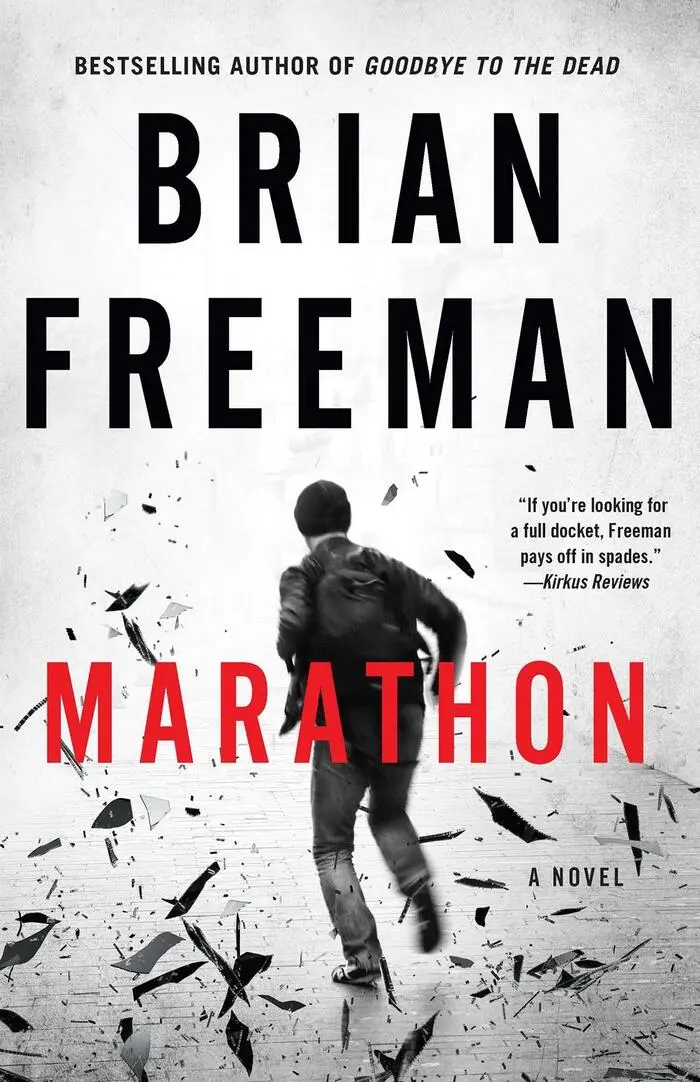
- Название:Marathon
- Автор:
- Издательство:Quercus
- Жанр:
- Год:2017
- Город:New York
- ISBN:978-1-68144-241-9
- Рейтинг книги:4 / 5. Голосов: 1
-
Избранное:Добавить в избранное
- Отзывы:
-
Ваша оценка:
Marathon: краткое содержание, описание и аннотация
Предлагаем к чтению аннотацию, описание, краткое содержание или предисловие (зависит от того, что написал сам автор книги «Marathon»). Если вы не нашли необходимую информацию о книге — напишите в комментариях, мы постараемся отыскать её.
Within minutes, Jonathan Stride, Serena Dial, and Maggie Bei are at work with the FBI to find the terrorists behind the tragedy. As social media feeds a flood of rumors and misinformation, one spectator remembers being jostled by a young man with a backpack not far from the bomb site. He spots a Muslim man in a tourist’s photo of the event and is convinced that this was the man who bumped into him in the crowd — but now the man’s backpack is missing.
When he tweets the photo to the public, the young man, Khan Rashid, becomes the most wanted man in the city. And the manhunt is on.
But are the answers behind the Duluth bombing more complex than anyone realizes? And can Stride, Serena, and Maggie find the truth before more innocent people are killed?
Marathon — читать онлайн бесплатно полную книгу (весь текст) целиком
Ниже представлен текст книги, разбитый по страницам. Система сохранения места последней прочитанной страницы, позволяет с удобством читать онлайн бесплатно книгу «Marathon», без необходимости каждый раз заново искать на чём Вы остановились. Поставьте закладку, и сможете в любой момент перейти на страницу, на которой закончили чтение.
Интервал:
Закладка:
“You’re sending me alone?”
“It’s the only way. Be alert, because we don’t have much time. Even outside Duluth, you’re still recognizable. Your photo has been everywhere. I found an old baseball cap for you. Keep it on. If you find a convenience store where it looks safe, buy a razor, shaving cream, and some other sundries so it doesn’t look suspicious, and shave off your beard. Get sunglasses, too, for the morning.”
“Where do I go?”
“Drive to West River Parkway in Minneapolis. Go to a place called Mill Ruins Park near the Mississippi. Park there by ten in the morning, and wait. A man will approach you. Go with him, and leave the Taurus and the keys behind. Someone else will take care of the car. After that, you’re in their hands. That’s the start of your new life, Khan.”
Khan laced his hands on top of his head. He could feel the sweat of his own anxiety gathering on his skin. “I don’t know if I can do this.”
“Yes, you can.”
“Not without you,” Khan said.
“It has to be this way.”
Khan walked to the front window and nudged the curtains aside an inch. He could see that Malik was right. The swirling lights of a police cruiser lit up the night where it was parked at the end of the street, near the golf course. Another police car swept past the house, even as he watched. They were in a box. He aligned the curtains again and shook his head.
“I’ll never make it,” Khan said. “They’ll grab me as soon as I leave.”
“Let me worry about that. I told you, I have a plan.”
“What is it?”
Malik didn’t answer. He crossed the room and embraced Khan tightly. He put both hands on Khan’s cheeks. “I know you never wanted to be in this position. Right now, the pain seems like it will never end, but someday it will get better.”
“Unlikely.”
“Think of the winds that scatter,” Malik told him, quoting the Qur’an. “They lift and bear away heavy weights.”
“I’d like to feel those winds. Right now, the burden feels impossible to carry. I’m lost.”
“Well, you’ll have time to find yourself, after tomorrow. Don’t forget what I told you. Wait until midnight. By then it should be safe to go to the car and make your escape.”
“Why?” Khan asked. “How can it be safe?”
“Because by then they will no longer be looking for you,” Malik said with a mysterious, serene smile. “At least not for a day or more. It will give you time.”
“How is that possible?”
“I told you, trust me. And remember to take the gun with you.”
Khan scowled. The last thing he wanted was to hold a gun in his hand. He couldn’t imagine it. He could never point it at another human being. The thought of it was immoral.
“No gun,” he insisted.
Malik sighed long and hard, as if Khan, who was years older, was as foolish as a little child. “Fine, give it back to me, then. I just hope you never need it.”
The gun was exactly where Malik had left it hours earlier, on the floor near a corner of the dusty room. Khan walked toward it, and Malik followed as closely as a shadow. Khan bent down to retrieve the weapon, although he was reluctant even to take it in his hand. The gun was an ugly thing. Behind him, he could hear the quick, nervous rush of Malik’s breathing and the rustle of his clothes.
“I’m very sorry, my friend,” Malik murmured in his ear.
Over his head, Khan felt rather than heard a rush of air.
Then something hard crashed down onto the bone of his skull, which erupted like a bomb of pain and light. His jaw clamped shut; he bit his tongue. His scalp burned. The room spun before his eyes. It was over in an instant. He didn’t feel himself falling into an abyss. He was already unconscious by the time his body collapsed to the floor.
42
Gayle Durkin tried to read Special Agent Maloney’s face as he sat down behind the desk. That was what she did; she read faces. She knew when people were hiding things. She knew when they were lying. Her insights typically gave her an advantage when she was face-to-face with someone. Most people couldn’t keep secrets from her, but Maloney was one of the few who could. The things that were so expressive in others — eyes, mouth, the tilt of one’s head, the positioning of hands — gave her no clues with him.
He’d asked for a private meeting. Just the two of them. Drop whatever she was doing, and come back to the DECC. She had no idea what to expect, and that made her nervous.
“Thank you for joining me, Agent Durkin,” Maloney told her in the same emotionless voice he always used. The desk in front of him was empty except for a slim file folder.
“Of course, sir.”
“Can you review for me the events on Sunday night that led up to the death of Officer Kenzie?” Maloney asked.
Gayle was confused. “Yes, sir. I did write up a full report about that yesterday.”
“I know. I’ve read it.” Maloney folded his hands together and waited. He didn’t say anything more.
She found herself stuttering, which was unlike her. “Okay. Well, I passed Rashid’s vehicle as I was responding to the reports from the Woodland Market. I reversed course and gave chase. I followed him to a road bordering the Park Hill Cemetery, where I found his taxi crashed. At that point, I pursued him on foot through the cemetery. I reached the road that divides Park Hill and Forest Hill, and at that point, I spotted Rashid on the other side of the fence. Backup was arriving from both directions, and I heard the voice of Officer Kenzie shouting at Rashid to stop.”
“Where was Officer Kenzie in relation to you?” Maloney asked.
“Based on the direction of his voice, I believe he was about thirty yards directly in front of me. That was also where his body was found.”
“And Rashid?”
“Rashid was at a forty-five-degree angle to me, about twenty-five yards inside the fence.”
“What happened next?” Maloney asked.
Gayle looked for any clues at all in Maloney’s face and voice as to what this interrogation was about. She found none. Even so, with each question, her anxiety soared.
“Well, there was a flash of lightning, and I saw a gun in Rashid’s hand, so I shouted a warning.”
“Are you sure about the gun?”
“Am I — well, it was dark and raining, and it happened fast, but, yes, I’m sure. And Officer Kenzie is dead, so obviously—”
Maloney interrupted her. “How many shots did you fire?”
“Two.”
“Did any of the backup units fire?”
“No, sir.”
“What about Officer Kenzie? How many shots did he fire?”
“I’m not sure. There were at least two shots from the other side of the fence before I fired, but I don’t know which shots came from Officer Kenzie and which came from Rashid.”
“Thank you, Agent Durkin.” Maloney opened the file folder in front of him. “I’m afraid I have upsetting news for you.”
Gayle could almost hear the roar of the blood pumping in her head. “What’s that, sir?”
“This is the ballistics report from Quantico,” Maloney told her, gesturing at the file. “They were able to match the bullet taken from Officer Kenzie’s body to the gun that fired it.”
“How is that possible? We didn’t recover Rashid’s gun at the scene.”
“I’m sorry, Agent Durkin. The bullet that killed Officer Kenzie didn’t come from Rashid’s gun. It came from your gun.”
Gayle blinked. “What? That’s not possible.”
“I’m afraid there’s no question about it. At my request, they ran the test again to be one hundred percent certain.”
She bolted from her chair but had to grab the desk to keep from falling. She felt as if a tornado were swirling in front of her face, threatening to suck her in. “Sir, I fired at Rashid . He was at an angle to me. Officer Kenzie was nowhere near my line of fire. I couldn’t possibly have hit him.”
Читать дальшеИнтервал:
Закладка:
Похожие книги на «Marathon»
Представляем Вашему вниманию похожие книги на «Marathon» списком для выбора. Мы отобрали схожую по названию и смыслу литературу в надежде предоставить читателям больше вариантов отыскать новые, интересные, ещё непрочитанные произведения.

Обсуждение, отзывы о книге «Marathon» и просто собственные мнения читателей. Оставьте ваши комментарии, напишите, что Вы думаете о произведении, его смысле или главных героях. Укажите что конкретно понравилось, а что нет, и почему Вы так считаете.