Brian Freeman - Marathon
Здесь есть возможность читать онлайн «Brian Freeman - Marathon» весь текст электронной книги совершенно бесплатно (целиком полную версию без сокращений). В некоторых случаях можно слушать аудио, скачать через торрент в формате fb2 и присутствует краткое содержание. Город: New York, Год выпуска: 2017, ISBN: 2017, Издательство: Quercus, Жанр: Детектив, на английском языке. Описание произведения, (предисловие) а так же отзывы посетителей доступны на портале библиотеки ЛибКат.
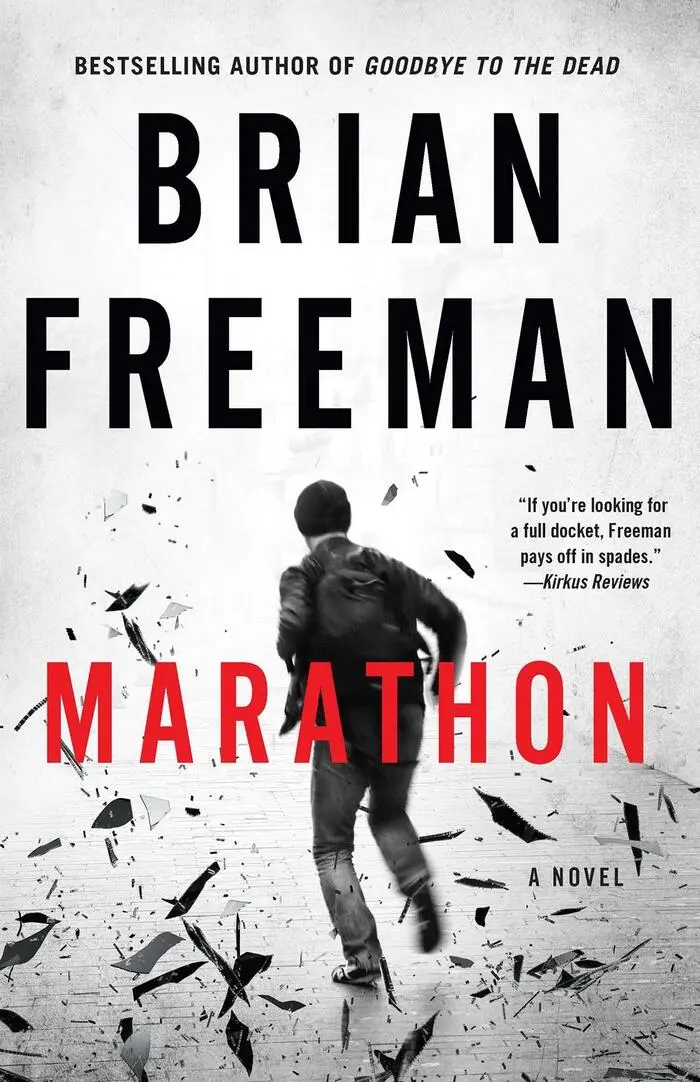
- Название:Marathon
- Автор:
- Издательство:Quercus
- Жанр:
- Год:2017
- Город:New York
- ISBN:978-1-68144-241-9
- Рейтинг книги:4 / 5. Голосов: 1
-
Избранное:Добавить в избранное
- Отзывы:
-
Ваша оценка:
Marathon: краткое содержание, описание и аннотация
Предлагаем к чтению аннотацию, описание, краткое содержание или предисловие (зависит от того, что написал сам автор книги «Marathon»). Если вы не нашли необходимую информацию о книге — напишите в комментариях, мы постараемся отыскать её.
Within minutes, Jonathan Stride, Serena Dial, and Maggie Bei are at work with the FBI to find the terrorists behind the tragedy. As social media feeds a flood of rumors and misinformation, one spectator remembers being jostled by a young man with a backpack not far from the bomb site. He spots a Muslim man in a tourist’s photo of the event and is convinced that this was the man who bumped into him in the crowd — but now the man’s backpack is missing.
When he tweets the photo to the public, the young man, Khan Rashid, becomes the most wanted man in the city. And the manhunt is on.
But are the answers behind the Duluth bombing more complex than anyone realizes? And can Stride, Serena, and Maggie find the truth before more innocent people are killed?
Marathon — читать онлайн бесплатно полную книгу (весь текст) целиком
Ниже представлен текст книги, разбитый по страницам. Система сохранения места последней прочитанной страницы, позволяет с удобством читать онлайн бесплатно книгу «Marathon», без необходимости каждый раз заново искать на чём Вы остановились. Поставьте закладку, и сможете в любой момент перейти на страницу, на которой закончили чтение.
Интервал:
Закладка:
“I’m not saying I didn’t think the whole pickle-and-onion thing on the ribs was weird,” she went on as if Guppo hadn’t said a word, “but you have to have faith in Mickey D’s. It works.”
“Hey, Maggie?” Guppo said again.
She noticed the change in his voice. “What’s up?”
“Check this out.”
Maggie got up from her chair and went around to Guppo’s side of the table. He froze the video on the monitor and rolled the footage back. She found herself staring at an open rear door of a white van. A tall man had his back to the camera as he filled a red plastic gas tank on the pavement. He wore sweats, a red T-shirt, and a baseball cap planted backward on his head.
“What am I looking at?” Maggie asked.
Guppo paused the camera feed as the man replaced the pump. He tried to zoom in on the image, but the resolution was blurred.
“Look inside the back of the van,” Guppo said. “I know it’s not very clear, but does that look like the edge of another gas can behind the van door?”
Maggie squinted. “Hard to say.”
Guppo rolled the feed a few more clicks. “How about now?”
“Maybe.”
“The shape looks right,” he said. “I think it’s another gas can.”
Maggie watched the man slide the full tank into the back of the van and slam the door. “Is that the only can he fills?”
“Yes.”
“Can you see his face?” she asked.
“Just a quick profile. The rest of the van gets blocked by an SUV as he’s driving away. I’ll run the plate and see what we get.”
“What’s the time stamp on the footage?”
“7:03 p.m.”
“Is this still the Spur on Central Entrance?”
Guppo nodded.
“Well, if he’s our guy, it looks like he’s only filling one tank at a time to avoid suspicion,” Maggie said. “So maybe he went straight from there to a different station to fill another tank. Or maybe he was coming to the Spur from somewhere else. Let’s take the two closest gas stations nearby and see if we spot him again.”
Maggie found the flash drives they’d collected from a SuperAmerica station on Miller Hill. She booted up the video for the evening feed and scrolled forward until the time stamp showed 6:30 p.m. She ran the video in quick mode, hunting for a white van. When the time stamp rolled to 7:10 p.m., she said, “Bingo. I got him.”
Guppo squeezed out of the chair and lumbered closer. His breath smelled of onion dip as he leaned behind her. “That’s him, all right, and he’s filling another red gas can. Think this is our guy?”
Maggie studied the face of the man filling the tank. Unlike in the other feed, she could see him clearly. He had long brown hair and a piercing in his lower lip. He was tall, good-looking in a bad-boy way, and built like an ox, with tattoos covering both arms.
She could see the logo on the truck, too.
The Bug Zappers.
“Yeah, I think that’s our guy,” Maggie said, “and I know who he is.”
“Serena thinks the bomb was in place four days before the marathon?” Durkin asked.
“That’s her theory,” Stride said.
The two of them stood outside the ruins of the Duluth Outdoor Company shop in Canal Park. The store was taped off, and the broken windows had been sealed with plywood. The rest of the street was open again, but tourists had been slow to return. Everyone knew the bomber was still on the loose. No one felt comfortable on the city streets.
Durkin studied the large gaps in the brick wall where the store windows had been. “No way. Someone would have spotted it.”
“Not necessarily. I called Drew Olson, who owns the store. He told me that the display windows only get overhauled every few weeks. Backpacks in the window are typically stuffed with paper to make them look full. So another backpack in the window — with a bomb — wouldn’t stand out.”
“You really believe this idea?” Durkin asked.
“I didn’t until we found Eagle’s body, but now I think Serena may be on to something. She’s with the marathon people now, trying to isolate street-level photos from Tuesday evening, to see if we can spot Eagle and his partner.”
Durkin didn’t hide the skepticism on her face. She shoved her hands into her pockets and wandered across the street, and Stride stayed with her. They crossed between two of the hotels and headed to the boardwalk that fronted the lake. Durkin sat on a bench, and Stride sat beside her. They heard the horn of the lift bridge and saw a giant red freighter taking aim at the narrow ship canal to make its way into the harbor.
“I miss it here,” Durkin said. “Although I think I mostly miss being a kid up here.”
“It’s a great place to grow up,” Stride said.
“You never wanted to leave?”
“No. Whenever I’ve left, it hasn’t worked out well, so I always came back. Besides, Duluth grounds me. I have a place to call home. I know I’m lucky.”
“You are lucky,” Durkin said. “You have a beautiful wife, too.”
“Thanks.”
“Living together and working together must be hard, though. Are you married to each other or to the job?”
“To each other, but some days it doesn’t feel that way. We didn’t even get to take a real honeymoon. Not yet, anyway. Maybe we can get away this winter.”
“My job is my life, too,” Durkin agreed, “so I get it. It is what it is.”
She said it matter-of-factly, not as if she was complaining, but there was a loneliness about Agent Durkin, beyond the intensity she showed the world. He also knew that the FBI culture wasn’t easy for female agents.
“I was sorry to hear about Ahdia Rashid and her son,” Durkin said. “I hate to see the violence spreading. Things are getting out of hand.”
Stride nodded. “That’s the way some people want it.”
“Dawn Basch?” Durkin asked.
“Right.”
“Yeah, she’s not helping. Look, Stride, I may come across as a hard-ass, but I hope you know I don’t support vigilantes.”
“I never said you did,” he told her.
“That doesn’t mean I’m not angry, because I am.”
“We’re all angry, Durkin.”
The FBI agent hesitated. “To be totally honest, I’ve always had a certain amount of sympathy for what Basch says. And not just because of Ron.”
“She knows what buttons to push,” Stride acknowledged. “That’s what makes her so dangerous. If there wasn’t a kernel of truth in what she’s saying, no one would listen to her. Even so, don’t believe the hype. Dawn Basch isn’t a martyr. She’s a narcissist who loves attention, and she’s making a volatile situation worse. I’m afraid that unless we solve this case soon, Basch is going to get exactly what she wants.”
“Which is?”
“War,” Stride said.
39
Serena climbed the stairs to the Duluth Marathon headquarters in Canal Park. Inside, she found a somber mood among the handful of staff who managed the race operations. The days following the marathon would normally be a time for celebration, but the tragedy had cast a pall over this year’s event. Even so, in typical Duluth fashion, the group had already set their sights on the future. On a chalkboard in the crowded main office, someone had scrawled in huge letters:
Serena didn’t doubt it for a minute. Nothing kept Duluth or Duluthians down. If they could survive the winters, they could survive anything. That was one of the things she loved about the character of her adopted hometown.
Most of the police knew the staff at the marathon, because they worked closely together on the race every year. There were no tears among any of them, just fierce determination, and that was true of the marathon runners, too. The race director, Lorena Baylor, told her that inquiries about entering next year’s race were already up 30 percent.
Читать дальшеИнтервал:
Закладка:
Похожие книги на «Marathon»
Представляем Вашему вниманию похожие книги на «Marathon» списком для выбора. Мы отобрали схожую по названию и смыслу литературу в надежде предоставить читателям больше вариантов отыскать новые, интересные, ещё непрочитанные произведения.










Обсуждение, отзывы о книге «Marathon» и просто собственные мнения читателей. Оставьте ваши комментарии, напишите, что Вы думаете о произведении, его смысле или главных героях. Укажите что конкретно понравилось, а что нет, и почему Вы так считаете.