Bill Pronzini - Zigzag
Здесь есть возможность читать онлайн «Bill Pronzini - Zigzag» весь текст электронной книги совершенно бесплатно (целиком полную версию без сокращений). В некоторых случаях можно слушать аудио, скачать через торрент в формате fb2 и присутствует краткое содержание. Город: New York, Год выпуска: 2016, ISBN: 2016, Издательство: Forge Books, Жанр: Детектив, на английском языке. Описание произведения, (предисловие) а так же отзывы посетителей доступны на портале библиотеки ЛибКат.
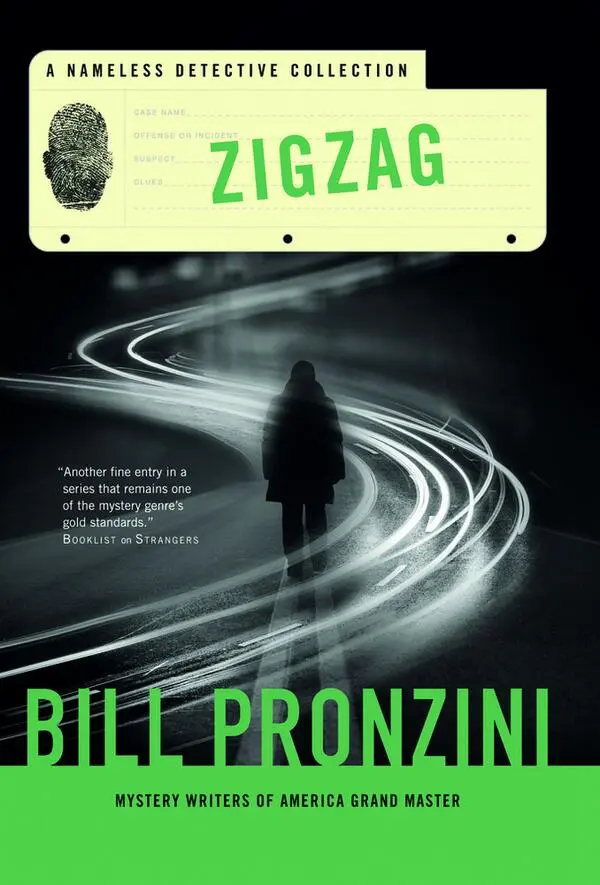
- Название:Zigzag
- Автор:
- Издательство:Forge Books
- Жанр:
- Год:2016
- Город:New York
- ISBN:978-0-7653-8103-3
- Рейтинг книги:4 / 5. Голосов: 1
-
Избранное:Добавить в избранное
- Отзывы:
-
Ваша оценка:
Zigzag: краткое содержание, описание и аннотация
Предлагаем к чтению аннотацию, описание, краткое содержание или предисловие (зависит от того, что написал сам автор книги «Zigzag»). Если вы не нашли необходимую информацию о книге — напишите в комментариях, мы постараемся отыскать её.
Ellery Queen’s Mystery Magazine
In the second short,
, readers discover how, indeed, one thing just leads to another (First published in
as
).
The final work,
, is another original novella and entangles Nameless in a weird crime with fearful occult overtones.
Zigzag — читать онлайн бесплатно полную книгу (весь текст) целиком
Ниже представлен текст книги, разбитый по страницам. Система сохранения места последней прочитанной страницы, позволяет с удобством читать онлайн бесплатно книгу «Zigzag», без необходимости каждый раз заново искать на чём Вы остановились. Поставьте закладку, и сможете в любой момент перейти на страницу, на которой закончили чтение.
Интервал:
Закладка:
“So okay,” Tamara said. “You want me to run a backgrounder on this Vok character, right?”
“Right. Him and his wife both. On the Erskines, too — anything that might have a bearing on this revenge thing.” We didn’t usually conduct background checks on clients without a compelling reason, but this was anything but an ordinary case. The more information I had, the better idea I would have of how to proceed.
“What else?”
I consulted my notes. Jake Runyon, Alex Chavez, and most other private operatives these days carry voice-activated devices to record client interviews, but I still use the old-fashioned method of writing down information in a private brand of shorthand. Truth is, I have an uneasy, need-hate relationship with modern technology. There’s no question that computers, Internet search engines, iPhones and iPads, and GPS systems are useful tools that make detective work and some aspects of life easier; but they’re also responsible for a considerable amount of negative change, chiefly the obliteration of personal privacy. The gadgets cluttering up my life are necessary sometimes, but I use them as sparingly as possible. Old habits are hard to break when a dinosaur like me gets into his so-called “golden years.”
“Whatever you can pull up on the freeway accident that started all this,” I said in answer to Tamara’s question. “Also the name of the San Jose reporter who found out about the alleged devil worship connection and tried to interview the Erskines.”
“That should be easy enough, if he worked for the Mercury News .”
“Other IDs, too, if possible: the doctor who attended Vok, the nurse and the other man who were in the hospital room, and the person or persons who claimed the bodies of Vok and his wife.”
“Not so easy. Hospital records are pretty hard to access without covert hacking.”
“Do what you have to, within reason,” I said. “But I don’t want to know the specifics.”
Tamara flashed me one of her sly grins. “Want me to get on this right away?”
“Tomorrow morning’s soon enough. It’s five-thirty. Why don’t you knock off early for a change?”
“No reason to. All that’s waiting for me in my flat is some leftover Chinese takeout and a bathroom that needs cleaning. Besides, I’ve got plenty of other work to do.”
“Not overloading you, am I?”
“Hah. Couldn’t if you tried. Only thing I’d rather do is screw, and I can’t even do that now that that asshole Horace and me busted up again. Or get next to Mr. V anymore. He went and died on me and I haven’t had a chance to replace him.”
I sighed and beat a hasty retreat into my own office. I did not want to hear any more about Mr. V for vibrator, dead or alive. Tamara’s insistence on sharing intimate details about her sex life, or lack thereof, was one of her less than endearing traits.
I did not tell Kerry about my interviews with Peter and Marian Erskine. Most of the time I confided in her whenever a provocative new case had my attention, just as she confided in me when there were interesting developments at Bates and Carpenter, the ad agency where she was now a vice president in charge of several accounts. But not this case.
It wasn’t that she would have openly disapproved of my decision to take it on, though she might have questioned the wisdom of it. It would have been an act of cruelty to bring disturbing topics like devil cults and black hosts and vengeful spirits into my home. It was one thing to deal with such matters professionally, where you could employ a certain amount of detachment, another to subject Kerry — and possibly my inquisitive fourteen-year-old adopted daughter, Emily — to any of the nasty details.
What I did do, after dinner, was boot up my laptop and conduct a little private Internet research into the history of Satanic worship — as much of it as I could stand to read. The practice had started among primitive peoples in all corners of the earth, I learned, a reverse worship engaged in when fertility rites failed and prayers to benign gods went unanswered. When that happened, some of those primitive races — ancient Babylonians and Druids, among others — appealed instead to the dark gods through virgin sacrifices and other blasphemies.
From the Dark Ages onward, all sorts of sorcerers and sorceresses joined in the Sabbat, or Witches’ Sabbath, to perform black masses and attempt to summon demons and make covenants with Satan. Human life was cheap in those days, and in the centuries that followed; people vanished without much effort to find out what had happened to them, especially when members of the nobility indulged in the black arts — human monsters like the Marquis de Sade, Gilles de Rais, Madame de Montespan.
There didn’t seem to be much doubt that devil worship continues to exist in these so-called enlightened times. Communicants, as they were called, were still being drawn into witch cults by the freedom to indulge in forbidden practices under the guise of ritual: sexual orgies, blood sacrifices, the black mass communion of drinking of real blood instead of consecrated wine, reading scripture backward, hanging crucifixes upside down. Crazy shit, as Tamara would have termed it. The communicants were of three general types: those who weren’t smart enough to know better, those who got a sick thrill out of sacrilegious ceremony, and those who were addicted to orgies and/or ritual killing. Which had Antanas Vok and his wife been? I wondered.
By the time I quit reading, I was having some second thoughts about cashing Peter Erskine’s retainer check and going ahead with the investigation. This case was like nothing in my experience. Grotesque, disturbing. I could still see that damned black host, still feel it unclean in the palm of my hand — a genuine symbol of evil. It was as if it had left a permanent invisible stain. Ridiculous thought, brought on by too much imagination and heightened by my Catholic upbringing, but it lingered nonetheless.
I wrestled with my feelings, and professionalism won. When I make a commitment, I honor it. I kept remembering the palpable tension and fear in Marian Erskine, too — fear for her husband’s life, fear of being at the mercy of unknown forces. The one sure way to dispel her superstitious concerns about revenants and the powers of darkness was to prove the threat human by exposing the person or persons behind it.
Still, I had the nagging thought that I’d gotten myself into something I didn’t completely understand and that one day, no matter what the outcome, I would come to regret it.
6
Tamara had already pulled up some of the information I’d requested when I arrived at the agency the next morning. It was only nine o’clock, so she must have come in early. She looked tired, her dark brown face drawn and the whites of her eyes streaked with faint red lines. Not getting enough sleep. And not eating much or well; she’d lost more weight recently than was good for a young woman with her large-boned body. Overwork, and the second difficult breakup with her cello-playing boyfriend, Horace Fields. But there was nothing I could say or do about it. She was as independent as they come. The only advice from me she’d take to heart was the professional kind, and sometimes only after an argument.
“Not too much on the Voks — wife’s name Elza — or the accident that you don’t already know,” she told me. “The reporter is a dude named Lenihan, first name Joseph. Only he doesn’t and never did work for the Mercury News . Freelancer for any newspaper or other publication that’ll run one of his creature features.”
“His what?”
“Far-out stuff. You know, weird happenings, unexplained phenomena, that kind of thing.”
Читать дальшеИнтервал:
Закладка:
Похожие книги на «Zigzag»
Представляем Вашему вниманию похожие книги на «Zigzag» списком для выбора. Мы отобрали схожую по названию и смыслу литературу в надежде предоставить читателям больше вариантов отыскать новые, интересные, ещё непрочитанные произведения.




Обсуждение, отзывы о книге «Zigzag» и просто собственные мнения читателей. Оставьте ваши комментарии, напишите, что Вы думаете о произведении, его смысле или главных героях. Укажите что конкретно понравилось, а что нет, и почему Вы так считаете.