Bill Pronzini - Zigzag
Здесь есть возможность читать онлайн «Bill Pronzini - Zigzag» весь текст электронной книги совершенно бесплатно (целиком полную версию без сокращений). В некоторых случаях можно слушать аудио, скачать через торрент в формате fb2 и присутствует краткое содержание. Город: New York, Год выпуска: 2016, ISBN: 2016, Издательство: Forge Books, Жанр: Детектив, на английском языке. Описание произведения, (предисловие) а так же отзывы посетителей доступны на портале библиотеки ЛибКат.
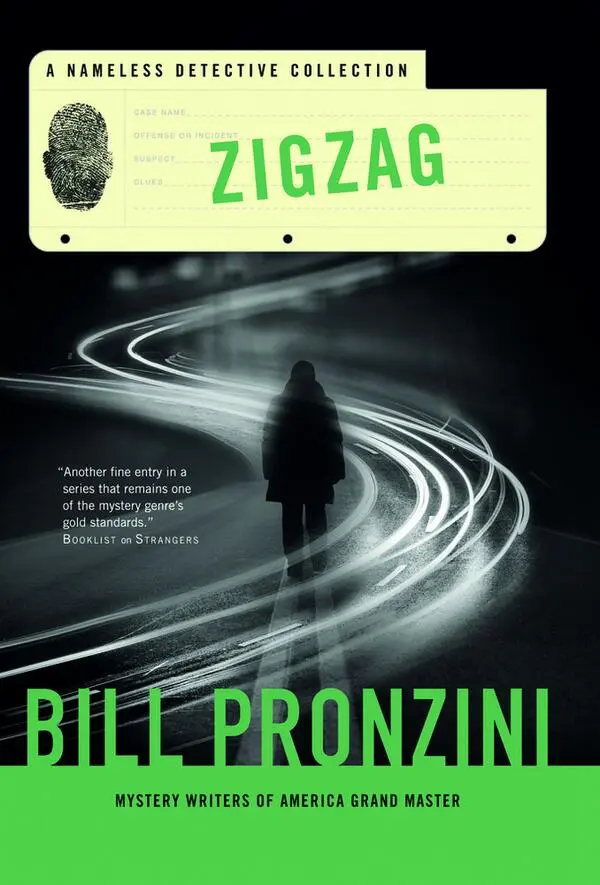
- Название:Zigzag
- Автор:
- Издательство:Forge Books
- Жанр:
- Год:2016
- Город:New York
- ISBN:978-0-7653-8103-3
- Рейтинг книги:4 / 5. Голосов: 1
-
Избранное:Добавить в избранное
- Отзывы:
-
Ваша оценка:
Zigzag: краткое содержание, описание и аннотация
Предлагаем к чтению аннотацию, описание, краткое содержание или предисловие (зависит от того, что написал сам автор книги «Zigzag»). Если вы не нашли необходимую информацию о книге — напишите в комментариях, мы постараемся отыскать её.
Ellery Queen’s Mystery Magazine
In the second short,
, readers discover how, indeed, one thing just leads to another (First published in
as
).
The final work,
, is another original novella and entangles Nameless in a weird crime with fearful occult overtones.
Zigzag — читать онлайн бесплатно полную книгу (весь текст) целиком
Ниже представлен текст книги, разбитый по страницам. Система сохранения места последней прочитанной страницы, позволяет с удобством читать онлайн бесплатно книгу «Zigzag», без необходимости каждый раз заново искать на чём Вы остановились. Поставьте закладку, и сможете в любой момент перейти на страницу, на которой закончили чтение.
Интервал:
Закладка:
“Hello, Moses,” I said.
He stood frozen for half a dozen beats. Other emotions flickered briefly in his eyes and on his deeply seamed face; the one that remained, I thought, was resignation.
“So you found out,” he said.
“Did you really believe we wouldn’t?”
“Figured you might. It don’t matter much anymore. You gonna take me to the po-lice now?”
“Let’s talk a little first.”
He backed up slowly into the room. I stepped inside, closed the door against the dish rattle and voice murmurs out front. The room was a windowless, fourteen-by-fourteen box, dimly lit by a low-wattage ceiling bulb, that had once been used for storage; still was, to an extent, judging by the cartons stacked along one wall. In the remaining space were a cot covered with an old army blanket, a rickety chair, a small table, and a kind of open, makeshift closet that contained Moses Arceneaux’s meager belongings. I wondered if he realized how much the room looked and felt like what he’d spent fifty-one years avoiding — a prison cell.
His trumpet lay on the cot. He caught it up when he sat down, held it on his lap. It was old and a little dinged here and there, but the brass surfaces still shone from myriad polishings. The one thing he owned that he cared about, I thought.
He said, “You find Robin Louise?”
“Yes, we found her. She lives in Shreveport.”
“Knew she was still alive. Knew it for sure.”
“She may not want to have anything to do with you,” I said. “You must know that, too.”
“I believe she will. Got some money saved for her, like I told you yesterday. Got to talk to her one last time before I die. Tell her I’m sorry. Tell her I never stopped loving her. Tell her the truth.”
“What truth?”
“About what happened to her mama and Marcus Dupres that night in ’63.” Arceneaux ran his long, gnarled fingers around the rim of the trumpet’s bell. “Tell you the truth, too, you want to hear it.”
“Go ahead.”
“I didn’t kill Lily or that piano man,” he said, “neither of ’em.”
I said nothing. The number of men and women charged with capital crimes who profess their innocence to the bitter end are countless. Nearly all such claims are self-serving obfuscations or outright lies. Ninety-five percent, at a reasonable guess. But it’s the five percent that make a cry of innocence worth listening to.
“Swear it on a Bible,” Arceneaux said. “I never done it.”
I stayed mute.
He put the wrong interpretation on my silence. “You like everybody down in N’Orleans,” he said, “you don’t believe it.” Surprisingly, there was no discernible bitterness in the words.
“Suppose you tell me the way it was.”
“I loved that woman, that’s the way it was. Even after I found out she was cheatin’ on me with that piano man. I might’ve whipped her ass some if I’d had the chance, but kill her dead? No, sir. Never.”
“She was shot with your pistol. Both of them were.”
“Not by me. Didn’t happen the way it looked.”
“All right. How did it happen?”
“Kind of hard to remember exactly, after so many years.” A bunch of seconds went by while he either worked his memory or built a framework of lies.
Then he said, “Horn man in Dupres’ band told me about her and him. Drunk, and he let it slip out. Man, it cut me deep. I was half outa my head, I admit that, when I went harin’ over to Dupres’ place that night.”
“With your pistol in your pocket.”
“No, sir. Lily was the one brought the gun. Dupres been stringin’ her along, told her they was gonna run off together. She believed him, must’ve wanted him bad, more’n she ever wanted me, but then she found out he had him another woman besides her, stringin’ that one along, too. She had a bad temper, Lily did. Didn’t go to Dupres’ place for screwin’ that night, went there for a showdown — make him choose between her and his other woman. That’s why she took the pistol with her.”
“How do you know all this?”
“They was yellin’ it at each other when I got there,” Arceneaux said. “Bastard must’ve hit her ’cause I heard a sound like a slap, and she screamed, and next thing I heard was that gun goin’ off. Door wasn’t locked. I got it open and run inside, and Dupres was on the floor with blood all over his face and Lily standin’ there with her eyes crazy wild. She swung around on me wavin’ the pistol like she was gonna shoot me, too. I tried to take it away from her, we grappled some, and... Lord, it went off again and she fell down dead as Dupres. Somebody come runnin’ in then, must’ve been one of the neighbors, and somebody else outside was hollerin’ for the cops, and there I was holdin’ the pistol that killed ’em both...”
“So you panicked and ran.”
“Yeah, that’s what I done. I threw the gun down and hauled ass outa there. I didn’t have no other choice.”
“Sure you did. You could’ve stayed and told the police what you just told me.”
He laughed, a hollow sound that morphed suddenly into one of his coughing fits. It took a little while, once the spell subsided, before he was able to go on talking.
“Man, you don’t know what it was like down south in them Jim Crow days. Black man in a room with his dead wife and her dead lover and his own pistol smokin’ in his hand. You think they’d of believed me? No way. They’d of thrown me in jail, likely beat on me, then put me in prison and the ’lectric chair. I wouldn’t of stood a chance in hell. Sure, I ran. Ain’t been closer to N’Orleans than five hundred miles since.”
“Fifty years of running and hiding,” I said. “What’d you do all that time?”
“Stayed out of trouble. Swear that on a Bible, too — I ain’t never once broke the law, nor even been tempted to. Mr. Good Citizen everywhere I went, one end of the country to the other. Never stayed too long in one place until I come out here to San Fran, been here seven years now. Worked to put food in my belly and clothes on my back, any kind of job I could get where I didn’t have to show identification. Pickin’ crops. Washin’ dishes. Diggin’ ditches. Janitor work, handyman work.” He ran his hands over the trumpet again, fingered the buttons. “Played and sang on the streets. In backstreet bars now and then, when I could get a gig and I was sure wouldn’t nobody recognize me or my style. Guess I been lucky.”
Yeah, I thought. Lucky.
I said, “And you have no regrets?”
“About runnin’ off the way I done? No. My music... yeah, some there, but the band I played with in N’Orleans wasn’t goin’ nowhere and neither was I. Only wrote one song that was any good, ‘Who You Been Grapplin’ With?’ Leavin’ and losin’ my daughter, that’s my only regret. But I knew she’d be all right, I knew her auntie’d take care of her.”
“You could have at least tried to find out.”
“Did once, year or so after. Man I knew, only one I figured I could trust, I got in touch with him and he told me Jolene and Bobby was gonna adopt Robin Louise. I asked him to keep an eye on her and he said he would, but he went and got himself killed in an accident.”
“And you never tried to contact her until now?”
“Thought about it plenty. Come close a dozen times, but I never could nerve myself up to it. Too scared of the police, dyin’ in prison for something I never done. Never stopped bein’ scared until just a little while ago, when I come to know for sure my time was almost up. Funny thing. Now I ain’t scared anymore.”
I had been watching him closely as he laid out his story. When you’ve been lied to as often as I have over the years, by all sorts of people good and bad, you develop ways to separate the truths from the untruths, a kind of homespun lie detector. Body language: nervous gestures, facial tics, shifty looks, or too-direct eye contact. Statements too glib or overly earnest, points glossed over or omitted or contradictory, voice inflections that don’t ring true. I’d neither seen nor heard any of those telltale indicators in Moses Arceneaux or his account of what had happened that August night in 1963.
Читать дальшеИнтервал:
Закладка:
Похожие книги на «Zigzag»
Представляем Вашему вниманию похожие книги на «Zigzag» списком для выбора. Мы отобрали схожую по названию и смыслу литературу в надежде предоставить читателям больше вариантов отыскать новые, интересные, ещё непрочитанные произведения.

Обсуждение, отзывы о книге «Zigzag» и просто собственные мнения читателей. Оставьте ваши комментарии, напишите, что Вы думаете о произведении, его смысле или главных героях. Укажите что конкретно понравилось, а что нет, и почему Вы так считаете.