Morag Joss - Half Broken Things
Здесь есть возможность читать онлайн «Morag Joss - Half Broken Things» весь текст электронной книги совершенно бесплатно (целиком полную версию без сокращений). В некоторых случаях можно слушать аудио, скачать через торрент в формате fb2 и присутствует краткое содержание. Жанр: Детектив, на английском языке. Описание произведения, (предисловие) а так же отзывы посетителей доступны на портале библиотеки ЛибКат.
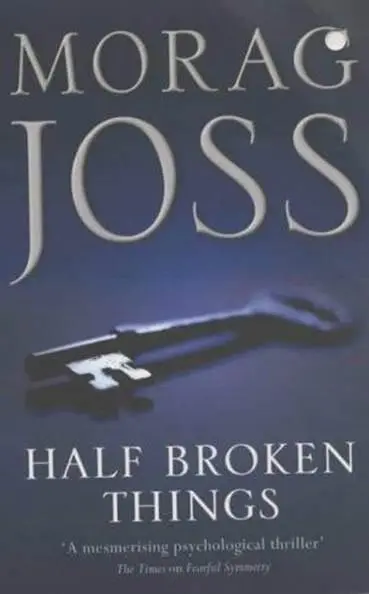
- Название:Half Broken Things
- Автор:
- Жанр:
- Год:неизвестен
- ISBN:нет данных
- Рейтинг книги:3 / 5. Голосов: 1
-
Избранное:Добавить в избранное
- Отзывы:
-
Ваша оценка:
Half Broken Things: краткое содержание, описание и аннотация
Предлагаем к чтению аннотацию, описание, краткое содержание или предисловие (зависит от того, что написал сам автор книги «Half Broken Things»). Если вы не нашли необходимую информацию о книге — напишите в комментариях, мы постараемся отыскать её.
Loners Jean, Micheal and Steph are drawn together to Walden Manor by a mixture of deceit, good luck and misfortune. There, they shape new lives, full of hope and happiness. When their idyll is threatened they discover their new lives are worth preserving. But at what cost?
Half Broken Things — читать онлайн бесплатно полную книгу (весь текст) целиком
Ниже представлен текст книги, разбитый по страницам. Система сохранения места последней прочитанной страницы, позволяет с удобством читать онлайн бесплатно книгу «Half Broken Things», без необходимости каждый раз заново искать на чём Вы остановились. Поставьте закладку, и сможете в любой момент перейти на страницу, на которой закончили чтение.
Интервал:
Закладка:
The body might, she also thought, be telling her that she was actually very, very hungry, a thing it had not told her, or that she had not heard it say, for years. In fact she ought perhaps to be listening a little more carefully, because she had the feeling that since she had arrived she had grown if anything a little thinner. As Jean had begun to enjoy the loosening of the customary austerity with which she managed her physical needs, she had been considering herself with a new gentleness. Her habitual tone of self-chastisement had quietened down; if she felt like resting in the afternoons, she did so, the word lazy barely crossing her mind. And she did now recall that she had made a little half-promise to herself, on what she now thought of as Wardrobe Day, that she would try to fill out her new clothes a little more convincingly. She was still a little small for them. Now, she recognised, if she were properly to fit her new life, the time had come to attend to the matter of feeding herself as if she still had some growing to do.
First, though, the chill in her joints called for a drink. She had noticed without concern or surprise on her first or second day that the decanters in the dining room were empty. She should have preferred to make her first visit to the cellar in daylight and when she was feeling less tired, but she rose, fetched the key, opened the low panelled door in the corner of the dining room and descended the cellar steps.
In the sudden fluorescent light and thick underground smell, Jean paused. From the bottom of the steps she could see, stretching down both sides of the cellar, a series of whitewashed, arched bays that were filled with metal racks laden with bottles. At Jean’s end, close to the steps, stood an old oak table. She looked at it closely. It was like nearly everything else in the house: old, imperfect, beautiful, and although the wood now looked hungry, having been left so long unpolished, Jean could imagine it being used as a dining table in many houses not much humbler than this one. On it sat a small torch, a candle in a metal holder, a leather-bound book and a number of corkscrews, one of which had, inexplicably, a brush on one end. There was also an unnerving sort of circular cutter that looked as if it had been designed for removing fingertips. On the wall behind the table a pair of metal tongs hung from a hook. Jean immediately felt intimidated, as if she had happened upon the instruments of a painful, semi-surgical religious ceremony of quite Masonic abstruseness. She scraped quietly along the flagged floor, peering into the racks and reading labels which told her nothing except how ignorant she was: Lйoville-Poyferrй, Batailley, Domaine de Chevalier. The shape of the bottles changed; she read Chambolle-Musigny, Vosne-Romanйe and sighed, unenlightened. It was easy to recognise the champagne bottles by their corks but it was not champagne she wanted now. Some treacherous-looking bottles on the lowest racks had lost their labels altogether and bore only a number and a daub of white paint, presumably having been caught by a swipe of the brush when the cellar was being whitewashed. Passing by them, knowing better than to open such dangerously old, unlabelled bottles, she walked on, reading names she could not pronounce and feeling, rather aggressively, that the whole thing was unnecessarily complicated. A nice red wine, or a glass of port or sherry, was all she wanted. It was absurd to be frightened by a lot of foreign names, but the trouble was not simply that they were the names of places she had never been to and of wines she had never drunk. They spoke of qualities she did not possess. Permanence and graciousness, let alone pedigree, had scarcely been the hallmarks of her life so far, she thought, lapsing for a moment into old habits and almost forgetting that she was not that Jean any more. She pulled out another bottle, of which there were at least half a dozen identical ones in the rack. Above the words ‘Chвteau Palmer 1982’ was a picture of the chвteau and she sighed again, this time with relief. At last, a name she could read, a nice ordinary English name. She recalled that there had been a Palmer family in Oakfield Avenue. And the chвteau on the label was, really, just a house when it came to it. Or rather not just a house like the one in Oakfield Avenue, it was a house like this one, Walden Manor. Her house. The thought gave her confidence. She scanned the drawing, imagining the heavy French furniture behind the tall drawing-room windows. There might be a pretty boudoir upstairs with another window looking over the back perhaps, onto a view of a terrace and gardens and vineyards. She turned the bottle in her hand, almost as if she thought that the far side would show the back of the house, and turned it back to the drawing. Who would live in this place? A woman, certainly. Madame, a woman of Jean’s age, would be at her dressing table under the window attending to her hair, pinning it into a simple, elegant chignon. I shall grow mine, Jean thought, patting her own, which was still damp at the ends from her bath. In fact, now that she thought about it, she would have to grow it, since she was not going to go out any more. The label drew her attention again. What a delightful place it was. On a summer morning, the chestnut trees- that Jean felt sure were there, flanking the courtyard just out of the frame of the drawing- would rustle in the breeze with a soft shivering note that would carry upon it the fluting calls of pigeons and doves. Madame would hear them from the open window at the back as she embedded the final long pin in her coiffure, and then she would look up to see- who? Her son, perhaps. Yes, definitely her son, some way off, moving thoughtfully between the vines, inspecting the grapes. Madame would know by the tilt of his head as he passed down the rows and as he paused to look up at the sky, that he was worrying a little, wondering if the weather would hold. Would the sun shine right up until the last day before the harvest? Jean smiled, then turned and made her way up the cellar steps, picking up a corkscrew as she went. The label had told her all she needed to know about the wine, whatever it might taste like.
It was nice, that first bottle of wine. It certainly loosened my poor old joints, at least. It was strong and I suppose what you’d call dry. I liked it more the more I drank, and it went well with my supper. Because after the first glass by the fire I started to think about food again. I’m no cook, or I wasn’t then- I’ve learned all that since. Up till then I hadn’t bothered with the Aga. I only had cereal or sandwiches, or I used the microwave for scrambled eggs or soup if I wanted something hot. I didn’t bother much. But that night I needed something more. I got the key to one of the two big freezers in the utility room and found bacon, sausages, butter. I noticed one or two other very tempting-looking things at the same time. For another day, I thought, half-expecting Michael. I’d already got eggs and tomatoes and bread. The Aga behaved itself. There was nothing difficult about it. There was an excellent pan for a big fry-up, and I sipped the wine while I cooked and the kitchen filled with the most wonderful smell. How they would have hated it, the owners! All of it: the smell of bacon and sausages, the fat-spattered Aga and the way I disobeyed their instructions about where I ate. I took my supper on a tray and ate by the drawing-room fire and finished the bottle of wine with some cheese. By then I felt rather sleepy so I made some very good coffee (theirs) and threw out my jar of instant as I waited for the kettle to boil. I wanted to stay awake, because after that wine label and everything that the chвteau had told me, I had been thinking about the importance of pictures. Photographs in particular.
Читать дальшеИнтервал:
Закладка:
Похожие книги на «Half Broken Things»
Представляем Вашему вниманию похожие книги на «Half Broken Things» списком для выбора. Мы отобрали схожую по названию и смыслу литературу в надежде предоставить читателям больше вариантов отыскать новые, интересные, ещё непрочитанные произведения.









Обсуждение, отзывы о книге «Half Broken Things» и просто собственные мнения читателей. Оставьте ваши комментарии, напишите, что Вы думаете о произведении, его смысле или главных героях. Укажите что конкретно понравилось, а что нет, и почему Вы так считаете.