Thomas Adcock - Brooklyn Noir 3 - Nothing but the Truth
Здесь есть возможность читать онлайн «Thomas Adcock - Brooklyn Noir 3 - Nothing but the Truth» весь текст электронной книги совершенно бесплатно (целиком полную версию без сокращений). В некоторых случаях можно слушать аудио, скачать через торрент в формате fb2 и присутствует краткое содержание. Город: New York, Год выпуска: 2008, ISBN: 2008, Издательство: Akashic Books, Жанр: Детектив, на английском языке. Описание произведения, (предисловие) а так же отзывы посетителей доступны на портале библиотеки ЛибКат.
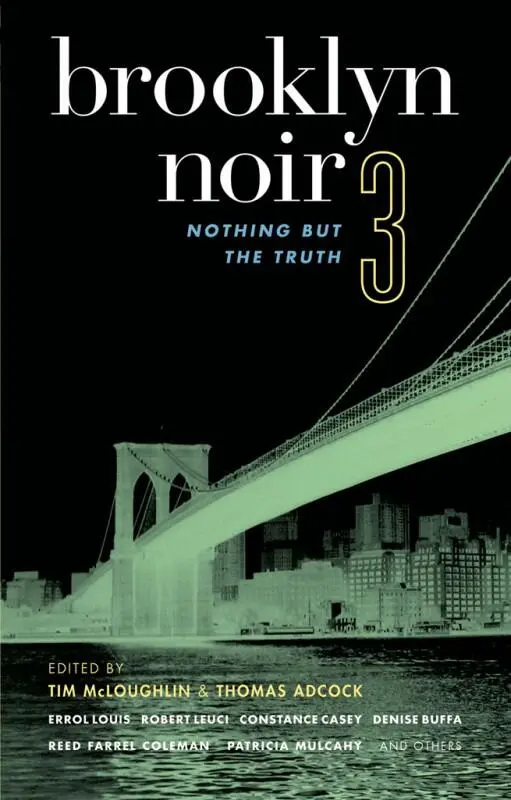
- Название:Brooklyn Noir 3: Nothing but the Truth
- Автор:
- Издательство:Akashic Books
- Жанр:
- Год:2008
- Город:New York
- ISBN:978-1-933354-14-9
- Рейтинг книги:3 / 5. Голосов: 1
-
Избранное:Добавить в избранное
- Отзывы:
-
Ваша оценка:
Brooklyn Noir 3: Nothing but the Truth: краткое содержание, описание и аннотация
Предлагаем к чтению аннотацию, описание, краткое содержание или предисловие (зависит от того, что написал сам автор книги «Brooklyn Noir 3: Nothing but the Truth»). Если вы не нашли необходимую информацию о книге — напишите в комментариях, мы постараемся отыскать её.
. This volume presents the first nonfiction collection in the series, curated by acclaimed novelists Tim McLoughlin and Thomas Adcock.
Brand-new stories by: Robert Leuci, Dennis Hawkins, Tim McLoughlin, Thomas Adcock, Errol Louis, Denise Buffa, Patricia Mulcahy, C. J. Sullivan, Reed Farrel Coleman, Aileen Gallagher, Christopher Musella, Kim Sykes, Robert Knightly, Jess Korman, Constance Casey, and Rosemarie Yu.
Brooklyn Noir 3: Nothing but the Truth — читать онлайн бесплатно полную книгу (весь текст) целиком
Ниже представлен текст книги, разбитый по страницам. Система сохранения места последней прочитанной страницы, позволяет с удобством читать онлайн бесплатно книгу «Brooklyn Noir 3: Nothing but the Truth», без необходимости каждый раз заново искать на чём Вы остановились. Поставьте закладку, и сможете в любой момент перейти на страницу, на которой закончили чтение.
Интервал:
Закладка:
Hinrichs’s team launched a manhunt, banging on dozens of doors all across the city, especially in Brooklyn and Queens. A tip led them some hundred and forty miles north of New York City to the state capital, Albany, where Pearson had once been busted on drug charges.
While looking for Pearson’s brother, a low-level Albany dope dealer, the cops found his wife — Kayson’s sister-in-law — who was on the outs with the Pearson family, saying she’d been raped and beaten by her husband. She gave the cops an earful, including the fact that the fugitive Kayson had sent her an e-mail asking her to send his Social Security card, birth certificate, and other identification to an address in Georgia.
That sent cops racing to the airport to catch the first available flight to Georgia. They had no authority to make an arrest out of state, but Georgia cops accompanied them to the small house where they were sure Pearson was hiding. He wasn’t there.
Flying back to New York — and closing in on a hundred hours without sleep — cops followed a fresh tip to a house in Yonkers where Pearson was staying with an eighteen-year-old girl he’d recently met. (The deadly charm had worked once again.)
Cops staked out the building and intercepted the young woman as she returned home. They showed her a picture of Pearson. She confirmed that he was inside and gave them a key to her apartment.
The capture was violent. Pearson had barricaded himself inside the bedroom, pushing the bed against the door. When cops burst in, Pearson lunged at them with a knife. A Yonkers cop shot him twice in the leg before he was taken into custody.
Back in Brooklyn, Hinrichs and his team were still shaking their heads.
“If you told me it’s two young kids snatching girls at random off the street and raping and killing them, I’d think you’re crazy,” said Hinrichs. “You know, this shit happens in fucking Idaho or some shit.”
Like everything else about the case, the trial was dramatic, violent, and sickening. Pearson and Hendrix each accused one another of murder, leading the court to pick two juries to hear the case — one to judge whether Pearson was guilty, the other for Hendrix. It made for long, complicated proceedings: It took twice as long as normal to find twenty-four jurors; every time evidence came up that might unfairly prejudice one set of jurors, the proceedings would stop and twelve people would be hustled out of the courtroom until the evidence was heard, after which they shuffled back in.
On January 19, 2006, several days into the trial, Pearson showed up in court dressed in white and wearing a yarmulke. Ever the charmer, he’d told his lawyer, Mitchell Dinnerstein, that he planned to convert to Judaism.
“We even recited some Hebrew blessings,” Dinnerstein later said.
It turned out to be just another con job by the murderous Pearson. A few minutes into the proceedings, members of Romona’s family noticed Pearson and Hendrix winking at each other. Both men saw they were being noticed, and accordingly brandished Plexiglas shivs, the nasty homemade blades inmates fashion out of jailhouse debris. The monsters had secreted the knives in their underwear before coming to court. Now they used the weapons to make a bloody bid for freedom.
Wheeling on Dinnerstein — the man he’d prayed with just minutes earlier — Pearson slashed him across the face. At the same time, Hendrix leaped over the rail separating witnesses from spectators, pouncing on a court officer and grabbing for his gun.
All hell broke loose.
There was blood everywhere. Dinnerstein’s shirt quickly became soaked in red. He would later need stitches to close the gash in his face. A fifty-eight-year-old court officer, Sergeant James Gorra, sprinted toward Pearson, who kept trying to stab Dinnerstein.
“I saw a weapon, and when he got close I gave a forearm as hard as I could and grabbed him. I couldn’t let him get behind me because the judge is behind me,” Gorra said later. “He hit me with the shiv twice, and then I flipped him over my side and then he hit me the third time. We were rolling around. I remember screaming out, ‘He’s going for my gun!’”
Albert Tomei, the sixty-six-year-old judge hearing the case, was at first puzzled by the chaos.
“While I was watching all this, I heard, ‘Gun, gun, gun!’” he said. “As soon as I heard that, I said, ‘I’m outta here!’”
Judge Tomei tried to leap from his perch on the bench and get to safety. “I’m not very good at jumping,” he said. “I missed the first time.”
Hendrix missed too. Officers swarmed over him, kicking him to the ground and hosing him down with pepper spray before he could get his hands on a gun.
Spectators fled the courtroom. Jurors dove to the floor. Romona’s mother, Elle Carmichael, was rolling on the ground, crying hysterically.
“They could have killed everybody in that room!” she screamed. “Hang them right now by the neck!”
Minutes after the escape attempt started, it was all over. Hendrix was wheeled out to an ambulance on a gurney, his face covered with an oxygen mask. He gave reporters the finger.
“In all my time on the criminal bench, it was the most frightened I’ve ever been,” Tomei later told colleagues. But there in the courtroom, amid the pandemonium, he was more blunt, looking at Dinnerstein’s soaked bloody shirt and voicing the feeling of everyone present.
“Holy shit!” said the judge.
Tomei had no choice but to declare a mistrial, which he did the following week. The juries that watched the escape attempt would be hopelessly prejudiced against Pearson and Hendrix. The judge also excused Dinnerstein from the case, assembled two more juries, and resumed the trial in February.
Anna-Sigga Nicolazzi, the prosecutor assigned to the second trial, squeezed Elle Carmichael’s hand, then began explaining to the jurors what had happened to Romona.
This time, Pearson and Hendrix were banned from the courtroom and made to watch the proceedings via video feed to the Rikers Island lockup. On the rare occasions they were brought to court individually to testify in person, each man’s arms and legs were shackled, their hands encased in mitts and surrounded by twenty officers.
“Any outburst on your part, any showing of your hands or shackles on your part in order to create a mistrial, will not result in a mistrial,” Justice Tomei told Pearson.
The trial dragged on for weeks, but the outcome was never in doubt. Both juries convicted the monsters on all counts.
At sentencing, Judge Tomei told Pearson and Hendrix he would not call them animals.
“That word is not appropriate because animals do not torture each other,” he said. “You are a deadly human virus... a deadly vessel of human terror.”
Then he sent them to jail forever.
“You’re going to be consigned to a place where there is no love, there is no compassion — [a place that is] cold and lonely. And you’ll be consigned to that place for a very, very long time,” he said.
Elle Carmichael sued the city for more than a million dollars, claiming that delays in searching for her daughter — along with the fact that the police closed the case while Romona was still alive — contributed to her death.
But for Carmichael, money is the least of her concerns.
She moved from the home she shared with her daughter and went for months of psychological counseling. She carried a picture of her smiling daughter as a kind of talisman to ward off thoughts of Romona’s final terrible days.
“The one question I always ask is, Why did it happen? I feel like at my worst times, when I feel most helpless, that’s the question I ask,” she told a reporter. “It puts me into a trance sometimes, so I try to avoid that question. But I still wonder, Why did this happen? ”
Читать дальшеИнтервал:
Закладка:
Похожие книги на «Brooklyn Noir 3: Nothing but the Truth»
Представляем Вашему вниманию похожие книги на «Brooklyn Noir 3: Nothing but the Truth» списком для выбора. Мы отобрали схожую по названию и смыслу литературу в надежде предоставить читателям больше вариантов отыскать новые, интересные, ещё непрочитанные произведения.






Обсуждение, отзывы о книге «Brooklyn Noir 3: Nothing but the Truth» и просто собственные мнения читателей. Оставьте ваши комментарии, напишите, что Вы думаете о произведении, его смысле или главных героях. Укажите что конкретно понравилось, а что нет, и почему Вы так считаете.