Josh Rogin - Chaos Under Heaven
Здесь есть возможность читать онлайн «Josh Rogin - Chaos Under Heaven» весь текст электронной книги совершенно бесплатно (целиком полную версию без сокращений). В некоторых случаях можно слушать аудио, скачать через торрент в формате fb2 и присутствует краткое содержание. Год выпуска: 2021, ISBN: 2021, Издательство: HMH Books, Жанр: Старинная литература, на английском языке. Описание произведения, (предисловие) а так же отзывы посетителей доступны на портале библиотеки ЛибКат.
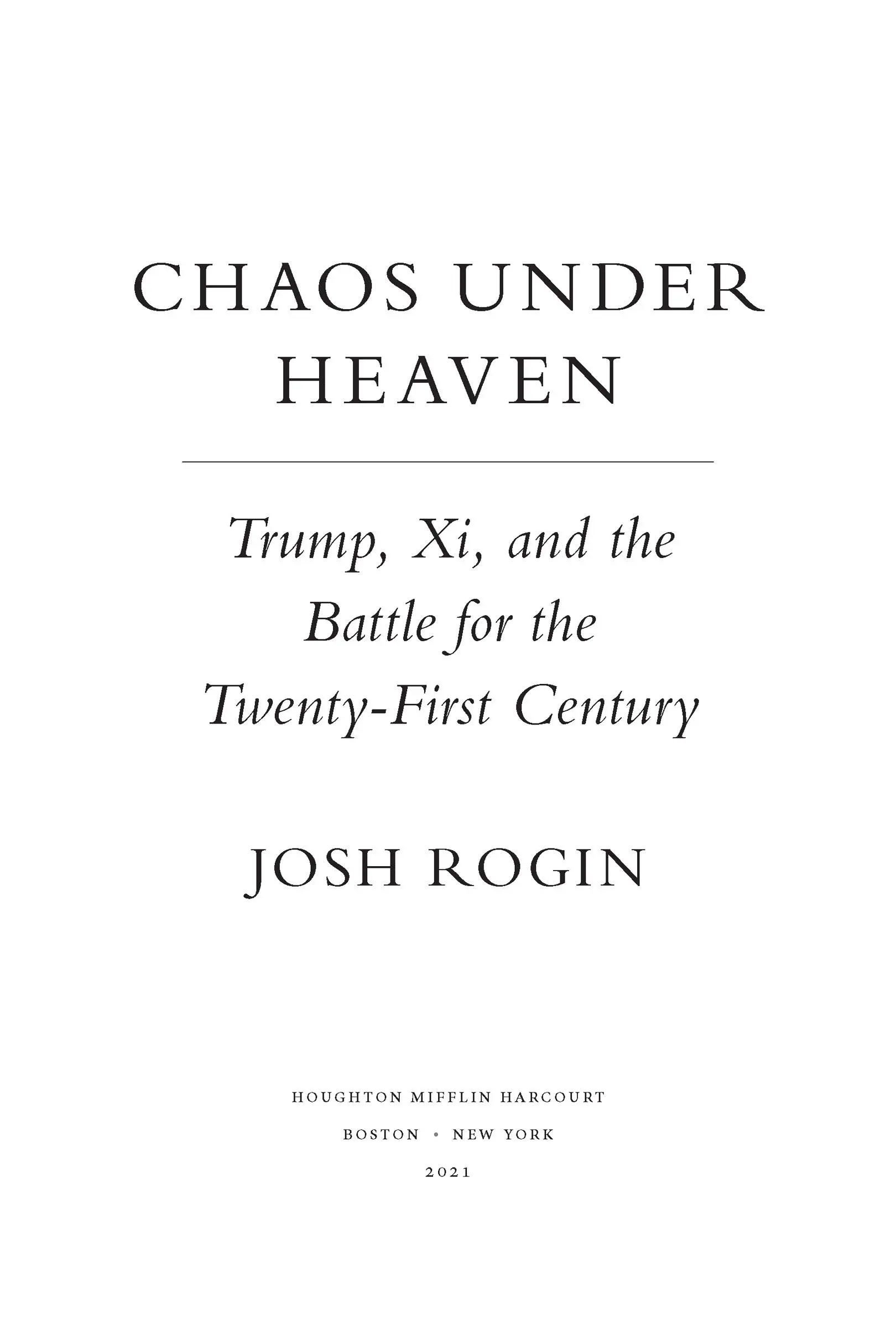
- Название:Chaos Under Heaven
- Автор:
- Издательство:HMH Books
- Жанр:
- Год:2021
- ISBN:9780358393832
- Рейтинг книги:4 / 5. Голосов: 1
-
Избранное:Добавить в избранное
- Отзывы:
-
Ваша оценка:
Chaos Under Heaven: краткое содержание, описание и аннотация
Предлагаем к чтению аннотацию, описание, краткое содержание или предисловие (зависит от того, что написал сам автор книги «Chaos Under Heaven»). Если вы не нашли необходимую информацию о книге — напишите в комментариях, мы постараемся отыскать её.
Chaos Under Heaven — читать онлайн бесплатно полную книгу (весь текст) целиком
Ниже представлен текст книги, разбитый по страницам. Система сохранения места последней прочитанной страницы, позволяет с удобством читать онлайн бесплатно книгу «Chaos Under Heaven», без необходимости каждый раз заново искать на чём Вы остановились. Поставьте закладку, и сможете в любой момент перейти на страницу, на которой закончили чтение.
Интервал:
Закладка:
Dr. Charles wasn’t even the only shady Chinese figure using a united front group to get into Mar-a-Lago. Florida businesswoman Cindy Yang became famous after New England Patriots owner Robert Kraft was busted soliciting sexual services in a massage parlor she had founded but since sold. After several years of allegedly building a prostitution empire in South Florida, she and her family became huge political donors, which put them in rooms with the Trump family (for example, at their Super Bowl party at Mar-a-Lago); Florida governor Ron DeSantis; Senator Rick Scott; Sarah Palin; the president’s campaign manager, Brad Parscale; and many others. Yang’s consulting company, GY US Investments, openly promised its clients access to President Trump and other top officials. Mother Jones reported that Yang herself was heavily involved in the Florida branch of the Council for the Promotion of the Peaceful Reunification of China and the Miami chapter of the American arm of the China Association for Science and Technology, both of which were known to be connected to the CCP and the united front. Who else would start a Florida group dedicated to forcing Taiwan to join the mainland? This is how united front networks have long operated on US soil.
“Any sustainable, long-term strategy for addressing China’s challenge requires the integrity of U.S. political and policymaking processes,” Mattis testified before the House Foreign Affairs Committee in May 2019. “This requires grappling with the challenges posed by the party’s efforts to shape the United States by interfering in our politics and domestic affairs. The United States, its political and business elite, its thinkers, and its Chinese communities have long been targets for the Chinese Communist Party.”
The Money Train
Both Mattis and Alex Joske, the Australian researcher who wrote some of the earliest work on the united front (and who served as a researcher for this book), identified one united front organization as the most influential nonparty body that works to coordinate with the party and advance its goals. This group is called the Chinese People’s Political Consultative Conference (CPPCC).
The CPPCC includes both party members and influential non-party members inside and outside China. Its annual confab was attended by more than two thousand party-approved representatives from different sectors of Chinese society. It coordinated and oversaw hundreds of other united front organizations around the world. “Organisations that claim to speak for different interest groups—the China Association for Science and Technology and the All-China Federation of Returned Overseas Chinese, for example—are official components of the CPPCC,” Joske wrote. “In practice, those organisations are controlled by the CCP.”
The CPPCC had been chaired over the years by Mao Zedong, Zhou Enlai, Deng Xiaoping, and Li Xiannian. The current CPPCC chairman as of this writing is Wang Yang, the standing committee member responsible for the united front system. The vice-chairman of the CPPCC is a man by the name of Tung Chee-hwa.
Tung has an impressive resume, and an impressive network in the United States and its allied nations. He served as the first chief executive of Hong Kong after the British handover in 1997. Tung is also a billionaire shipping magnate whose family has been doing business for decades with the family of Elaine Chao, Trump’s transportation secretary and the wife of Senate Majority Leader Mitch McConnell.
Tung also leads one of the largest united front influence operations inside the United States under the cover of an organization he founded called the China-United States Exchange Foundation (CUSEF). The story of how CUSEF tried to fund the China program at a major university in 2017 is also the story of the first success of the Bingo Club in stopping a united front influence operation in its tracks.
A Showdown in Texas
When David Firestein, a former career foreign service officer, first laid out his plans to colleagues to build out the China center at the prestigious Lyndon B. Johnson School of Public Affairs at the University of Texas at Austin, he didn’t tell all of them he planned to use a CCP-linked influence organization as his primary funding source and use that money to host affiliates of the Chinese intelligence services.
His friend and proposed donor, Tung Chee-hwa, was no stranger in Washington. Tung’s CUSEF had given money or sponsored research at major Washington think tanks, including the Brookings Institution, the Carnegie Endowment for International Peace, the Center for Strategic and International Studies, the Center for American Progress, and the Atlantic Council. CUSEF funds the endowed professorship in the China Studies Department in Johns Hopkins University’s School of Advanced International Studies and a research project called the Pacific Community Initiative. Obama’s top Asia adviser, Jeffrey Bader, thanked CUSEF for its support in his book on Obama and China.
Firestein, who had worked with CUSEF at his previous job at the East-West Institute, proposed to take over a million dollars from CUSEF for the LBJ School’s new China center. This was a first for CUSEF. Usually, it funded specific research programs or projects. This would fund the center’s operations as well, making CUSEF its primary financial backer, after the university itself, which put up an initial $2 million to get it off the ground. If successful, his plan would have established a CCP influence campaign within the walls of one of America’s top public universities.
Several of the professors inside the LBJ School were shocked and concerned upon finding out (belatedly) that a CCP-linked billionaire would be funding their new China center. One junior assistant professor who specializes in Chinese politics and international relations, Joshua Eisenman, raised concerns about the plan during a faculty meeting in November 2017. It erupted into a feud that would become a pivotal first battle in the war to stop Chinese influence operations on American soil.
On a trip to DC in November, Eisenman saw his old friend Peter Mattis at a Bingo Club dinner and asked him for assistance in his effort to help the UT leadership understand CUSEF and its actual mission. Mattis passed Eisenman a memo he had written about CUSEF and a book chapter draft he had written on Chinese influence via the CPPCC. A few days later, Mattis also reached out to professional staffers at the offices of both Texas senators, John Cornyn and Ted Cruz, to inform them of the brewing controversy unfolding at UT Austin, and sent them the CUSEF memo as well.
Dr. Will Inboden, a senior professor and former congressional staffer and State Department official, also reached out to Cornyn’s office and alerted UT president Gregory Fenves. Fenves initiated an investigation and Inboden arranged for Fenves to get a briefing from US counterintelligence officials about CUSEF and Chinese influence operations in general.
In early December 2017, soon after Eisenman questioned CUSEF funding for the LBJ School’s China center at the faculty meeting, the faculty email list became a battleground over the nature of Chinese influence operations inside our country. I obtained a trove of these emails. Eisenman argued that there was wide and growing awareness of united front influence operations targeting US institutions of all kinds and pointed to Marco Rubio’s statement at a hearing that, “We have a lot of discussion of Russian interference in our elections, but the Chinese efforts to influence our public policy and our basic freedoms are much more widespread than most people realize.”
Firestein responded by defending CUSEF. He admitted that Tung was vice-chairman of the CPPCC, but said there’s no evidence the CPPCC was connected to the united front. Eisenman replied all with a list of links to exactly this evidence, starting with the document posted in English on the official CPPCC website dated July 3, 2012, that states, “The CPPCC is a Chinese people’s patriotic united front organization” and “is under the leadership of the Communist Party of China.”
Читать дальшеИнтервал:
Закладка:
Похожие книги на «Chaos Under Heaven»
Представляем Вашему вниманию похожие книги на «Chaos Under Heaven» списком для выбора. Мы отобрали схожую по названию и смыслу литературу в надежде предоставить читателям больше вариантов отыскать новые, интересные, ещё непрочитанные произведения.






Обсуждение, отзывы о книге «Chaos Under Heaven» и просто собственные мнения читателей. Оставьте ваши комментарии, напишите, что Вы думаете о произведении, его смысле или главных героях. Укажите что конкретно понравилось, а что нет, и почему Вы так считаете.