Arnon Grunberg - The Jewish Messiah
Здесь есть возможность читать онлайн «Arnon Grunberg - The Jewish Messiah» весь текст электронной книги совершенно бесплатно (целиком полную версию без сокращений). В некоторых случаях можно слушать аудио, скачать через торрент в формате fb2 и присутствует краткое содержание. Год выпуска: 2008, Издательство: Penguin Group US, Жанр: Современная проза, на английском языке. Описание произведения, (предисловие) а так же отзывы посетителей доступны на портале библиотеки ЛибКат.
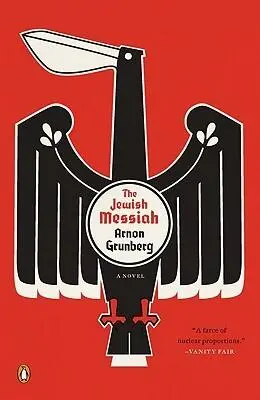
- Название:The Jewish Messiah
- Автор:
- Издательство:Penguin Group US
- Жанр:
- Год:2008
- ISBN:нет данных
- Рейтинг книги:4 / 5. Голосов: 1
-
Избранное:Добавить в избранное
- Отзывы:
-
Ваша оценка:
The Jewish Messiah: краткое содержание, описание и аннотация
Предлагаем к чтению аннотацию, описание, краткое содержание или предисловие (зависит от того, что написал сам автор книги «The Jewish Messiah»). Если вы не нашли необходимую информацию о книге — напишите в комментариях, мы постараемся отыскать её.
) Arnon Grunberg is one of the most subtly outrageous provocateurs in world literature.
, which chronicles the evolution of one Xavier Radek from malcontent grandson of a former SS officer, to Jewish convert, to co- translator of Hitler's
into Yiddish, to Israeli politician and Israel's most unlikely prime minister, is his most outrageous work yet. Taking on the most well-guarded pieties and taboos of our age,
is both a great love story and a grotesque farce that forces a profound reckoning with the limits of human guilt, cruelty, and suffering. It is without question Arnon Grunberg's masterpiece.
The Jewish Messiah — читать онлайн бесплатно полную книгу (весь текст) целиком
Ниже представлен текст книги, разбитый по страницам. Система сохранения места последней прочитанной страницы, позволяет с удобством читать онлайн бесплатно книгу «The Jewish Messiah», без необходимости каждый раз заново искать на чём Вы остановились. Поставьте закладку, и сможете в любой момент перейти на страницу, на которой закончили чтение.
Интервал:
Закладка:
The boys drove her into one corner of the schoolyard, shouting at her quotes from Kierkegaard that she could only partly understand, because she was numbed with fear. She was wearing a blue skirt and suspenders.
At last the boys succeeded in driving her into a corner of the schoolyard where the teachers couldn’t see them, not even if they looked out the window.
They took her book bag away from her. They examined the books quickly and wistfully. How well they remembered having bought and read these same books themselves. Time flew, the school was a sausage factory, the office was a sausage factory, the family was a sausage factory. Hospitals were sausage factories. Train stations, airports — there one encountered sausages in transit.
After they had flipped through the books and put them back neatly in the bright pink bag, they looked in her pencil case. There wasn’t much in it — three pens, a pencil, an eraser, a protractor, a calculator.
“Kierkegaard is our hero,” the tall boy said, holding her pencil case in his hand. The case had a picture of Snoopy on it. It had been a gift back in primary school, but she still used it. She liked Snoopy.
“We read him and reread him,” the tall boy said. “We’ll keep reading him till we’re dead. Kierkegaard. Who’s your hero?”
Because the girl was mad with fear, she couldn’t answer them at first, but the boys insisted. “Tell us,” they said, “you can tell us. We can keep a secret.” After a little while she succeeded in whispering, “Papa and Mama.”
Her father was a friendly rabbi who did a bit of matchmaking in his free time. Her mother had given birth to thirteen children.
The boys were disappointed with her answer. It made them sad.
“These are the days of superficiality,” the tall boy said, after consulting with his friends in a whisper. “We live in the age of sausage. The difference between life and death has been reduced to a minimum. The dead seem alive, the living seem dead. And the people seem like sausages. This is supposed to be the best school in Basel.” He pointed to the old, slightly dilapidated building. “At this school we became acquainted with Kierkegaard; others became acquainted with Kleist, and others with Plato. And with whom have you become acquainted? Your papa and mama. That hurts us to the quick. We look at you and we see that your papa and mama are of no consequence, we see that your papa and mama are ugly people. We look at you and we see a culture in decay.”
His friends chimed in. The boy who wore his father’s raincoat went up and stood right in front of the girl. “Those who look at you,” he said solemnly, “see the end of days.”
The tall boy took the calculator out of her case. It was a simple machine, Texas Instruments. It had been passed down to Danica by Awromele.
“What is this?” the tall boy asked.
A sound came from Danica’s mouth, but it was unintelligible.
“What is this?” the tall boy asked again. “What am I holding in my hand?”
Danica was frightened, but still able to say “calculator.”
“Precisely. Very good. A calculator.” He pronounced the word emphatically, as though speaking to a deaf person. “This calculator is no good to us. It won’t help us, it won’t help you. Technology that falls into the hands of the incompetent leads to catastrophes, catastrophes lead to death, one death leads to another; death is everywhere, can’t you smell it?” He took a deep breath, stepped forward, pressed his nose against hers, and asked: “Don’t you have a nose? Are you the sausage that can only smell ketchup?”
Danica shook her head with conviction. “I can smell it,” she said quietly. “I smell death.”
“She can smell it!” the tall boy said mockingly. He looked around at his friends and said again, “She can smell it.” Then he mumbled, to no one in particular, “This is how our culture dies.” As though he were a magician who had to mumble a bit of hocus-pocus before completing his trick — because the audience expected it.
He put the calculator down carefully on the ground and looked lovingly at the girl with the braces. He was so moved by his own words that he truly believed that, when looking at this child, you could see a culture going down the tubes.
“Your heroes are your papa and your mama,” he said. “My God. Jesus Christ.”
He slammed his heel down on her calculator.
It was quiet in the schoolyard; you could hear the wind blowing through the trees, the sound of a few cars in the distance. You could hear how the calculator shattered.
Then the girl could no longer contain her tears. The four boys looked at her and her tears and were moved.
She saw her pencil case dangling from the tall boy’s hand. She had to stop crying now. That would only make things worse. That’s what her mother had always said: the weak scream and weep.
“There’s so much sorrow in an individual,” the tall boy said. “It’s inexhaustible.” He put his hand on the girl’s shoulder, and the touch startled her so badly that she took a step back.
“Listen, little girl,” he said. “Don’t be frightened. Kierkegaard once said, The door to happiness opens out. There is nothing to be done about it. But you are trying to open the door to happiness from the outside. It doesn’t work that way. That makes us sad, that causes us pain.”
His friends nodded. They loved Kierkegaard; without him they would be nothing.
“We are on the other side of the door,” the tall boy said. “And that door keeps hitting us in the face. Because you keep trying to get through.”
The tears that were running down her cheeks gave the tall boy goose pimples. He was sentimental by nature, especially in the morning.
“We’re going to put you to the test,” he said. “Because we want only the best for you, we are going to test you, and if you pass that test you will enjoy our protection for the rest of your life.”
STILL UNDER SEDATION, Xavier was carried into the hospital. A nurse recognized him right away. “It’s that boy,” she told the doctor. “You know, the one who was manhandled so terribly.”
The doctor nodded and subjected Xavier to a quick examination.
In another room, a doctor and two assistants were working on Awromele. He was suffering from hypothermia and dehydration, to say nothing of his broken hand, the many wounds on his body, and the ear that had been kicked. That ear in particular worried the doctors. They had already seen the X-rays of his broken hand; they had put it in a cast.
The nurse began disinfecting Xavier’s cuts. A sense of pride came over her, pride in the fact that this boy, who was rather famous in Basel, and certainly in medical circles, was now dependent on her care. That she was now tending to his wounds, yes, that made her feel good. This was why she had become a nurse.
“Look,” she said to the doctor, “I think he’s waking up.” Xavier’s eyelids trembled. He opened his eyes, only to close them again a few seconds later.
The doctor wasn’t paying much attention to her; he had the stethoscope in his hand and wanted to listen to Xavier’s heart.
“Maybe we should call his parents,” the nurse said. “His mother — I saw her here a few times, if I remember correctly.”
The doctor shook his head impatiently. Xavier’s eyes were open wide now, and he was asking for Awromele. When no response came, he said again, a little louder this time: “Awromele, where’s Awromele? Where’s my wheelbarrow?”
He tried to sit up, but the nurse pushed him down gently and the doctor took a step back in irritation. He couldn’t work like this. Patients had to lie still — lie still and don’t get up — that was the crux of the matter. That was the mother of all recovery.
Читать дальшеИнтервал:
Закладка:
Похожие книги на «The Jewish Messiah»
Представляем Вашему вниманию похожие книги на «The Jewish Messiah» списком для выбора. Мы отобрали схожую по названию и смыслу литературу в надежде предоставить читателям больше вариантов отыскать новые, интересные, ещё непрочитанные произведения.









Обсуждение, отзывы о книге «The Jewish Messiah» и просто собственные мнения читателей. Оставьте ваши комментарии, напишите, что Вы думаете о произведении, его смысле или главных героях. Укажите что конкретно понравилось, а что нет, и почему Вы так считаете.