Arnon Grunberg - The Jewish Messiah
Здесь есть возможность читать онлайн «Arnon Grunberg - The Jewish Messiah» весь текст электронной книги совершенно бесплатно (целиком полную версию без сокращений). В некоторых случаях можно слушать аудио, скачать через торрент в формате fb2 и присутствует краткое содержание. Год выпуска: 2008, Издательство: Penguin Group US, Жанр: Современная проза, на английском языке. Описание произведения, (предисловие) а так же отзывы посетителей доступны на портале библиотеки ЛибКат.
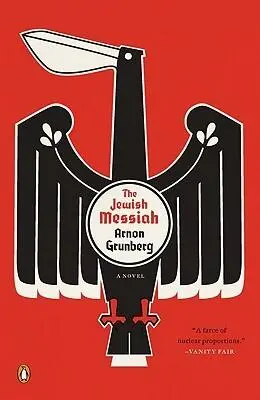
- Название:The Jewish Messiah
- Автор:
- Издательство:Penguin Group US
- Жанр:
- Год:2008
- ISBN:нет данных
- Рейтинг книги:4 / 5. Голосов: 1
-
Избранное:Добавить в избранное
- Отзывы:
-
Ваша оценка:
The Jewish Messiah: краткое содержание, описание и аннотация
Предлагаем к чтению аннотацию, описание, краткое содержание или предисловие (зависит от того, что написал сам автор книги «The Jewish Messiah»). Если вы не нашли необходимую информацию о книге — напишите в комментариях, мы постараемся отыскать её.
) Arnon Grunberg is one of the most subtly outrageous provocateurs in world literature.
, which chronicles the evolution of one Xavier Radek from malcontent grandson of a former SS officer, to Jewish convert, to co- translator of Hitler's
into Yiddish, to Israeli politician and Israel's most unlikely prime minister, is his most outrageous work yet. Taking on the most well-guarded pieties and taboos of our age,
is both a great love story and a grotesque farce that forces a profound reckoning with the limits of human guilt, cruelty, and suffering. It is without question Arnon Grunberg's masterpiece.
The Jewish Messiah — читать онлайн бесплатно полную книгу (весь текст) целиком
Ниже представлен текст книги, разбитый по страницам. Система сохранения места последней прочитанной страницы, позволяет с удобством читать онлайн бесплатно книгу «The Jewish Messiah», без необходимости каждый раз заново искать на чём Вы остановились. Поставьте закладку, и сможете в любой момент перейти на страницу, на которой закончили чтение.
Интервал:
Закладка:
Xavier heard the sound of hoofbeats. Not far from the park was a riding school. He seized the handles of the wheelbarrow and turned in his thoughts to King David. The wheelbarrow was so heavy now that Xavier had to put it down and rest every three steps. Slowly, he succeeded in leaving behind the sacred place, the bare spot beneath the pine tree. The spot where he had taken Awromele’s penis in his mouth, where he had been given a black eye, where he had listened to his friend’s bloodcurdling screams, and where he had come to the conclusion that without Awromele his life would end.
AWROMELE’S MOTHER FIXED breakfast for her remaining twelve children, and said quietly to her husband, “It’s our fault, Asher; we should have taken better care of him.”
“What do you mean?” the rabbi said. “Take better care of him? Who should have taken better care of him? Me? I don’t have time. How can we hope to protect ourselves against the anti-Semite? The anti-Semite is strong, and we are weak. The anti-Semite is big, we are little; the anti-Semite is everywhere, we are nowhere. What were we supposed to do? We can’t lock up our children, we can’t turn their bedrooms into prisons, can we?” He had spent a sleepless night and was even grouchier than usual, early in the morning.
“Dirty Jews,” his wife said, sprinkling cornflakes in the children’s bowls.
“What did you say?”
“Dirty Jews.”
“Who?”
“All of you,” the rabbi’s wife said.
“What do you mean? What are you trying to say?”
“What have these dirty Jews from the Committee of Vigilant Jews done for us? They sat here, drank our coffee, drank our vodka, emptied the cookie jar, and now they’re laughing at us behind our backs. Especially at you, because you’re autistic. And have they found my Awromele? Have they found even one hair of his head? Even one little shoelace? Maybe they didn’t even go looking for him. I wouldn’t put it past them, those dirty Jews.”
“Why do you keep saying ‘dirty Jews’?” The rabbi was wearing a wrinkled white shirt; his coat was still hanging over a chair in the living room.
“Because they’re dirty Jews, Asher. Dirty Jews they are, and dirty Jews they’ll remain.”
“Don’t talk like that. That’s the language of the anti-Semite.”
His wife put the box of cornflakes down on the counter, picked up a pack of low-fat milk, and upended it into the bowls, so that it splashed all over. “I’ll say ‘dirty Jews’ whenever I feel like it. I’m not going to let you tell me what to do anymore. What I’m allowed to say, what I’m not allowed to say. What kind of shopping I’m supposed to do, and when I’m supposed to do it. Cursed be the day I met you, cursed be the day the Almighty created the world, cursed be the dirty Jews, cursed be me for being a dirty Jewess, cursed and cursed again.”
And then the rabbi’s wife picked up a dishcloth, smacked it on the counter a few times, and cried out: “I want my Awromele back. Oh God, I want my Awromele back, give me back my Awromele!”
She put the bowls of cornflakes on a tray and took it to the living room, where most of her children were already waiting at the table. Some of them were still in their pajamas, others were already dressed. “Eat,” she shouted, “eat. And don’t let everything fall on the floor the way you always do.” She went back to the kitchen, where the rabbi was still standing speechless. His wife had never called him a dirty Jew before. “You,” she said, “you. Go do something. Go look for Awromele. Get out of the house. Cheating on your wife with her sister, you’re man enough for that, and if my sister had been prettier than me I could have forgiven you, but she wasn’t, she was ugly as sin. And she had a bad personality, too, no personality at all, she was as fickle as the wind, she was always like that. God rest her soul, but I don’t know what you saw in her; I don’t know, and I don’t want to know, either. And now you’re getting out of the house, now you’re finally going to go do something, go look for your firstborn, because I want my Awromele back.”
She pushed him out of the kitchen, grabbed his overcoat, threw it over his shoulders, and pulled him towards the door.
There he put up a little resistance, but it was more for show. He said, “Shouldn’t we wait to see what the Committee of Vigilant Jews has to report?”
“Stop it!” she shouted. “Enough already with those dirty Jews. Go find your child.”
Then she pushed her husband out the door and bolted it.
The rabbi stood on the pavement. His wife went back to the living room, where the children were spooning loudly at their cornflakes.
Rochele said: “Mama, mama. Now I know. The Messiah is a pelican.”
The rabbi’s wife couldn’t take it anymore; years of grief came rushing out. She hit Rochele over the head with the box of cornflakes, so hard that the box tore and the cornflakes rained down on Rochele’s head. “Stop it,” she shouted. “A pelican. Knock it off. I don’t want to hear any more about it. Dirty Jews. A pelican! Shut your mouth and eat.”
“Don’t call us dirty Jews, Mama,” said Jehoedele, one of Awromele’s brothers, stirring his cornflakes listlessly. “We’re not dirty Jews. That’s anti-Semitic.”
“Mama,” said the girl with the braces — Danica was her name. “Jehoedele’s right. You shouldn’t call us that. That’s really nasty.” Danica wasn’t pretty, but she was intelligent. That was why she didn’t go to Hebrew school: she was allowed to go to the Gymnasium.
“But you’re all a bunch of dirty Jews anyway!” the mother shouted. “Just like your father. And I’m the one who decides what’s anti-Semitic around here. You don’t have any say in the matter, so shut up and eat. I don’t want to hear another sound — it’s too much for me this morning.”
Then she went into the kitchen and sank down in a chair. She closed her eyes and began to pray.
The rabbi wandered the streets of Basel. He didn’t feel too great; he’d been wearing the same clothes for the last twenty-four hours. And he didn’t get a lot of searching done. Every once in a while he looked in a doorway, but he didn’t see Awromele anywhere.
XAVIER HAD ROLLED the wheelbarrow onto a path. They were still in the park, but at least it was a path. He checked Awromele’s pulse and thought he detected a little movement there. That gave him hope. “Here we go,” he said.
More people were out now, not only dogs with their masters but also joggers wearing headphones. A couple of commuters were cutting through the park. They looked strangely at Xavier but didn’t stop cutting through the park, not even when he waved his arms.
“They’re afraid of us,” Xavier said, leaning over the wheelbarrow. “But soon we’ll get to the doctor, and then we’ll take a shower. I know it’s not very comfortable for you, dearest, but I can’t carry you.” He took three steps and had to put the wheelbarrow down again.
A young woman in a pink jogging suit came running up. Xavier shouted, “Can you help us for a minute?”
The young woman in the pink jogging suit started running even faster. Ever since she was a girl, she’d been hearing stories about rapists who pretended to be people in trouble.
Xavier looked into the wheelbarrow as though it were a baby carriage and said, “We’re almost at the doctor’s, Awromele, hang in there.” The jacket of his jogging suit, which he had first draped across Awromele like a blanket, he now rolled up and tucked behind Awromele’s head.
The strollers were moving past quickly. The day was becoming brighter, and the more the people saw, the faster they walked.
A woman in her fifties with a spaniel was the only one who seemed intrigued by the sight of a half-naked boy pushing a wheelbarrow. She didn’t pick up the pace, she didn’t turn and hurry away — she stopped to look. Then she slowly walked up to Xavier.
Читать дальшеИнтервал:
Закладка:
Похожие книги на «The Jewish Messiah»
Представляем Вашему вниманию похожие книги на «The Jewish Messiah» списком для выбора. Мы отобрали схожую по названию и смыслу литературу в надежде предоставить читателям больше вариантов отыскать новые, интересные, ещё непрочитанные произведения.





Обсуждение, отзывы о книге «The Jewish Messiah» и просто собственные мнения читателей. Оставьте ваши комментарии, напишите, что Вы думаете о произведении, его смысле или главных героях. Укажите что конкретно понравилось, а что нет, и почему Вы так считаете.