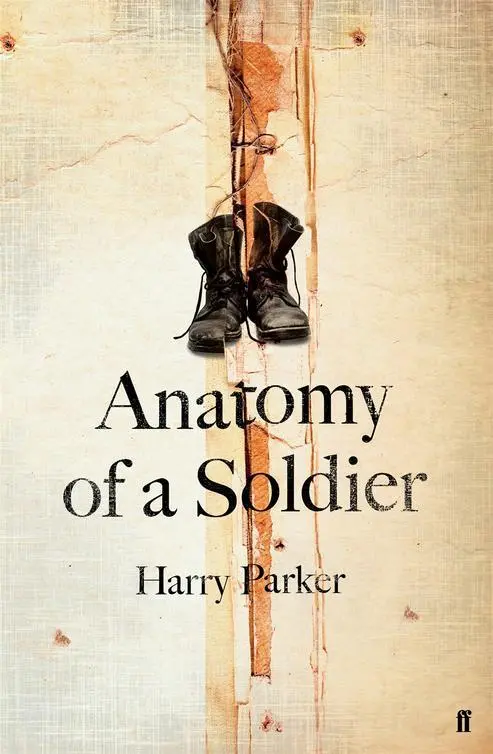
Harry Parker - Anatomy of a Soldier
Здесь есть возможность читать онлайн «Harry Parker - Anatomy of a Soldier» весь текст электронной книги совершенно бесплатно (целиком полную версию без сокращений). В некоторых случаях можно слушать аудио, скачать через торрент в формате fb2 и присутствует краткое содержание. Год выпуска: 2016, ISBN: 2016, Издательство: Faber & Faber, Жанр: Современная проза, на английском языке. Описание произведения, (предисловие) а так же отзывы посетителей доступны на портале библиотеки ЛибКат.
- Название:Anatomy of a Soldier
- Автор:
- Издательство:Faber & Faber
- Жанр:
- Год:2016
- ISBN:9780571325849
- Рейтинг книги:5 / 5. Голосов: 1
-
Избранное:Добавить в избранное
- Отзывы:
-
Ваша оценка:
Anatomy of a Soldier: краткое содержание, описание и аннотация
Предлагаем к чтению аннотацию, описание, краткое содержание или предисловие (зависит от того, что написал сам автор книги «Anatomy of a Soldier»). Если вы не нашли необходимую информацию о книге — напишите в комментариях, мы постараемся отыскать её.
We see them not as they see themselves, but as all the objects surrounding them do: shoes and boots, a helmet, a trove of dollars, a drone, that bike, weaponry, a bag of fertilizer, a medal, a beer glass, a snowflake, dog tags, an exploding IED and the medical implements that are subsequently employed.
Anatomy of a Soldier is a moving, enlightening and fiercely dramatic novel about one man's journey of survival and the experiences of those around him. Forty-five objects, one unforgettable story.
'This is a brilliant book, direct from the battle zone, where all the paraphernalia of slaughter is deployed to tell its particular and savage story.' Edna O'Brien
'A tour de force. In this brilliant and beguiling novel Harry Parker sees the hidden forces that act on the bodies and souls of combatants and non-combatants. . It feels like war through the looking glass but it is utterly real.' Nadeem Aslam
Anatomy of a Soldier — читать онлайн бесплатно полную книгу (весь текст) целиком
Ниже представлен текст книги, разбитый по страницам. Система сохранения места последней прочитанной страницы, позволяет с удобством читать онлайн бесплатно книгу «Anatomy of a Soldier», без необходимости каждый раз заново искать на чём Вы остановились. Поставьте закладку, и сможете в любой момент перейти на страницу, на которой закончили чтение.
Интервал:
Закладка:
*
They walked back to the patrol base that was marked near my centre in blue. He used a metal detector to lead them over a bridge and then they cut across a field. He looked at me once more to report his location but soon he could see the camp and didn’t need me any more.
When one of his men said he’d seen movement behind us, BA5799 commanded a team to go static and protect the rest of the platoon. He stayed with them, focusing on a motorbike in the distance before we collapsed back to safety.
When they were all back in the camp, BA5799 removed his helmet and sighed. He was hot and thirsty and went to get some water, where he met a man who asked him how it had gone. He took me out and described the patrol, hovering a pen over my grid lines, and talked about the suspicious young man, the atmospherics in the market, and how they’d been followed by a motorbike as they returned.
And then the camp was attacked.
‘Deep joy,’ BA5799 said, put me away in my pouch and jogged for cover.
24
My warps were strung vertically on a loom. Three women worked on me. They hooked out my upright threads and knotted dyed wool to them, cutting away the loose ends with a flick of a knife. They threaded weft horizontally to hold me together and banged me down with a heavy comb to compact my knots. I slowly grew up from the ground.
Sometimes the women talked but for most of the day they were silent. They checked a design on the wall, matching red, orange, ivory and deep blue to its tiny squares and knotting the colours into me.
My deep crimson pattern of encircling leaves and stepped diagonals piled up until, on the forty-second day, I was finished.
My fringe was cut from the loom and the women were paid. I was taken across the road, placed in a drum and spun so wooden battens beat me and settled my pile. I was dragged out and men pulled me flat and I was shorn with electric clippers that cut my threads short and sharpened my pattern. A hand checked the smoothness of my soft surface and two boys laid me out on the floor, soaked me and pushed brooms across me. Soap foamed through me and my colours shone.
I was hung and dried. Two weeks later I was folded, covered in plastic and stacked with others on the back of a truck. I was driven from the village and into the green valleys, through mountains along a road that clung to the rock and weaved a course down the steep spurs and finally onto flat plains. The truck stopped in a city that night and the driver sat with others by a fire and drank. And then we drove on west across a desert, past villages and camel trains, burnt tanks rusted and scrawled with graffiti and convoys of white lorries.
The road became congested and the traffic shimmered around us as we crept forward. In a town crowds thronged around administrative buildings and queued in lines that blocked the street. Some had purple dye on their right index fingers and were excited.
We then arrived in a large city, where I was unloaded into a warehouse and waited.
*
Weeks later, a man pulled me from the stack and I flopped on the concrete floor, spiralling dust up into the air. He pulled out others and threw them down next to me. Another man knelt down and ran the flat of his hand over me. He studied the others and then he chose me. They discussed whether payment should be made in the new currency or dollars.
I was folded and taken out by one of the men. He put me on a cart with rubber tyres and a pony pulled us out of the city into the fields. We stopped by a high, long compound wall that shadowed the road. The driver stepped down from the cart and knocked on a tall, black gate. Kushan Hhan opened the door and greeted him and came out onto the road to look at me. He was pleased and put his arm around the man in thanks.
He called over two boys who were out in the field, running as fast as they could, trying to make a kite fly, and laughing.
‘Faridun, this is Noor Hhan,’ Kushan Hhan said, introducing the driver. ‘We are working together on a new venture.’ He put an arm on the boy’s shoulder and pointed at me. ‘Look what he has given me.’
‘It is wonderful, Father,’ Faridun said.
‘It is from the north,’ the driver said. ‘It is a very fine carpet.’
‘My father says the best carpets are from there,’ the other boy said.
‘It is a generous gift,’ Kushan Hhan said. ‘Now, Faridun, can you and Latif take it into the house, please? I need to speak with Noor Hhan.’
‘He is a handsome boy, Kushan,’ the driver said as the boys lifted me up.
‘He should be working, not playing with his friends. He’s nearly a man.’
They watched the boys take me through the gate into a courtyard. It was an oasis of green and colourful flowers, many the same red as me. Water trickled down a channel and clear white stone paths cut between pergolas and wooden frames of lush vines. Tulips and herbs scented the cool air. The boys stepped up onto a veranda and into a clean painted room and put me down on the floor.
‘Where do you think?’ Latif said, pulling me along by a corner. ‘Here?’
‘I’m not sure,’ Faridun said. ‘Mother will know where to put it.’ He had his hands on his hips and looked down at me. There were two other carpets in the room around a small gas stove and a few bowls. To one side was a low table and cushions. ‘Shall we fly the kite again? We could use my new bike to get more speed.’
‘I want to try first.’
‘It was my idea and it is my bike,’ Faridun said and ran out.
*
The family had meals together, sprawled on me and the cushions around the room. Some of them slept on me and they all walked on me. The children learnt to crawl and took their first steps across me. Sometimes the family celebrated and the men danced to music, their bare feet jumping up and down on me as they leapt in a circle and clapped.
I stayed in that room and every few months I was taken into the garden, held up while the dust was thumped from me and then returned to the endless pattern of daily existence as the family revolved around the house. Rains came and the garden cycled through the seasons outside.
A few times a year, men gathered around me to discuss the land and irrigation and what crops to grow, to argue about the government and the governor. Kushan Hhan led the debates. He sat on me and tea was brought out for his guests as they talked.
One summer, gunfire and explosions sounded in the distance. When the men now met they talked about the arrival of the foreign soldiers and their helicopters. They argued over the sale of a compound at the edge of the village where they had erected new watchtowers and walls. Their voices deepened as they discussed the shadow of the old government and the men who came from the mountains to fight the soldiers.
The family noticed the changes too. Whenever gunfire could be heard crackling in the distance they hid in the corner of the room. But this soon became normal: now they listened to work out how far away the danger was and often continued what they were doing.
Kushan Hhan’s meetings grew strained and he worked hard to lead the men through the suddenly painful discussions. The fair division of water into the ditches of their fields was no longer the most important subject. Now the balance of power across the land had split them. Many blamed the foreigners and told Kushan Hhan that everything had been fine before they came, so why were they here? And what of the constant explosions?
Kushan Hhan urged them to stay calm about this foreign presence: it was for the good of the country. But some said that a good country would do nothing and that the fighting was ruining them, scorching their fields and stopping trade. He told them that the foreign soldiers needed time to bring peace.
Читать дальшеИнтервал:
Закладка:
Похожие книги на «Anatomy of a Soldier»
Представляем Вашему вниманию похожие книги на «Anatomy of a Soldier» списком для выбора. Мы отобрали схожую по названию и смыслу литературу в надежде предоставить читателям больше вариантов отыскать новые, интересные, ещё непрочитанные произведения.










Обсуждение, отзывы о книге «Anatomy of a Soldier» и просто собственные мнения читателей. Оставьте ваши комментарии, напишите, что Вы думаете о произведении, его смысле или главных героях. Укажите что конкретно понравилось, а что нет, и почему Вы так считаете.