Nikos Kazantzakis - Zorba The Greek
Здесь есть возможность читать онлайн «Nikos Kazantzakis - Zorba The Greek» весь текст электронной книги совершенно бесплатно (целиком полную версию без сокращений). В некоторых случаях можно слушать аудио, скачать через торрент в формате fb2 и присутствует краткое содержание. Жанр: Современная проза, на английском языке. Описание произведения, (предисловие) а так же отзывы посетителей доступны на портале библиотеки ЛибКат.
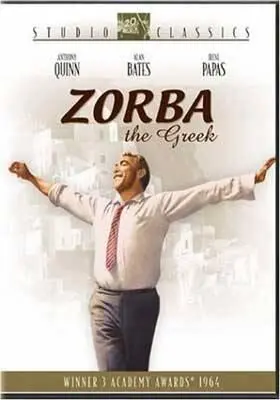
- Название:Zorba The Greek
- Автор:
- Жанр:
- Год:неизвестен
- ISBN:нет данных
- Рейтинг книги:3 / 5. Голосов: 1
-
Избранное:Добавить в избранное
- Отзывы:
-
Ваша оценка:
Zorba The Greek: краткое содержание, описание и аннотация
Предлагаем к чтению аннотацию, описание, краткое содержание или предисловие (зависит от того, что написал сам автор книги «Zorba The Greek»). Если вы не нашли необходимую информацию о книге — напишите в комментариях, мы постараемся отыскать её.
Zorba The Greek — читать онлайн бесплатно полную книгу (весь текст) целиком
Ниже представлен текст книги, разбитый по страницам. Система сохранения места последней прочитанной страницы, позволяет с удобством читать онлайн бесплатно книгу «Zorba The Greek», без необходимости каждый раз заново искать на чём Вы остановились. Поставьте закладку, и сможете в любой момент перейти на страницу, на которой закончили чтение.
Интервал:
Закладка:
We hurried through the village. The moonlight was disturbing. Imagíne how ít would be if you had been drinking and came out for a walk and found the world suddenly transformed. The roads had turned into rivers of milk, the holes in the road and the ruts overflowed with chalk, the hills were covered with snow. Your hands, face and neck were phosphorescent, like a glowworm's tail. And the moon hung on your chest like an exotic round medal.
We were walkíng along briskly, in silence. Intoxicated by the moonlight as well as by the wine, we hardly felt our feet touch the ground. Behind us, in the sleeping village, the dogs had got up on the roofs and were howling at the moon. And we, for no reason at all, also felt a desire to stretch our necks towards the moon and begin to howl…
We came to the widow's garden. Zorba stopped. Wine, good food and the moon had turned his head. He craned his neck and, in his big ass's voice, began to bray a bawdy couplet which, in his excited state, he composed on the spur of the moment.
"She's another of the devil's horns!" he said. "Let's go, boss!"
Dawn was about to break when we arrived at the hut. I threw myself on my bed, worn out. Zorba washed, lit the stove and made some coffee. He crouched on the floor by the door, lit a cigarette and began to smoke placidly, his body straight and motionless as he looked out at the sea. His face was grave and thoughtful. He reminded me of a Japanese painting I like: an ascetic sitting on his crossed legs and wrapped in a long orange-colored robe; his face shining like a carving in hard wood, blackened by the rain; his neck erect, smiling as he gazes, without fear, into the dark night…
I looked at Zorba in the light of the moon and admired the jauntiness and simplicity with which he adapted himself to the world around him, the way his body and soul formed one harmonious whole, and all things-women, bread, water, meat, sleep-blended happily with his flesh and became Zorba. I had never seen such a friendly accord between a man and the universe.
The moon would soon be setting now. It was round and of a pale green. An indescribable peacefulness spread across the sea.
Zorba threw away his cigarette and reached out for a basket. He fumbled in it and pulled out some string, pulleys and little pieces of wood; he lit the oil-lamp and once more started to experiment with his overhead railway. Stooping over his primitive toy, he began to make calculations which must have been extremely complicated and difficult, for every other second he scratched his head furiously and swore.
Suddenly he had had enough of it. He aimed one kick at the model and it crashed to the ground.
12
SLEEP OVERCAME ME, and when I awoke Zorba had gone. It was cold and I did not have the slightest desire to rise. I reached up to some bookshelves above my head and took down a book which I had brought with me and of which I was fond: the poems of Mallarmé. I read slowly and at random. I closed the book, opened it again, and finally threw it down. For the first time in my life it all seemed bloodless, odorless, void of any human substance. Pale-blue, hollow words in a vacuum. Perfectly clear distilled water without any bacteria, but also without any nutritive substances. Without life.
In religions which have lost their creative spark, the gods eventually become no more than poetic motifs or ornaments for decorating human solitude and walls. Something similar had happened to this poetry. The ardent aspirations of the heart, laden with earth and seed, had become a flawless intellectual game, a clever, aerial and intricate architecture.
I reopened the book and began reading again. Why had these poems gripped me for so many years? Pure poetry! Life had turned into a lucid, transparent game, unencumbered by even a single drop of blood. The human element is brutish, uncouth, impure-it is composed of love, the flesh and a cry of distress. Let it be sublimated into an abstract ídea, and, in the crucible of the spirit, by various processes of alchemy, let it be rarefied and evaporate.
All these things which had formerly so fascinated me appeared this morning to be no more than cerebral acrobatics and refined charlatanism! That is how it always is at the decline of a civilization. That is how man's anguish ends-in masterly conjuring tricks: pure poetry, pure music, pure thought. The last man-who has freed himself from all belief, from all illusions and has nothing more to expect or to fear-sees the clay of which he is made reduced to spirit, and this spirit has no soil left for its roots, from which to draw its sap. The last man has emptied himself; no more seed, no more excrement, no more blood. Everything having turned into words, every set of words into musical jugglery, the last man goes even further: he sits in his utter solitude and decomposes the music into mute, mathematical equations.
I started. "Buddha is that last man!" I cried. That is his secret and terrible significance. Buddha is the "pure" soul which has emptied itself; in him is the void, he is the Void. "Empty your body, empty your spirit, empty your heart!" he cries. Wherever he sets his foot, water no longer flows, no grass can grow, no child be born.
I must mobilize words and their necromantic power, I thought, invoke magic rhythms; lay siege to him, cast a spell over him and drive him out of my entrails! I must throw over him the net of images, catch him and free myself!
Writing Buddha was, in fact, ceasing to be a literary exercise. It was a life-and-death struggle against a tremendous force of destruction lurking within me, a duel with a great NO which was consuming my heart, and on the result of this duel depended the salvation of my soul.
With briskness and determination I seized the manuscript. I had discovered my goal, I knew now where to strike! Buddha was the last man. We are only at the beginning; we have neither eaten, drunk, nor loved enough; we have not yet lived. This delicate old man, scant of breath, has come to us too soon. We must oust him as quickly as possible!
So I spoke to myself and I began to write. But no, this was not writing: it was a real war, a merciless hunt, a siege, a spell to bring the monster out of its hiding place. Art is, in fact, a magic incantation. Obscure homicidal forces lurk in our entrails, deadly impulses to kill, destroy, hate, dishonor. Then art appears with its sweet piping and delivers us.
I wrote, pursued, struggled the whole day through. In the evening I was exhausted. But I felt I had made progress, had mastered a few advance posts of the enemy. I was now anxious for Zorba to return, so that I could eat, sleep and build up my strength to resume the fight at dawn.
It was already dark when Zorba came in. He had a radiant expression on his face. He has found the answer to something, too, I thought. And I waited.
I had begun to grow impatient with him and, only a few days before, I had said angrily:
"Zorba, our funds are getting low. Whatever has to be done, do it quickly! Let's get this railway going; if we're not successful with the coal, let's go all out for the timber. Otherwise we've had it!"
Zorba had scratched his head.
"Funds getting low, are they, boss? That's bad!" he said.
"They're gone, Zorba. We've swallowed up the lot. Do something! How are your experiments going? No luck yet?"
Zorba had hung his head and made no reply. He had felt ashamed that evening. "That damned slope!" he said furiously. "I'll get the better of it yet!" And now he had come in, his face lit up with success.
"I've done it, boss!" he shouted. "I've found the right angle! It was slipping through my hands, trying to get away from me, but I held on and pinned it down, boss!"
"Well, hurry up and get the thing working! Fire away, Zorba! What else do you need?"
Читать дальшеИнтервал:
Закладка:
Похожие книги на «Zorba The Greek»
Представляем Вашему вниманию похожие книги на «Zorba The Greek» списком для выбора. Мы отобрали схожую по названию и смыслу литературу в надежде предоставить читателям больше вариантов отыскать новые, интересные, ещё непрочитанные произведения.





Обсуждение, отзывы о книге «Zorba The Greek» и просто собственные мнения читателей. Оставьте ваши комментарии, напишите, что Вы думаете о произведении, его смысле или главных героях. Укажите что конкретно понравилось, а что нет, и почему Вы так считаете.