A. AHomes - The Mistress's Daughter
Здесь есть возможность читать онлайн «A. AHomes - The Mistress's Daughter» весь текст электронной книги совершенно бесплатно (целиком полную версию без сокращений). В некоторых случаях можно слушать аудио, скачать через торрент в формате fb2 и присутствует краткое содержание. Год выпуска: 2007, Издательство: Viking Adult, Жанр: Современная проза, Биографии и Мемуары, на английском языке. Описание произведения, (предисловие) а так же отзывы посетителей доступны на портале библиотеки ЛибКат.
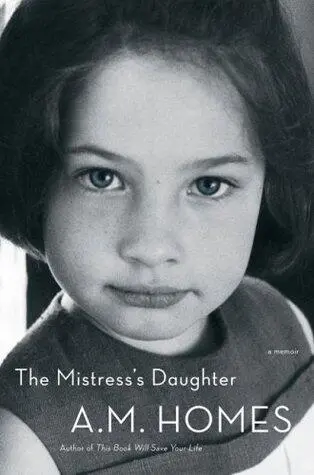
- Название:The Mistress's Daughter
- Автор:
- Издательство:Viking Adult
- Жанр:
- Год:2007
- ISBN:нет данных
- Рейтинг книги:5 / 5. Голосов: 1
-
Избранное:Добавить в избранное
- Отзывы:
-
Ваша оценка:
The Mistress's Daughter: краткое содержание, описание и аннотация
Предлагаем к чтению аннотацию, описание, краткое содержание или предисловие (зависит от того, что написал сам автор книги «The Mistress's Daughter»). Если вы не нашли необходимую информацию о книге — напишите в комментариях, мы постараемся отыскать её.
Before A.M. Homes was born, she was put up for adoption. Her birth mother was a twenty-two- year-old single woman who was having an affair with a much older married man with children of his own.
is the story of what happened when, thirty years later, her birth parents came looking for her.
Homes, renowned for the psychological accuracy and emotional intensity of her storytelling, tells how her birth parents initially made contact with her and what happened afterward (her mother stalked her and appeared unannounced at a reading) and what she was able to reconstruct about the story of their lives and their families. Her birth mother, a complex and lonely woman, never married or had another child, and died of kidney failure in 1998; her birth father, who initially made overtures about inviting her into his family, never did.
Then the story jumps forward several years to when Homes opens the boxes of her mother's memorabilia. She had hoped to find her mother in those boxes, to know her secrets, but no relief came. She became increasingly obsessed with finding out as much as she could about all four parents and their families, hiring researchers and spending hours poring through newspaper morgues, municipal archives and genealogical Web sites. This brave, daring, and funny book is a story about what it means to be adopted, but it is also about identity and how all of us define our sense of self and family.
The Mistress's Daughter — читать онлайн бесплатно полную книгу (весь текст) целиком
Ниже представлен текст книги, разбитый по страницам. Система сохранения места последней прочитанной страницы, позволяет с удобством читать онлайн бесплатно книгу «The Mistress's Daughter», без необходимости каждый раз заново искать на чём Вы остановились. Поставьте закладку, и сможете в любой момент перейти на страницу, на которой закончили чтение.
Интервал:
Закладка:
“How about ‘Fondly’ or ‘Sincerely’?” she asks.
“Yeah,” I say, “you’re good at this. ‘Fondly.’ That would be great.”
“Sincerely” sounds like a business letter. “Fondly” sounds slightly authoritarian, slightly condescending, like someone trying to be warm. Later someone tells me I could have said “Warmly,” but that too is flawed, like you’re intentionally holding back.
“Well,” the operator says, “it’s for a friend, right?”
And I think about it. I think about the difference in ordering flowers for a parent—“Happy Birthday, Mom.” That’s clean and clear, no confusion there. I think about ordering flowers for a loved one in glee, in passion, in slight regret.
“‘Fondly’ it is,” the operator says. “Hold for your total.”
It is more than I want to spend on a variety of levels. I hang up exhausted.
Over the summer, I am invited to meet Norman’s wife — like a date with the queen, only she is also the archetypical stepmother. Norman makes the arrangements. I will meet them at the Mayflower Hotel in downtown Washington — yet another hotel, this time one of the oldest, most historic, known as “Washington’s second-best address.”
I arrive early, again auditioning, always auditioning, for a role that is never clear. The hotel is crawling with Secret Service — men in blue suits and red ties talking into their lapels. The external tension, the twittery buzz, humming headsets and walkie-talkies adds a surreal edge — a peculiar psychological reality — to the situation. A bomb-sniffing dog is led past me and into the ladies’ room. Maybe she really is the queen?
Norman is in the lobby, arms open, welcoming me as if this were his own home. He tells me he’s sorry but his wife will be late — there was a problem with the daughter, something vaguely medical and disturbing. We exchange small talk about traffic and parking. She arrives, he goes to her, like her footman, her servant, her guilty suitor, an alley cat dragging in his bastard surprise. She is not what you would expect a queen to be — she is dowdy and dour, a short, middle-aged woman — and from the moment we say hello, it’s clear that this is just a formality, that she is not interested in anything about me. She has already made up her mind.
Norman leads us not into the restaurant but into the pub that is part of the bar. We sit at a small round table, too small for a table of strangers. Norman is between us. The waitress comes. His wife orders half a sandwich and it is clear that this will be brief, this is all that any of us are getting. We each order half a sandwich and Norman has a drink.
“You seem like an awfully nice person,” she says.
I nod. I am nothing if not totally polite and respectful despite what I might be feeling — which is in part fear, the need for her approval, her welcome, some stamp of acknowledgment.
“Norman would like to take you around and introduce you to people, but you know he can’t,” she says.
Because it will embarrass you, I am thinking — because you will have to admit what happened.
Norman is sitting between us — I am more of him than she. He says nothing.
Later he tells me, “You and my wife didn’t hit it off,” as though it is my responsibility.
Meanwhile I get letters from Norman’s eldest son, his namesake — someone I describe as Mr. Christian Adoption. He has two children from Korea and prides himself on being a good guy, doing the right thing, telling me stories about what a great guy his (our) father is, asking if I want to see pictures of the others — playing the rebel offering to slip me contraband.
This is the boy who used to go out with Norman and Ellen. He is the one witness to it all. He was ten when everything fell apart. He thinks we have something in common — the fact that we share our father’s secret — the one contradiction being that I don’t share the secret, I am the secret.
Norman arranges for the three of us to have lunch at the country club near my parents’ house — a club I have never been inside because my adoptive parents are so politically opposed to country clubs that the “CCC” on the flag flying outside might as well read “KKK.” No blacks, no Jews, no one “other” is welcome here.
This is the world Norman lives in — faded but presumed aristocracy. The fact is, Norman is not upper class, he is overextended. (Oddly both Norman and Ellen are obsessed with class and glamour — and talk about themselves in relation to, and as though they have something in common with, figures of the 1960s like Frank Sinatra and Jackie O.)
Norman Jr., the number one son, looks nothing like his (our) father. His hair is dark, coarse, and his complexion swarthy by comparison. We drink iced tea, eat salads of iceburg lettuce and waxy tomatoes, and talk about “my people.” At a certain point, I feel like a white female Martin Luther King Jr. I want to join hands and sing, “We Shall Overcome.”
By that fall of 1994, the second autumn since we met, Norman still hasn’t told his other children about me.
He calls. “It’s Norman. I thought I’d call ya and tell ya that I have some news. I think we’ve sold our house and I think we’re going to be moving to Florida. But I want to talk to you when you have a chance. Uh, it’ll be in the next week — so will you give me a call? Thank you, doll. Bye-bye.”
At least when he’s in Washington I know where he is. I return the call. Someone else answers, a boy, a man — maybe my brother or a nephew. “Can I help you?” he asks.
“I’ll call back.”
In 1994, I write to Norman to tell him how disappointed I am that he has not done what he promised. My life has been painful enough — I have worked too hard to get where I am in the world to now be kept a secret, to be something that anyone is embarrassed about.
Norman never mentions the letter to me. I hear about it in a letter from Norman Jr.: “Whoops, I almost forgot to answer your question about your letter….” He tells me that my letter was opened by mistake by Norman Sr.’s youngest son, prompting a family crisis. Norman Jr. goes on to say that it was fortunate the letter was opened, that he too was tired of the secrecy and what I said to our father was typical of what an adopted child would say to a biological father under these circumstances: “I would have written the same letter, only sooner.”
We all drift — estranged.
In the middle of the winter Ellen calls—“You’d better call your father. I don’t think he’s going to last.”
They now have more of a relationship with each other than they do with me, the intensity of their ongoing interest a testament to the power of the attraction.
I send Norman a note; I get no answer. I don’t know if he’s dead or alive.
Norman Jr. writes asking if it’s okay to come to a reading I’m giving in Washington. I call and tell him that I’m happy to make a plan to meet him for a drink or lunch but that I’d rather he not come to the reading. I never hear from him again.
After the millionth phone call I ask Ellen to stop calling. I am happy to exchange letters with her, but no more calls.
“What if I go to the doctor and he tells me I have twenty-four hours to live — should I call?” she asks.
“Wait twenty-five, then call,” I say, half joking.
The fact is that whatever each of them is in this for has nothing to do with me — it is not about my need, my desire, and for the moment I have had enough.
In December 1997, a week before my birthday, she sends a birthday card. It’s a putrid pale pink with roses, the color of femininity, of a box of sanitary napkins. I have now come to officially loathe my birthday, to live in fear of what it might bring.
Читать дальшеИнтервал:
Закладка:
Похожие книги на «The Mistress's Daughter»
Представляем Вашему вниманию похожие книги на «The Mistress's Daughter» списком для выбора. Мы отобрали схожую по названию и смыслу литературу в надежде предоставить читателям больше вариантов отыскать новые, интересные, ещё непрочитанные произведения.









Обсуждение, отзывы о книге «The Mistress's Daughter» и просто собственные мнения читателей. Оставьте ваши комментарии, напишите, что Вы думаете о произведении, его смысле или главных героях. Укажите что конкретно понравилось, а что нет, и почему Вы так считаете.