Pearl Buck - The Living Reed
Здесь есть возможность читать онлайн «Pearl Buck - The Living Reed» весь текст электронной книги совершенно бесплатно (целиком полную версию без сокращений). В некоторых случаях можно слушать аудио, скачать через торрент в формате fb2 и присутствует краткое содержание. Год выпуска: 2012, Издательство: Open Road Media, Жанр: Современная проза, на английском языке. Описание произведения, (предисловие) а так же отзывы посетителей доступны на портале библиотеки ЛибКат.
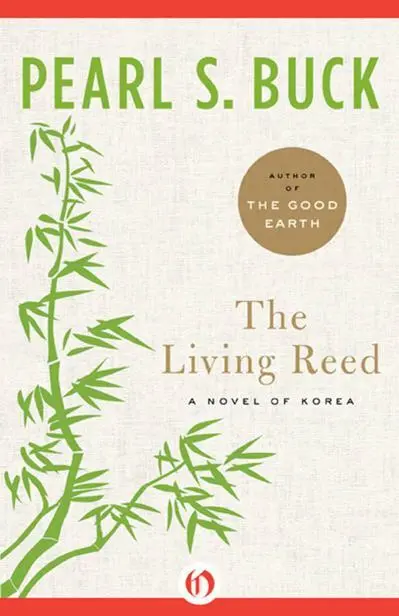
- Название:The Living Reed
- Автор:
- Издательство:Open Road Media
- Жанр:
- Год:2012
- ISBN:нет данных
- Рейтинг книги:4 / 5. Голосов: 1
-
Избранное:Добавить в избранное
- Отзывы:
-
Ваша оценка:
The Living Reed: краткое содержание, описание и аннотация
Предлагаем к чтению аннотацию, описание, краткое содержание или предисловие (зависит от того, что написал сам автор книги «The Living Reed»). Если вы не нашли необходимую информацию о книге — напишите в комментариях, мы постараемся отыскать её.
, Pearl S. Buck’s epic historical novel about four generations of one aristocratic family in Korea. Through the story of the Kims, Buck traces the country’s journey from the late nineteenth century through the end of the Second World War. The chronicle begins as the Kims live comfortably as advisors to the Korean royal family. That world is torn apart with the Japanese invasion, when the queen is killed and the Kims are thrust into hiding. Regarded by Buck as “the best among my Asian books,”
is a gripping account of a nation’s fight for survival, and a detailed portrait of one family’s entanglement in the ebb and flow of history.
The Living Reed — читать онлайн бесплатно полную книгу (весь текст) целиком
Ниже представлен текст книги, разбитый по страницам. Система сохранения места последней прочитанной страницы, позволяет с удобством читать онлайн бесплатно книгу «The Living Reed», без необходимости каждый раз заново искать на чём Вы остановились. Поставьте закладку, и сможете в любой момент перейти на страницу, на которой закончили чтение.
Интервал:
Закладка:
To his surprise the missionary had shown anger and he made retort.
“It is not at all the same. There is only one God and he is not Buddha. He is Jehovah.”
Yul-han had considered reply, for did it matter, if it was true that there was only one Being, whether his name was Buddha or Jehovah? But he was peaceable by nature and he kept question and answer to himself.
The missionary turned now to the people. The church was crowded and men stood leaning against the walls. Women sat close together, many of them with children in their arms. Why were they here except to seek comfort and encouragement in their sorry lives? The missionary looked at them and his rugged face took on a rugged tenderness.
“Let us sing,” he said. “Let us praise the Lord.”
The church was filled with the music of human voices. His people could sing, Yul-han knew, and he listened to the mighty chorus. Tears suddenly filled his eyes. These men and women, these poverty-stricken, oppressed people of his, singing! With all their hearts they were singing, in harmony, in rhythm, born singers and lovers of song, singing like children in the dark and to the unknown God. Out of his heart spontaneously a cry rose to his lips.
“Oh God, whatever your name, help me to help my people, for I love them—”
He heard no voice, but words sprang clearly into his mind, “For God so loved the world—”
Immediately he too began to sing, his powerful voice leading the melody. Well-being surged through mind and body as he sang through the hymn. The missionary spoke in his usual simple Korean, struggling to convey great thoughts through imperfect language and the people listened, rapt, the intense silence broken only by the occasional cry of a restless child. What was this sense of health and calm in himself? For the first time Yul-han was sure that he had decided rightly in becoming a Christian. He was not sure what it meant in entirety but he believed now that he could learn and grow. He was humble as he had never been before. There were many poor people in the church, those who were ignorant and who were not yangban. At first he had been reluctant to think that he must mingle with these people and call them his brothers, he who was born of a proud and ancient clan. Now he was cleansed of that pride. It did not exist in him, swept away in a moment and by what means he did not know, except that it was not there. He belonged here, and these were truly his brethren.
The hour passed and he heard the missionary ask those who were to be baptized to come forward and, half dazed, he stumbled to his feet and went forward with a dozen others, men and women. He bowed his head as the missionary prayed and his heart beat fast. This was the moment that committed him wholly to the unknown future.
“You may suffer persecution,” the missionary was saying. “You may be called upon to die even as Christ died on the cross.”
Yes, it was true. There had been such crucifixions by the Japanese gendarmes. In a village in the north three Christians had been crucified.
“I baptize you,” the missionary was saying, “in the name of the Father and of the Son and of the Holy Ghost.”
He felt a trickle of cold water on his bare head. It ran down his cheeks and fell on his coat but he did not wipe it away.
“And Jesus took bread and blessed it and brake it and gave it to the disciples and said, ‘Take, eat, this is my body—’
“And he took the cup and gave thanks and gave it to them, saying, ‘Drink ye all of it—’”
The deep voice of the missionary intoned the words and Yul-han felt the unleavened bread dry upon his tongue and he tasted the sharp acid of the red wine. It was done. By a strange mystic ceremony, he was born again into a Christian, as surely as long ago he had been born into the family of Kim.
Yul-han had stayed away from the trials of the conspirators against the Governor-General’s life, and this at the beseeching of Induk. He had yielded to her not for his own sake, but because she insisted that her parents and brothers and sisters would also be in danger if by any chance he were seen there as a Christian. This wife of his, so brave where a good deed was to be done, could be as frightened as a child of police or soldiers or any official person. She shrank at the sight of a gun, and would walk far out of her way to avoid any man in uniform. Nevertheless Yul-han read of the trials assiduously each day in the newspapers and on the walls, for on the walls there was more than news. In spite of watchful police, always during the night some rebel would steal to the wall and in the darkness he would scrawl secret messages. If Yul-han went early, he could read before the police washed the words away. Thus he learned how the trials went and how all prisoners made the same confession of guilt one day and denied it the next, saying that they had been forced to give false testimony under torture. On the day after his Christian ceremony he read of the man now called the Living Reed.
“Beware — beware the Living Reed!” the secret message proclaimed.
In the newspapers under the eyes of the rulers, he read too the full account of what had taken place at the trials on the twelfth day. On that day, the newsmen reported, Baron Yun, a Korean of high yangban family, confessed before the Japanese judge that he was indeed the head of the New Peoples Society.
Now Yul-han knew this aged noble man very well, for Baron Yun had been a friend of his father’s, and the two had often drunk tea together in the best teahouses of the capital. Yul-han himself could remember such times, when his father had taken him, a boy of twelve or so, to the teashops to meet gentlemen scholars. He remembered Baron Yun especially, for he was such a man that his father would not sit in his presence until Baron Yun insisted upon it. The Baron was a slight man, his face always pale, and he moved and spoke with serene dignity wherever he was. Now in his old age he was on trial for his life. He made his defense in fluent Japanese, for he had studied Japanese in Japan in his youth, Chinese in Shanghai and English in America. He had traveled also to Russia, and upon his return to his own country he had held many high posts, especially as Vice-Minister of Foreign Affairs during the Russo-Japanese war. When the invaders entered his country he became a Christian, and was deposed by the newcomers and thereafter took a post in a Christian school.
It was morning when Yul-han read the story of the trial. He sat at his breakfast table alone, as head of the house. Question by the Court, answer by Baron Yun, he read on, forgetting that he had classes at the school.
“What were your feelings when you were compelled to retire from the Foreign Service?”
“I was overwhelmed with grief.”
“Are you not the head of the New Peoples Society?”
“I am, but I told the members that I would not perform violent acts.”
“Yet you must have been indignant at the annexation of your country.”
“I would never have found myself in this court if I had possessed the power at that time to prevent Japan from becoming lord over my country.”
“Would it not be reasonable, nevertheless, for you to have formed a plan to change the situation?”
“I was rather too old to do more than I did, but it is true that I felt bitterly indignant at the position of my country.”
Yul-han, reading these brave words, could see before his eyes the gallant old gentleman in his white Korean robes, his long white beard streaming over his breast, his staff in his hand, his wrinkled face, his steadfast dark eyes. The warmth of fresh courage, fresh hope, new faith, reached Yul-han’s heart. If young and old among his people could be so fearless, should he be afraid?
Induk came to the door at this moment. “Do you forget that you must go to your class?”
Читать дальшеИнтервал:
Закладка:
Похожие книги на «The Living Reed»
Представляем Вашему вниманию похожие книги на «The Living Reed» списком для выбора. Мы отобрали схожую по названию и смыслу литературу в надежде предоставить читателям больше вариантов отыскать новые, интересные, ещё непрочитанные произведения.








Обсуждение, отзывы о книге «The Living Reed» и просто собственные мнения читателей. Оставьте ваши комментарии, напишите, что Вы думаете о произведении, его смысле или главных героях. Укажите что конкретно понравилось, а что нет, и почему Вы так считаете.