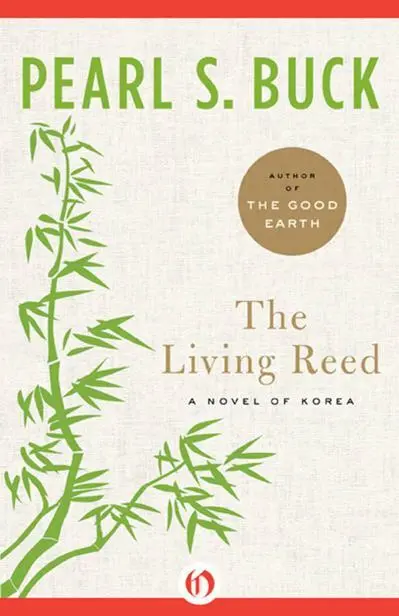
Pearl Buck - The Living Reed
Здесь есть возможность читать онлайн «Pearl Buck - The Living Reed» весь текст электронной книги совершенно бесплатно (целиком полную версию без сокращений). В некоторых случаях можно слушать аудио, скачать через торрент в формате fb2 и присутствует краткое содержание. Год выпуска: 2012, Издательство: Open Road Media, Жанр: Современная проза, на английском языке. Описание произведения, (предисловие) а так же отзывы посетителей доступны на портале библиотеки ЛибКат.
- Название:The Living Reed
- Автор:
- Издательство:Open Road Media
- Жанр:
- Год:2012
- ISBN:нет данных
- Рейтинг книги:4 / 5. Голосов: 1
-
Избранное:Добавить в избранное
- Отзывы:
-
Ваша оценка:
The Living Reed: краткое содержание, описание и аннотация
Предлагаем к чтению аннотацию, описание, краткое содержание или предисловие (зависит от того, что написал сам автор книги «The Living Reed»). Если вы не нашли необходимую информацию о книге — напишите в комментариях, мы постараемся отыскать её.
, Pearl S. Buck’s epic historical novel about four generations of one aristocratic family in Korea. Through the story of the Kims, Buck traces the country’s journey from the late nineteenth century through the end of the Second World War. The chronicle begins as the Kims live comfortably as advisors to the Korean royal family. That world is torn apart with the Japanese invasion, when the queen is killed and the Kims are thrust into hiding. Regarded by Buck as “the best among my Asian books,”
is a gripping account of a nation’s fight for survival, and a detailed portrait of one family’s entanglement in the ebb and flow of history.
The Living Reed — читать онлайн бесплатно полную книгу (весь текст) целиком
Ниже представлен текст книги, разбитый по страницам. Система сохранения места последней прочитанной страницы, позволяет с удобством читать онлайн бесплатно книгу «The Living Reed», без необходимости каждый раз заново искать на чём Вы остановились. Поставьте закладку, и сможете в любой момент перейти на страницу, на которой закончили чтение.
Интервал:
Закладка:
In the eighth month of that moon year, the tenth month of the sun year, two days after the season date of Cold Dew, a fresh trouble fell upon the people. The Japanese Governor-General, Count Terauchi, then on a journey toward the north, barely escaped death at the hands of a Korean assassin at the railroad station in the city of Syun-chun. The news spread to every ear and silence fell upon the people, silence of dread and terror. All remembered the murder of the first Resident-General, Prince Ito, before Korea had been formally annexed to the Japanese empire. Though that prince was a kindly man and one who endeavored to make his rule gentle and even just, insofar as he was able, he had been killed by a Korean exile in the city of Harbin in the country of Manchuria. In reprisal the Japanese put the whole of Korea under military rule. Each Governor-General was now surrounded wherever he went by a bodyguard of soldiers, ruthless in their duty to preserve his life.
In spite of this, however, it seemed that the Korean conspirators did all but succeed in their goal. There was a great gathering of people to greet the Governor-General upon his arrival at Syun-chun. Schoolboys from both Christian and public schools were in line on the platform among other Koreans and some Japanese. All Koreans were searched by police for weapons concealed on their persons before they were allowed on the platform. Yet, in spite of precautions, a man was able to hide a revolver somewhere on himself, or had another given to him after he was searched. Who could know?
The Governor-General walked up and down the lines of students, he shook hands with the school principals, among whom were two or three missionaries from Christian schools, one of them American. When he turned to enter the special armored train upon which he traveled, a slender tall man appeared suddenly from among the Christians, in his uplifted right hand a revolver. A shot pierced the air but too high to reach its target. Soldiers swarmed upon the students, pushing them helter-skelter, but none could discover who the assassin was, or whether he was in student uniform. All in the vicinity were arrested, both students and others, in the hope that one would confess the deed. They were thrown into prison, guilty or not, and there waited until trial was held.
This was the news, and Il-han learned of it from the small sheet he found one morning under the door. Ever since Yul-chun had left, Il-han had risen before dawn while Sunia slept to see if there was such a sheet of paper under the door. One morning there it was, a bit of cheap paper, the printing blotted. Who was the assassin? Was it Yul-chun? For this purpose had he returned to his own land? Il-han pondered the dreadful question in his own heart and could find no answer. He resolved that he would not divide his burden by telling Sunia. Let her live her woman’s life, make her kimchee and mend their winter clothes! And if Yul-chun were locked in some cold prison throughout the winter, at least he was alive and safe. Safe? How could he speak the foolish word? His son would be beaten and tortured when he would not confess.
Now Il-han understood the lesson of the hollow reed. When one died, another took his place — if one must die!
Throughout the winter Il-han kept his own silence. His flesh fell away from his bones and Sunia fretted by day because he would not eat and by night because he could not sleep. He took to hiding himself from her when he washed or when he changed his inner garments, for she cried out when she saw him.
“Oh, your poor bare bones,” she mourned. “When I remember you on our wedding night—”
“Be quiet, woman,” he said. And then when he saw her face he tried to laugh. “If I do not please you, look elsewhere.”
It was a grim joke, an aging man and woman, exiles in their own country, hair graying, faces lined, alone in their house.
Still he did not tell Sunia his burden, nor did he tell his second son.
The winter wore on. Through snow and ice his pupils came in the black of the night, but now not every night. The attempt to assassinate the Governor-General had set the rulers into such fury that everywhere more spies roamed among the people. No village was free of them, no country road lonely enough to escape them. Even women were seized and questioned and punished, and this at first because they were Christian.
There was some reason here, for the girls in the Christian schools were more daring than others, and again it was in the news sheet that Il-han read the story, without date or place:
In a Christian day school, in another city, the girls resigned their places. The American woman who was their principal was troubled when they did so, but her pupils laughed and said they would not have her whom they loved punished for what they might do. That same evening she was summoned by the Chief of Police. She made haste to go to his office and he led her to the main street and there were her pupils, waving banners they had made, demanding the release of the prisoners who were accused of plotting to assassinate the Governor-General. The girls had stirred up the citizens and men had joined them and began to shout against the Chief of Police.
Not all Japanese were cruel, and this Chief was in distress. “I cannot arrest them all,” he exclaimed. “The prison is already full.”
The missionary went out and pleaded with the girls to go home, but they only embraced her and greeted her with cheers, and they would not listen.
“Arrest me, then,” she told the Chief of Police. “I will take their place.”
He was a man of good heart, however, and he refused, for the missionary was a small old woman, her hair white, her pale face wrinkled and her eyes very blue and brave.
“I will tell them you will arrest me if they do not go home and I demand that you arrest me if they do not obey,” she declared.
What could her pupils say when she stood before them, her white hair blowing in the winter wind? They looked at each other, and their leader said to those men who had gathered to help them, “You men, fight on! At least we have shamed you into battle.” And so saying, she led them home.
This story Il-han read in the early dawn, forgetting to shut the door while he read, and the cold wind blew through his thin garments and chilled the marrow in his bones. He took the sheet and put it in the kitchen stove and lit a match and held his hands to warm them over the quickly dying flame. All that day he thought of the woman Yul-han loved, and in spite of himself his heart softened toward his son because of the brave schoolgirls who were Christian.
Not all women were treated so kindly by the police. Students continued in many cities to rebel and girls were beaten and kicked by police wearing heavy boots. The printed sheets lay almost daily now under Il-han’s door.
“I was cross-questioned three times,” a girl student said. “A police officer accused me of wearing straw shoes. I said my father was in prison and for me it was as though he were dead, and I wear the shoes of mourning.
“‘It is a lie,’ the officer said and with his hands he pulled my mouth so wide that it bled. Then he forced me to open my jacket to show my breasts and he sneered at me, saying, ‘I congratulate you.’ Then he slapped me and struck my head with a stick until I was dazed, and he said, ‘Did the foreigners teach you to rebel?’ I told him I knew no foreigners except the principal of the school. Then he yelled at me that I was pregnant and when I said I was not, since I was not married, he ordered me to take off all my clothes. He said he knew the Christian Bible, and it teaches that if people are sinless they may go naked. Were not Adam and Eve naked in the Garden of Eden? Only when they sinned did they hide themselves. He tried to take off my clothes and I fought him. And while he said these vile things the Korean interpreter stood sorrowfully by, refusing to speak, so that the officer had to use his own broken Korean, and he was angry and ordered the Korean to beat me, but the Korean said he would not beat a woman and he would bite his hand off first, so the officer beat me with his own fists.”
Читать дальшеИнтервал:
Закладка:
Похожие книги на «The Living Reed»
Представляем Вашему вниманию похожие книги на «The Living Reed» списком для выбора. Мы отобрали схожую по названию и смыслу литературу в надежде предоставить читателям больше вариантов отыскать новые, интересные, ещё непрочитанные произведения.









Обсуждение, отзывы о книге «The Living Reed» и просто собственные мнения читателей. Оставьте ваши комментарии, напишите, что Вы думаете о произведении, его смысле или главных героях. Укажите что конкретно понравилось, а что нет, и почему Вы так считаете.