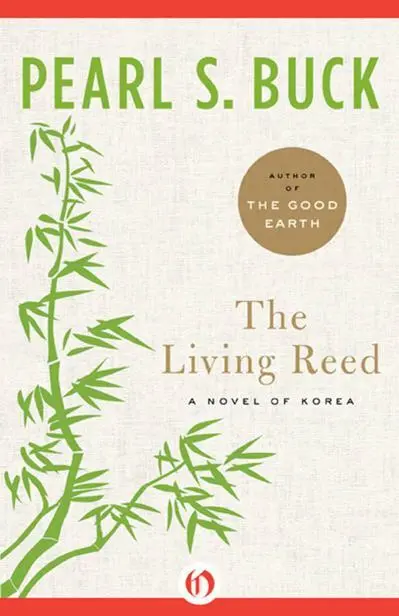
Pearl Buck - The Living Reed
Здесь есть возможность читать онлайн «Pearl Buck - The Living Reed» весь текст электронной книги совершенно бесплатно (целиком полную версию без сокращений). В некоторых случаях можно слушать аудио, скачать через торрент в формате fb2 и присутствует краткое содержание. Год выпуска: 2012, Издательство: Open Road Media, Жанр: Современная проза, на английском языке. Описание произведения, (предисловие) а так же отзывы посетителей доступны на портале библиотеки ЛибКат.
- Название:The Living Reed
- Автор:
- Издательство:Open Road Media
- Жанр:
- Год:2012
- ISBN:нет данных
- Рейтинг книги:4 / 5. Голосов: 1
-
Избранное:Добавить в избранное
- Отзывы:
-
Ваша оценка:
The Living Reed: краткое содержание, описание и аннотация
Предлагаем к чтению аннотацию, описание, краткое содержание или предисловие (зависит от того, что написал сам автор книги «The Living Reed»). Если вы не нашли необходимую информацию о книге — напишите в комментариях, мы постараемся отыскать её.
, Pearl S. Buck’s epic historical novel about four generations of one aristocratic family in Korea. Through the story of the Kims, Buck traces the country’s journey from the late nineteenth century through the end of the Second World War. The chronicle begins as the Kims live comfortably as advisors to the Korean royal family. That world is torn apart with the Japanese invasion, when the queen is killed and the Kims are thrust into hiding. Regarded by Buck as “the best among my Asian books,”
is a gripping account of a nation’s fight for survival, and a detailed portrait of one family’s entanglement in the ebb and flow of history.
The Living Reed — читать онлайн бесплатно полную книгу (весь текст) целиком
Ниже представлен текст книги, разбитый по страницам. Система сохранения места последней прочитанной страницы, позволяет с удобством читать онлайн бесплатно книгу «The Living Reed», без необходимости каждый раз заново искать на чём Вы остановились. Поставьте закладку, и сможете в любой момент перейти на страницу, на которой закончили чтение.
Интервал:
Закладка:
… Their wedding day was set for the summer solstice, which is on the third day of the lunar month and the twenty-first day of the solar month. Yul-han sent word to his father, and to his mother, and he gave the name of the church where the ceremony would take place. Whether they would be there he did not know, and no letter came from them by servant or by the postal system which the Japanese had reformed and made useful again. Neither he nor Induk spoke of his parents but both waited during the closing days of their schools. In the few days before the wedding he did not return to the grass roof to visit his father, lest his mother insist that he must bring Induk there to live. For Induk wanted a small house of her own and in his heart he planned that he would ask for some of the land he would inherit from his father. He had saved money enough to build a house but he could not buy land, for the cost of land had risen since the Japanese were buying land everywhere. No Korean was able to buy unless he had influence to help him.
The wedding day dawned in mist. The season called the Small Heat was hotter than usual, and the sun hung in the sky like a silver plate.
“Shall I wear my Korean robes?” he had asked Induk.
She had hesitated. “I have never seen you except in this foreign dress, but yes, I would like to marry a Korean in Korean dress.”
He put on his Korean robes, therefore, and his best friend helped him, a teacher of mathematics, surnamed Yi and named Sung-man, a secret revolutionist but a man of merry nature. Sung-man had never married and he made jokes as he helped Yul-han to put on the white robes, and the boat-shaped shoes made from Japanese rubber, and the scholar’s hat of woven horsehair, the crown high, the brim narrow.
Sung-man stared at his tall friend. He himself was a short stout man, not handsome, and clumsy of hand and foot.
“Is it you?” he exclaimed.
“I feel strange to myself,” Yul-han acknowledged, “as though I were my own grandfather.”
Nevertheless thus garbed he walked to the church, Sung-man at his side and taking two steps to his one. So they arrived at the church and went in. The benches were already full of people, men on one side, women on the other. On the platform the missionary stood waiting, dressed in black, and a foreign music came from somewhere, of a sort Yul-han had never heard. He walked up the central aisle looking neither to right nor left, Sung-man behind him, and the missionary motioned to them to stand at his right on the platform. While they stood there waiting suddenly the gentle music changed to loud clear music, very joyous, and Yul-han saw Induk coming up the aisle beside her father. In front of her walked two small boys, her brother’s children as Yul-han knew, scattering flowers as they came, and behind her walked her mother and older sister. But it was at Induk that he looked. She wore a full skirt of pink brocaded satin and a short jacket to match, and her face was half hidden behind a veil of thin white silk. She walked steadily toward him and up the two steps while he waited, trying not to look at her and yet seeing her all the way until she was at his side.
Of that strange marriage ceremony he remembered not a word, except that when he was asked by the missionary if he would have Induk for his wife he replied in a loud voice that he would indeed, and it was only for this purpose that he had come. He was surprised to hear stifled laughter from some women in the audience and he wondered if he had said something he should not have said. The missionary went on, whatever he had said, and in a few minutes, before he could recover himself, he heard the missionary pronounce them man and wife. He hesitated, not knowing what came next, but Induk guided him gently by her hand in the curve of his elbow and he found himself walking down the aisle with her, arm in arm.
He had all but forgotten his parents in the agitation of the ceremony but when he reached the door he saw his father standing at the end of the last bench and passed him near enough to touch his shoulder. Father and son, they looked at each other, the one in gravity, the other in amazed gratitude.
Now he and Induk were at the door and now they had passed through into the outer air. It was over. Yul-han was a married man.
“Why should you build a house?” Sunia demanded. “Our ancestral house is empty of children. When we die it will be yours.”
Yul-han and Induk exchanged looks. How could they explain to his mother that they were different in this generation? Sunia had come to her husband’s house when she was a bride, the house was the home of their ancestors, and where else could she go, or indeed where else would she want to go?
She continued, addressing herself to Induk. “It is because you think I will not have a Christian in my house?”
“Surely not, Mother,” Yul-han said quickly.
But Induk reflected. “Mother, you are right — and wrong. Being Christian does indeed make me different from other young women. You are kind, but you would find me irksome in your house.”
“How are you different?” Sunia demanded, doubtful but determined still to have her own way.
Induk turned to Yul-han. “How am I different?”
He stroked his head, considering. “I have not had time to find out, but different you are.”
Sunia yielded then, complaining privately to Il-han. “She wants to take care only of her husband. Is that a good daughter-in-law? Who brought her precious husband into this world? Who but me?”
“You forget that I—” Il-han began thus but Sunia stopped him.
“Oh you men,” she cried, “you never think whether what you do will produce a child. Yes, yes, you are necessary, else why would a woman spend her life taking care of you? But it is we who create the child and with no more from you than a few drops of water upon an open flower.”
“Peace,” he said with dignity. “Tell me what you want and I will see if it is possible, but do not make me promise that they live with us under our grass roof. These are new times. And I myself do not know whether I want a Christian under the same roof with me.”
The compromise was that Yul-han was to build a house attached to his father’s but with a separate entrance. During the summer months of his great happiness with Induk thereafter Yul-han began the building of his own house. With the help of the one man servant he brought gray stones from the mountains and he cut cedar trees from the forest lands for the pillars to holdup the roof, but to his father’s annoyance Yul-han employed a Japanese roof company to make the roof of tile instead of thatch.
“What,” Il-han exclaimed one day when as usual he walked into the garden to see the new house, “do you buy tiles of the enemy instead of using the good thatch grass from our own fields?”
“Father,” Yul-han replied, not pausing in the work of making a window, “the thatch must be renewed every three or four years, whereas this red tile will last for a century.”
“You are too hopeful,” Il-han retorted. “It is enough to look ahead for a few years. Who knows whether any of us will be alive beyond that?”
“You are too hopeless,” Yul-han retorted gaily.
The house-building was only for the summer until such time as the schools were open after harvest. He must continue his teaching and so must Induk, she at least until she had a child, and in this summer he and Induk lived in a part of the ancestral home, and it was during this time that they both began to understand the sufferings of their people. In the village near which they lived Yul-han heard one night a great wailing of a woman screaming and crying for help. He was working late and alone and was about to break off his labor, for the mosquitoes were singing about his ears, when this voice came to him in waves of agony, borne upon the rising night wind. He put down his plastering trowel and listened.
Читать дальшеИнтервал:
Закладка:
Похожие книги на «The Living Reed»
Представляем Вашему вниманию похожие книги на «The Living Reed» списком для выбора. Мы отобрали схожую по названию и смыслу литературу в надежде предоставить читателям больше вариантов отыскать новые, интересные, ещё непрочитанные произведения.

Обсуждение, отзывы о книге «The Living Reed» и просто собственные мнения читателей. Оставьте ваши комментарии, напишите, что Вы думаете о произведении, его смысле или главных героях. Укажите что конкретно понравилось, а что нет, и почему Вы так считаете.