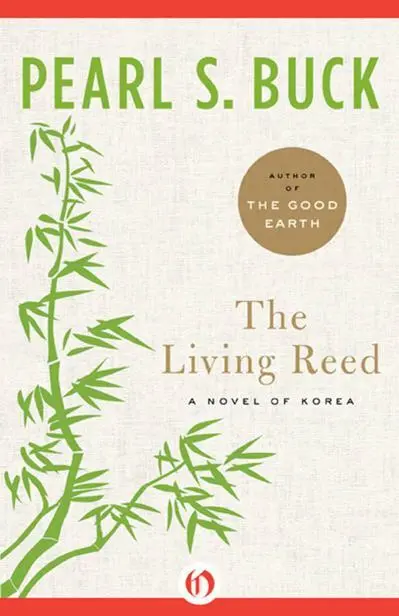
Pearl Buck - The Living Reed
Здесь есть возможность читать онлайн «Pearl Buck - The Living Reed» весь текст электронной книги совершенно бесплатно (целиком полную версию без сокращений). В некоторых случаях можно слушать аудио, скачать через торрент в формате fb2 и присутствует краткое содержание. Год выпуска: 2012, Издательство: Open Road Media, Жанр: Современная проза, на английском языке. Описание произведения, (предисловие) а так же отзывы посетителей доступны на портале библиотеки ЛибКат.
- Название:The Living Reed
- Автор:
- Издательство:Open Road Media
- Жанр:
- Год:2012
- ISBN:нет данных
- Рейтинг книги:4 / 5. Голосов: 1
-
Избранное:Добавить в избранное
- Отзывы:
-
Ваша оценка:
The Living Reed: краткое содержание, описание и аннотация
Предлагаем к чтению аннотацию, описание, краткое содержание или предисловие (зависит от того, что написал сам автор книги «The Living Reed»). Если вы не нашли необходимую информацию о книге — напишите в комментариях, мы постараемся отыскать её.
, Pearl S. Buck’s epic historical novel about four generations of one aristocratic family in Korea. Through the story of the Kims, Buck traces the country’s journey from the late nineteenth century through the end of the Second World War. The chronicle begins as the Kims live comfortably as advisors to the Korean royal family. That world is torn apart with the Japanese invasion, when the queen is killed and the Kims are thrust into hiding. Regarded by Buck as “the best among my Asian books,”
is a gripping account of a nation’s fight for survival, and a detailed portrait of one family’s entanglement in the ebb and flow of history.
The Living Reed — читать онлайн бесплатно полную книгу (весь текст) целиком
Ниже представлен текст книги, разбитый по страницам. Система сохранения места последней прочитанной страницы, позволяет с удобством читать онлайн бесплатно книгу «The Living Reed», без необходимости каждый раз заново искать на чём Вы остановились. Поставьте закладку, и сможете в любой момент перейти на страницу, на которой закончили чтение.
Интервал:
Закладка:
Yul-han interrupted. “They won the war with Russia, and—”
Il-han interrupted in turn. “The causes for that war still exist. Russia has no ice-free port on the Pacific.”
“Father,” Yul-han pleaded, “we were talking only of my marriage. Why are we quarreling about governments?”
“Nothing is private nowadays,” Il-han retorted. “If you marry into a Christian family, you undertake their burdens. Do not forget that among the twenty-one Koreans who tried to kill the Prime Minister of Japan who was visiting here, eighteen were Christians!” Here Il-han paused to point his long forefinger at his son. “What was the result? Count Terauchi was sent to rule us without mercy, because he believed that desperate men among us were hiding themselves among the Christians. He surrounds himself with military officers and soldiers. When he goes into our peaceful countryside — I saw it with my own eyes. Only the other day he passed through our villages on his way somewhere, an army swarming about him. Your mother was wailing. She thought they were coming after me. I am not so important any more, I told her.”
“I will not argue with you, Father,” Yul-han said. “I ask only one question. Will you come to my wedding?”
Il-han’s eyebrows shot up. “You insist upon this marriage?”
“Yes, Father,” Yul-han said, very steady.
“Then I will not come,” Il-han declared. “Nor will I allow your mother to come.”
Father and son, they exchanged a long, last look
“I am sorry, Father,” Yul-han said. He made deep obeisance and went away.
… He met Induk the next day, a holiday. The date was the seventeenth day of the fourth lunar month and the sixth day of the sixth solar month. By tradition this day was for the transplanting of rice seedlings from dry earth into watery fields, and though this was done only by landfolk, the day was celebrated by city folk, too, for rice is the food of life.
They had grown wise, these two, in their knowledge of the city and where they could meet, and today they planned to walk outside the gates and along some country road. Their meetings until now had been brief and they had always to be careful of being seen. Today, however, they would be in no haste for they would be far from all who knew them. They met by the west gate, and Yul-han paused to buy two small loaves of bread for their noon meal. Then they turned toward the mountains and away from city and field alike. The sun was already hot as they climbed the unshaded flanks of the bare mountains.
“Here is shelter at last,” Yul-han said.
He left the narrow path and stopped beneath an overhanging rock. Under it they could escape from the burning sun. He smoothed away small stones and lifted moss from the shallow cavern behind the rock and spread it as a floor cushion for her to sit upon. They sat down then, side by side but not too near, each shy of the other in this new loneliness, around them the noble stillness of the mountain and above them the deep and passionate blue of the sky.
In silence Induk poured a small bowl of tea for Yul-han from the bottle she had put in the basket and then one for herself. It was cool and refreshing, they sipped it, and gazed down upon the city they had left. The landscape was splendid, the high rocky mountains guarding the jewel of the city set deep into the green circle of a valley. The sun glittered on the roofs and hid the poverty of huts and crowded streets.
“I am hungry,” Yul-han said.
She gave him bread and broke a loaf in half for herself, and they ate. He felt a peace he had never known before. She was so near that he could put out his hand and take hers, but he had no need to touch her. They were together, committed to a long life ahead, always together. Nothing must be hurried or transient. They were laying deep foundations for the future, even in this silence. He ate his fill and leaned against the bank beneath the rock in profound content.
It was Induk who spoke first. “I have not told you what your mother said when I told her my family is Christian.”
“Tell me,” he said without urgency, his eyes on her calm face.
“At first,” Induk went on, “she could not believe me. Then she was puzzled and she asked me what it meant to be a Christian. Would it mean, she asked, that we would not let her see the children? Assuredly not, I promised her. I said that everything would be the same except that our children would not go to the temple to worship Buddhist gods. Instead they would go to the Christian church and learn the teachings of Jesus. ‘Who is Jesus?’ she asked. When I told her, she was unhappy. ‘He is a foreigner,’ she exclaimed.”
His children Christian? The thought was new and Yul-han was not sure he liked it.
“I had not considered the matter of children,” he said slowly. Far off against the purple-blue sky an eagle soared upward toward the sun.
“Do you not want them to be Christian?” she inquired.
“How can I tell? I know nothing about this religion.”
“But it is mine!”
“Must it be mine?”
She looked at him thoughtfully, considering how to answer. “Have you read the book I gave you?”
“Some of it.”
“What do you think?”
“It is a strange book,” he said in the same slow voice, almost as though he were dreaming. “When one reads it — well, there is a short story in the last part — a revelation. Someone, I do not know who, says that he ate a small book. He had been told to eat it by a spirit from Heaven — or perhaps from Hell, I could not decide, since it is all a sort of poetry, but this man ate the book. It tasted sweet upon his tongue, but when he had eaten it the sweetness went away and the taste was bitter. That is how it was with me. When I read your book it was sweet to my taste, but as I think about it, I feel bitterness.”
“Oh, why?” she asked softly.
“I cannot say,” he replied. “I only feel. It is dangerous to take a new religion in an old country. It is an explosive.”
He did not wish to tell her now what his father had said, not on this first day of their being alone.
“Do you wish me not to be Christian?” she asked after silence.
“I want you to be yourself,” he replied. “Whatever you are, that is what I want you to be.”
“If you are not Christian, I do not wish to be Christian. I will not be separated from you.”
His heart flooded his being with tenderness. What? She would give up so much for him? He could not allow it but he felt his blood warm in his veins.
“Nothing can separate us,” he said, “nothing — nothing! And I give you a promise. I will talk with the missionary. I will learn more about this God in whom you trust. If I can come to the same faith, I will not hold back.”
“But shall we be married by my religion?”
“Yes! I have none of my own any more. The old beliefs have been taken from us and we have been given nothing in return. Why do I say they have been taken from us? Perhaps they have died of their own age and uselessness. Now let us talk no more of these matters. Time will guide us because we love each other.”
He dared to put out his hand now and take her hand and they sat side by side, shy of more than this and yet yearning for more. But the old traditions held. The palm of a man’s hand, they had been taught, must not touch the palm of a woman’s hand, for the palm is a place of communication, where one heart beats close to another heart. It is the first meeting place of love between man and woman, and for these two it was a virgin experience. From it, love would proceed to consummation.
He sat holding her palm against his until he grew afraid of his own rising passion, to which he must not yield.
“Come,” he said resolutely, “it is time for us to go back to the city.”
Читать дальшеИнтервал:
Закладка:
Похожие книги на «The Living Reed»
Представляем Вашему вниманию похожие книги на «The Living Reed» списком для выбора. Мы отобрали схожую по названию и смыслу литературу в надежде предоставить читателям больше вариантов отыскать новые, интересные, ещё непрочитанные произведения.

Обсуждение, отзывы о книге «The Living Reed» и просто собственные мнения читателей. Оставьте ваши комментарии, напишите, что Вы думаете о произведении, его смысле или главных героях. Укажите что конкретно понравилось, а что нет, и почему Вы так считаете.