Pearl Buck - The Living Reed
Здесь есть возможность читать онлайн «Pearl Buck - The Living Reed» весь текст электронной книги совершенно бесплатно (целиком полную версию без сокращений). В некоторых случаях можно слушать аудио, скачать через торрент в формате fb2 и присутствует краткое содержание. Год выпуска: 2012, Издательство: Open Road Media, Жанр: Современная проза, на английском языке. Описание произведения, (предисловие) а так же отзывы посетителей доступны на портале библиотеки ЛибКат.
- Название:The Living Reed
- Автор:
- Издательство:Open Road Media
- Жанр:
- Год:2012
- ISBN:нет данных
- Рейтинг книги:4 / 5. Голосов: 1
-
Избранное:Добавить в избранное
- Отзывы:
-
Ваша оценка:
The Living Reed: краткое содержание, описание и аннотация
Предлагаем к чтению аннотацию, описание, краткое содержание или предисловие (зависит от того, что написал сам автор книги «The Living Reed»). Если вы не нашли необходимую информацию о книге — напишите в комментариях, мы постараемся отыскать её.
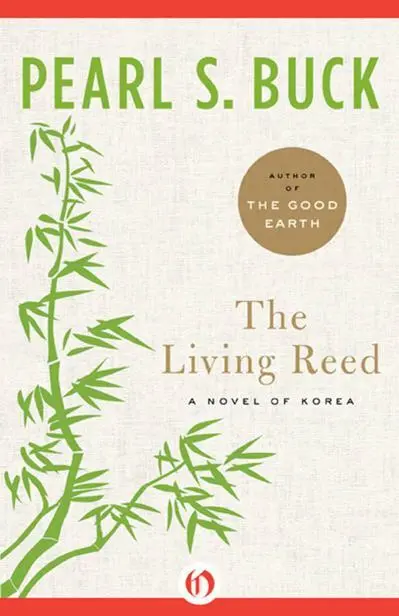
, Pearl S. Buck’s epic historical novel about four generations of one aristocratic family in Korea. Through the story of the Kims, Buck traces the country’s journey from the late nineteenth century through the end of the Second World War. The chronicle begins as the Kims live comfortably as advisors to the Korean royal family. That world is torn apart with the Japanese invasion, when the queen is killed and the Kims are thrust into hiding. Regarded by Buck as “the best among my Asian books,”
is a gripping account of a nation’s fight for survival, and a detailed portrait of one family’s entanglement in the ebb and flow of history.
The Living Reed — читать онлайн бесплатно полную книгу (весь текст) целиком
Ниже представлен текст книги, разбитый по страницам. Система сохранения места последней прочитанной страницы, позволяет с удобством читать онлайн бесплатно книгу «The Living Reed», без необходимости каждый раз заново искать на чём Вы остановились. Поставьте закладку, и сможете в любой момент перейти на страницу, на которой закончили чтение.
Интервал:
Закладка:
Suddenly it occurred to him one day how to ask Induk if she would be his wife. It was a Sunday afternoon, the first in the sixth solar month. They had met by arrangement in one of the new city parks, and had walked to a quiet pool under hanging willows. He spread his coat on the bench for her to sit upon and together they watched the goldfish darting among the water lilies. Now — now was the moment. He began diffidently, wondering if he dared to touch her hand.
“Induk, I have something to ask you.”
She did not turn her head. “What is it?”
Across the pool a flowering quince tree, growing in the shade of the willows, was still in bloom. He saw the red petals dropping into the water. Goldfish darted up to nibble them and darted away again. He went on slowly, feeling his cheeks burning hot.
“Will you go with me to a fortuneteller?”
His voice was so low that he feared it lost in the ripple of the small waterwall at the end of the pool. But she heard.
“Do you believe in fortunetellers?” she asked, incredulous.
“To discover whether our birth years agree,” he said.
She understood. He knew it by her sudden stillness. She neither spoke nor moved. He looked at her sidewise and saw a rose-pink flush mounting from her soft neck to her cheeks. She was shy! She who seemed always so calm, so competent, so sure of herself, was shy before him, and seeing her thus, his own diffidence faded. He sprang to his feet and held out his hand.
“Come,” he commanded. “We will go now.”
She looked up at him, hesitating. “Alone? The two of us? Will it not seem strange to the fortuneteller?”
“What do we care?” he asked, very bold.
He smiled down into her eyes, infusing her with his own daring. She grasped his hand and leaped lightly to her feet. Hand in hand in the gathering dusk they went through the now lonely park and into a narrow cross street. There in a corner sheltered by an overhanging roof an old fortuneteller sat in the dim light of a paper lantern swinging over his head, waiting for customers. Before him was a small table, upon it the tools of his trade. He peered through his horn-rimmed spectacles at Yul-han and Induk.
“What do you seek?” he asked, his voice cracked with his sitting in wind and rain, snow and heat.
“Our birth years,” Yul-han said. “Are they suited for marriage?” And he gave the years in which he and Induk were born.
The fortuneteller muttered and mumbled over his signs and fumbled in worn old books. They waited, hands clasped and hidden behind the table. At last he looked up, and took off his spectacles.
“Earth,” he declared. “Both of you belong to Earth. Thus far it is yes. As to which animal …”
Here he pursed his withered lips and mused aloud while he pondered his books again.
“I can almost guess by looking at the two of you what your animal years are. People are like the animals under which they are born. You are not pig, or snake, or rat …”
He fell silent while his long dirty fingernail traced the paper.
“A-ha!” he cried. “You are safe, both of you! You, the male, are dragon; you, the female, are tiger. Dragon is stronger than tiger, young man, but tiger is strong, and she will fight you sometimes, though she can never win, for the dragon sits above, always in the clouds.”
In spite of their avowed disbelief in the old symbols both Yul-han and Induk were relieved. Tradition was still powerful and a man may not marry a woman whose animal is stronger than his own, else she will rule him without remorse or tenderness. Yet each was ashamed to show relief.
“I must fight you, it seems,” Induk said.
“You will always lose, remember,” Yul-han retorted.
Induk sighed in pretended despair and Yul-han laughed. Then something occurred to him.
“Old Fortuneteller,” he said, “are you not shocked that we make inquiry for ourselves?”
The old man stroked his few gray whiskers. “Not at all,” he said. “Young ones come nowadays to inquire for themselves.”
They were too surprised to reply to this and they went away in silence. But their joy was increased. When they parted, Yul-han held both her hands for a long moment as they stood in the shadow of a stranger’s gate.
“So there are many of us,” he murmured before he let her go.
… As for Il-han, he took no further interest in the marriage, which was, after all, women’s business. Indeed, as he reflected upon it, the wedding might bring only dissension into his house, for the young woman whom Yul-han wished to marry now broke all tradition by coming herself one day to see Sunia, her future mother-in-law, and, to his surprise, himself, for when the girl arrived alone except for an old woman servant, she asked not only to see the house but her future father-in-law. He was disturbed by Sunia, who came breathless into his library to tell him the strange news.
“She is here,” Sunia exclaimed.
“She?” Il-han repeated.
“The woman — the girl — Yul-han—” She paused, not knowing what to say. Betrothed she was not as yet and to use the word “friend” in relation to a son would have evil implication. “Her name is Induk,” she finished.
“Well?” Il-han asked.
“What shall we do? She wishes to see us both!”
“Tell her I am busy,” Il-han said promptly.
Sunia hesitated. “Will she not think it rebuff? Yet what will the neighbors say if you do see her?”
Yul-han now arrived by another way, in time to hear these words. He came in and slid the wall door shut behind him. “Father — Mother—” He had been running and he breathed hard. “Remember that everything is different nowadays. She teaches the girls and I teach the boys, but we see each other in the corridors and on the playground in passing. I asked her myself if she would have me and she said yes. She wants our wedding to be modern.”
“What is modern?” Sunia inquired with some scorn.
“Well, she does not wish you to give her the usual red and green sets of garments. She says a ring on her finger at the time of our marriage is enough.”
“How does she mean enough?” Sunia demanded. “The red garments signify the passion any marriage must have for happiness and the green signifies that you will grow together, you two young ones. How will you say such things except through these gifts?”
Yul-han shrugged his shoulders. He could not explain to his parents how such things were said nowadays.
Sunia’s sharp eyes saw the shrug and immediately she went on. “Doubtless the girl is not serious. At any rate, we do not know whether the marriage will be propitious. Fortunetellers must be called. We do not even know your two birth years. How can we know the combination of your lives?”
Yul-han smiled. He went to the garden door and stood there. The summer peonies were in bloom, their red and white flowers were vivid against the young green. In the pond a frog croaked. “Only for fun,” he said, “she and I did inquire of a fortuneteller. We were both born in the year of Earth and though she is Tiger, I am Dragon.”
Sunia could not but be pleased. “Can it be so! Earth? Then as every branch of a tree bursts into flower, your children will prosper and grow.” She turned to Il-han, suddenly radiant. “We will be cared for in our old age!”
“If we believe in such things,” Il-han said drily.
Sunia refused to be discouraged. “There is something in such symbols. Do not forget that our ancestors lived by their belief and are we better than they?”
The two men, father and son, said nothing. Each had his thoughts — Yul-han that any happiness his mother could find would be well for himself and Induk, and Il-han that he would not at this time of her life disturb Sunia’s faith and hope. They remained silent while Sunia prattled on.
Читать дальшеИнтервал:
Закладка:
Похожие книги на «The Living Reed»
Представляем Вашему вниманию похожие книги на «The Living Reed» списком для выбора. Мы отобрали схожую по названию и смыслу литературу в надежде предоставить читателям больше вариантов отыскать новые, интересные, ещё непрочитанные произведения.


Обсуждение, отзывы о книге «The Living Reed» и просто собственные мнения читателей. Оставьте ваши комментарии, напишите, что Вы думаете о произведении, его смысле или главных героях. Укажите что конкретно понравилось, а что нет, и почему Вы так считаете.