Pearl Buck - The Living Reed
Здесь есть возможность читать онлайн «Pearl Buck - The Living Reed» весь текст электронной книги совершенно бесплатно (целиком полную версию без сокращений). В некоторых случаях можно слушать аудио, скачать через торрент в формате fb2 и присутствует краткое содержание. Год выпуска: 2012, Издательство: Open Road Media, Жанр: Современная проза, на английском языке. Описание произведения, (предисловие) а так же отзывы посетителей доступны на портале библиотеки ЛибКат.
- Название:The Living Reed
- Автор:
- Издательство:Open Road Media
- Жанр:
- Год:2012
- ISBN:нет данных
- Рейтинг книги:4 / 5. Голосов: 1
-
Избранное:Добавить в избранное
- Отзывы:
-
Ваша оценка:
The Living Reed: краткое содержание, описание и аннотация
Предлагаем к чтению аннотацию, описание, краткое содержание или предисловие (зависит от того, что написал сам автор книги «The Living Reed»). Если вы не нашли необходимую информацию о книге — напишите в комментариях, мы постараемся отыскать её.
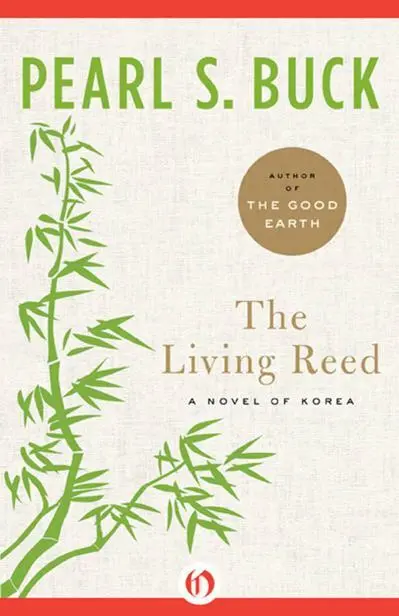
, Pearl S. Buck’s epic historical novel about four generations of one aristocratic family in Korea. Through the story of the Kims, Buck traces the country’s journey from the late nineteenth century through the end of the Second World War. The chronicle begins as the Kims live comfortably as advisors to the Korean royal family. That world is torn apart with the Japanese invasion, when the queen is killed and the Kims are thrust into hiding. Regarded by Buck as “the best among my Asian books,”
is a gripping account of a nation’s fight for survival, and a detailed portrait of one family’s entanglement in the ebb and flow of history.
The Living Reed — читать онлайн бесплатно полную книгу (весь текст) целиком
Ниже представлен текст книги, разбитый по страницам. Система сохранения места последней прочитанной страницы, позволяет с удобством читать онлайн бесплатно книгу «The Living Reed», без необходимости каждый раз заново искать на чём Вы остановились. Поставьте закладку, и сможете в любой момент перейти на страницу, на которой закончили чтение.
Интервал:
Закладка:
“How long will you go on with this teaching?” she exclaimed. “You look like an old man.”
“I feel like an old man,” he said. “A very old man.”
“You are only fifty-four,” she retorted, “and I beg you will not call yourself old for then you make me old. Drink this ginseng soup. Why have you kept the pupils all night?”
He took the bowl of soup and blew it and supped. “There was a moving light, unexplained.”
“If you had called me,” she said somewhat crossly, “I would have told you that our younger son is here. He came in the back gate, carrying a lantern.”
“Yul-han? Why did you not tell him to come in?”
“He forbade it,” she replied.
She was tidying the room as she spoke, picking up bits of paper the pupils had left, smoothing the floor cushions, dusting the table.
“Forbade it?”
“You are getting the habit of repeating what I say. Yes, he forbade it!”
He looked at her mildly. The strain of the times, the constant living in fear of the knock on the door, the secrecy, the poverty, all were changing his Sunia into a weary, irritable woman. He felt a new love for her, tender with pity. She had not his inner resources, his place of retreat into the calm of poetry and music. He put out his hand as she passed him and laid hold of her skirt.
“My faithful wife,” he murmured.
The tears came to her eyes but she would not shed them.
“You have not eaten,” she exclaimed. “I forget my duty.” She hurried to the door and paused. “Shall I tell Yul-han to come in now?”
“Do so,” he replied.
Before she returned, his younger son entered. Yul-han was the name given him when he began school, and it suited him, in both sound and meaning — Spring Peace! Now at twenty-nine years of age, he was neither tall nor short but slim and strong, his round face pleasant without being handsome. He wore the western garments which many young men wore nowadays under Japanese rule, a suit of gray cloth, trousers and coat and under the coat a blue shirt open at the neck and on his feet leather shoes. It was a nondescript garb, proclaiming no nationality, and Il-han, saying nothing, was always displeased when he saw his son wearing such garments. Did it mean he avoided proclaiming himself Korean? Was this son a prudent fellow, escaping trouble and argument in this vague attire? He refused himself answers to such private doubts and questions.
“Father,” Yul-han said and bowed.
“Son, sit down,” Il-han replied and inclined his head. “Have you eaten?”
“Not yet. I came early because I must go back to my school.”
Il-han did not reply. This son of his was a teacher in a school where, as in all schools now, the classes were conducted in the Japanese language and the curriculum was planned by the Japanese Board of Education. When Yul-han first told him that he had accepted this position, Il-han was more angry than he had ever been before in his life.
“You!” he had exclaimed. “You sell yourself to these invaders!”
He had never forgotten his son’s quiet reply.
“Father, I ask you to consider my inheritance — the inheritance of all my generation. What have you left us, you elders? A government rotten with corruption, a people oppressed by the yangban, taxes on everything but never spent on the people! Is it a wonder that the people are always rioting and rising up? Is there ever peace in the provinces? Is it strange that we have for generations been split into a score of parties? What does it all mean except that we are desperate? Yes, I chose the Il Chon Hui because among our enemies I favor the Japanese! At least they are trying to make order out of our ancient chaos. And the worst chaos, as you very well know, is in our national finances. Two hundred Japanese are scattered throughout our country, collecting new figures. Why do I say new? There are no figures. No one knew how much money was collected in taxes or how it was spent. As for property — I do not know how you have held our own lands except that we are yangban, and you, too, had your special influence in court.”
Here Il-han had stopped him. “If you insinuate that I, your father, am corrupt—”
“The corruption began long before your generation,” Yul-han said. “Before you were born — or my grandfather was born — there was already no distinction made between Court and Government property or between State and private properties or State and Imperial household properties. Why do I tell you, Father? You know that magistrates collected taxes as they pleased and spent them as they pleased. Land tax — house tax — but have we ourselves ever paid taxes, Father?”
To this Il-han had not replied except to say, “You echo your brother’s complaints.”
Father and son were silent then for a long moment. It was the sorrow of this household that none knew where the elder son had gone, or even whether he had been killed as so many young men were killed when the invaders came. Even were he dying he must continue in exile, for the invaders knew the name of every man who had opposed them. During the war with China the Japanese had marched into Korea on the way, and when they were victorious, Russia, fearful lest Japan hold the country, had sent in her own armies to contend. Japan had trebled her forces only to declare war next against Russia, and this war she won, too, to the admiration of the western powers, and especially of the United States, whose citizens applauded the doughty small nation who dared to fight the Russian giant. In their approbation, the Americans forgot their treaty of protection, wherein they had promised to help Korea to freedom, for in that treaty the Americans had promised that if any country dealt with Korea unjustly or oppressively, their government would “bring about an amicable arrangement.”
Such watery words were meaningless, Il-han had so told the King at the time and it was proved. For the King, in despair when the invaders came, appealed to the Americans and one good American, Homer Hulbert, who was head of the government school in Seoul, himself went to Washington to plead for the Koreans, whom, though a foreigner, he had learned to love. But the President, one Theodore Roosevelt, would not receive him, and his Secretary of State merely brought the message that the United States would not intervene in Korea. And later that same President openly made this declaration:
“Korea is absolutely Japan’s.”
Yet by treaty it had been solemnly covenanted that Korea should remain independent. Alas, Korea was helpless and Japan maintained that it was her own duty to her own children and children’s children to override the treaty, and so Japan formally annexed the country. And the first Japanese Governor-General, when he came to rule the Koreans, tore up the treaty and threw the scattered bits of paper into the air.
“Yet we are civilized,” he declared, and in proof he did not behead the King or his feeble son. Instead he gave them an annuity, and the two lived on in the palace.
Today, remembering the unanswered question, Il-han looked at his son half quizzically.
“It may please you,” he said, “to know that yesterday the Japanese tax gatherers came here to collect tax from me.”
The young man’s face showed concern. “Did you have the money, Father?”
“No,” Il-han said calmly. “Nowadays I have no money.”
“So?”
“I gave them a deed to the big field at the north of the village.”
Yul-han looked grave. “You must reckon on regular taxes, Father, land or no land. And we must admit that the money is being well used. The streets are much improved — you would not know the city now. We are not sunk in mud when it rains, the streets are no longer drains and dumping places, and roads are being made in the country connecting the villages. Even the side paths are being improved, and trees are planted.”
Читать дальшеИнтервал:
Закладка:
Похожие книги на «The Living Reed»
Представляем Вашему вниманию похожие книги на «The Living Reed» списком для выбора. Мы отобрали схожую по названию и смыслу литературу в надежде предоставить читателям больше вариантов отыскать новые, интересные, ещё непрочитанные произведения.


Обсуждение, отзывы о книге «The Living Reed» и просто собственные мнения читателей. Оставьте ваши комментарии, напишите, что Вы думаете о произведении, его смысле или главных героях. Укажите что конкретно понравилось, а что нет, и почему Вы так считаете.