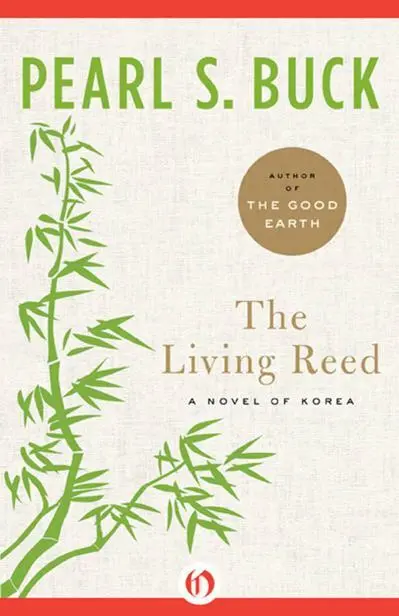
Pearl Buck - The Living Reed
Здесь есть возможность читать онлайн «Pearl Buck - The Living Reed» весь текст электронной книги совершенно бесплатно (целиком полную версию без сокращений). В некоторых случаях можно слушать аудио, скачать через торрент в формате fb2 и присутствует краткое содержание. Год выпуска: 2012, Издательство: Open Road Media, Жанр: Современная проза, на английском языке. Описание произведения, (предисловие) а так же отзывы посетителей доступны на портале библиотеки ЛибКат.
- Название:The Living Reed
- Автор:
- Издательство:Open Road Media
- Жанр:
- Год:2012
- ISBN:нет данных
- Рейтинг книги:4 / 5. Голосов: 1
-
Избранное:Добавить в избранное
- Отзывы:
-
Ваша оценка:
The Living Reed: краткое содержание, описание и аннотация
Предлагаем к чтению аннотацию, описание, краткое содержание или предисловие (зависит от того, что написал сам автор книги «The Living Reed»). Если вы не нашли необходимую информацию о книге — напишите в комментариях, мы постараемся отыскать её.
, Pearl S. Buck’s epic historical novel about four generations of one aristocratic family in Korea. Through the story of the Kims, Buck traces the country’s journey from the late nineteenth century through the end of the Second World War. The chronicle begins as the Kims live comfortably as advisors to the Korean royal family. That world is torn apart with the Japanese invasion, when the queen is killed and the Kims are thrust into hiding. Regarded by Buck as “the best among my Asian books,”
is a gripping account of a nation’s fight for survival, and a detailed portrait of one family’s entanglement in the ebb and flow of history.
The Living Reed — читать онлайн бесплатно полную книгу (весь текст) целиком
Ниже представлен текст книги, разбитый по страницам. Система сохранения места последней прочитанной страницы, позволяет с удобством читать онлайн бесплатно книгу «The Living Reed», без необходимости каждый раз заново искать на чём Вы остановились. Поставьте закладку, и сможете в любой момент перейти на страницу, на которой закончили чтение.
Интервал:
Закладка:
The mob filled the palace, and the rough soldiers seized every woman by the hair as soon as they saw her, demanding to know whether she was the Queen. Whatever the women said, the soldiers beheaded them and threw the heads aside or tossed them from a window. Still further the mob went until they reached the very last room, and now Il-han, pressed among them, heard two shots. Then he heard a low scream and he knew it was the Queen who screamed. The scream ended in a long moaning sigh. He bent his head and bit his lips until he tasted his own blood, but he could do nothing. She was dead.
The crowd stopped, men looked at one another, and then one by one they went away, the looters to loot and those who had committed the deed to escape so that none was known to be guilty. When all were gone and only Il-han was left, he went into the room where the Queen lay alone and he looked down into the lovely face he knew so well, still the same lovely face though aged now with the years during which he had not once seen her. He crouched down beside her and took her hand, still warm. Blood flowed from her left breast and from her smooth neck and he lifted the edge of her wide silk skirt and held it to the wounds. The silk was crimson and it did not show the stain except that the stuff turned a deeper crimson.
So he sat in the empty palace until sunrise and he sat on into the morning until at about the ninth hour a gardener came to the door, barefoot, so that Il-han did not hear his footsteps. He peered in and saw Il-han, whom he did not know, so long had Il-han been absent from the palace.
“Who are you, brother?” he asked.
“I am her servant,” Il-han said.
The man came near and stared down into the pale face of the dead Queen. “She liked white lotus flowers,” he said at last, “and now her face is as white as any lotus flower. What shall we do with her, brother?”
“Have you a cart?” Il-han asked.
“I have an oxcart,” the man said.
“Bring it to the nearest door and help me lift her into it,” Il-han said.
The man went away and in a short time came back again and they lifted the Queen, so slender that her weight was nothing for the two men, and they carried her to the cart and laid her there and the man covered her with the straw that filled the cart. Then he climbed up and the ox drew the cart away while Il-han followed far behind and slowly, for his hip was swollen and tears ran down his face for pain. Yet even this was not enough. Before the cart had reached the gate the dead Queen was discovered by soldiers and ragamuffins and they dragged her body out from under the straw and hacked it to pieces with swords and knives and piled the straw about the pieces and set all afire.
It was time for Il-han’s heart to break. He covered his face with his hat and hobbled away from that fire and into the street. His horse was gone, but the oxcart was there and he climbed into it, and bade the man take him home.
… Of that beautiful queen all that was left, he heard afterward, was the little finger of her right hand. This escaped the flames and was found by the man when he went back next day at Il-han’s command to see what bones were there, so that he might bring them together and give them honor. No bones were there, for dogs had wandered freely throughout the palace, but under a stone lay the little finger. The man took it up tenderly and wrapped it in a lotus leaf he had plucked from the lake. Then he took it to the King’s palace and demanded entrance and was received.
“I went into the King’s palace,” he told Il-han when all was done, for Il-han had said he would pay him well if he came to his grass roof with the whole story. “I went into the audience hall and the King sat on his throne surrounded by his ministers, and the old Prince-Parent sat there again at his right hand. The King listened to what I told him and he covered his eyes with his hand and he would not receive the lotus leaf from me. But he bade a minister take it and embalm it in a golden box and he said the Queen must be given a great funeral and a tomb must be built.”
Sunia was there while all this was told, and when the man was gone she took Il-han’s hand and held it and said not a word, but only sat beside him in silence, her warm hand clasping his.
So they sat until at last Il-han gave a great sigh and he turned to her and said, “My wife — my wife of great heart.”
Then he put her hand away and returned to his books.
… Two years passed before the astrologers could fix upon the place for the Queen’s tomb and then they fixed upon a stretch of land a few miles beyond the city wall. A thousand acres were here sequestered by the King and all houses were removed, for the tract held villages as well as mountains, hills, brooks and fields. Thousands upon thousands of young trees were planted upon the King’s command and fortunes spent in making a beautiful garden such as the Queen loved when she was alive. Her tomb was built upon the highest spot, a tomb of marble, encircled by a carved balustrade of marble. Before the tomb was a great table of white marble polished to shine like glass, and this was for making sacrifices to the spirit of the Queen. Beside the table stone lanterns miraculously carved were set into rock, and marble figures stood in graceful reverence.
When all was finished to his content, the King announced the day for the funeral, a fine fair day, and people came from far and near. In spite of all her whims and ways, the people had loved their Queen for her beauty, for her merriment, for her courage and her brilliant mind and even for her stubborn will. For them, now that she was dead, she remained as a symbol of what their country once had been and could no more be. Already the victorious conquerors were at work to stamp out the ancient ways, the language and traditions of the Koreans.
Il-han stood far off and alone, and he watched the splendid scene. With the Queen gone, could his nation survive? He asked the question and could make no answer. His heart lay dead within him. He could not feel its beat. The Queen whom he had reverenced, the woman whom he had — had he loved her? He did not know. Perhaps Sunia knew better than he, but if she did, he would not ask her. Let the secret lie within the tomb of all that was ended and could not live again. He had no faith in resurrection.
Part II
II
THE YEAR WAS 4243 after Tangun of Korea and 1910 after Jesus of Judea. The season was near the end of winter, the day was the tenth of the first moon month, the hour was midnight.
Il-han woke sharply and by habit now well established. He rose, taking care to be quiet so that Sunia would not wake as he crept from beneath his quilt. The ondul floor was cold. Fuel was too scarce to bank fires at night and the only warmth was from the quick flame of dried grass when the evening meal was cooking. He went into the next room, his stockinged feet noiseless, and there he poured cold water into a basin set on the table and washed his face and hands. Then he unwound his hair, oiled and combed it and coiled it again on top of his head. This hair he had kept short ever since he had been in America, against Sunia’s complaints that women would think he was not married, but when the Japanese rulers moved into the capital he felt compelled to let his hair grow in defiance of the command of the Japanese Prince, now Resident-General. He had sent out a decree declaring that no reforms could be made in Korea until the men cut off their topknots, for he maintained that in this stubborn coil of hair was the symbol of Korean nationalism which must be utterly destroyed since Korea had become a colony of imperial Japan. The Governor-General then announced that the King had cut off his coil of hair and that he, the King, commanded his subjects to follow his example. This the Koreans had at first refused to do, saying that the King had not cut his hair by his own free will but had been forced to do so by his Japanese masters. In the end many had refused to obey, including Il-han, and so his hair was long again.
Читать дальшеИнтервал:
Закладка:
Похожие книги на «The Living Reed»
Представляем Вашему вниманию похожие книги на «The Living Reed» списком для выбора. Мы отобрали схожую по названию и смыслу литературу в надежде предоставить читателям больше вариантов отыскать новые, интересные, ещё непрочитанные произведения.

Обсуждение, отзывы о книге «The Living Reed» и просто собственные мнения читателей. Оставьте ваши комментарии, напишите, что Вы думаете о произведении, его смысле или главных героях. Укажите что конкретно понравилось, а что нет, и почему Вы так считаете.