Уильям Макгиверн - Soldiers of ’44
Здесь есть возможность читать онлайн «Уильям Макгиверн - Soldiers of ’44» весь текст электронной книги совершенно бесплатно (целиком полную версию без сокращений). В некоторых случаях можно слушать аудио, скачать через торрент в формате fb2 и присутствует краткое содержание. Город: New York, Год выпуска: 1979, ISBN: 1979, Издательство: Arbor House, Жанр: prose_military, на английском языке. Описание произведения, (предисловие) а так же отзывы посетителей доступны на портале библиотеки ЛибКат.
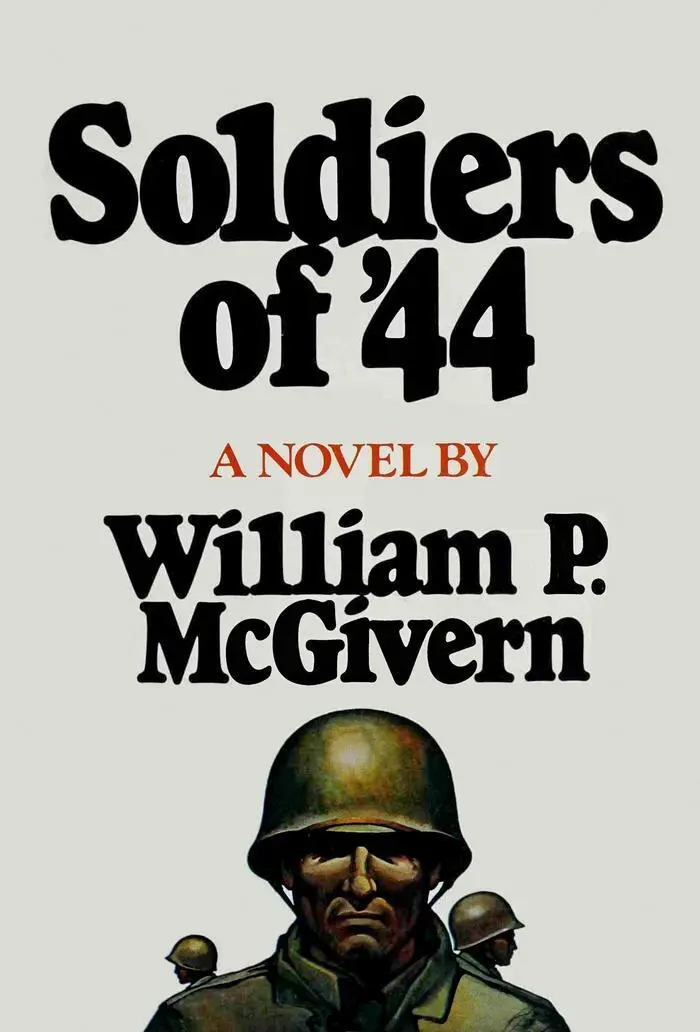
- Название:Soldiers of ’44
- Автор:
- Издательство:Arbor House
- Жанр:
- Год:1979
- Город:New York
- ISBN:978-0-87795-208-4
- Рейтинг книги:3 / 5. Голосов: 1
-
Избранное:Добавить в избранное
- Отзывы:
-
Ваша оценка:
Soldiers of ’44: краткое содержание, описание и аннотация
Предлагаем к чтению аннотацию, описание, краткое содержание или предисловие (зависит от того, что написал сам автор книги «Soldiers of ’44»). Если вы не нашли необходимую информацию о книге — напишите в комментариях, мы постараемся отыскать её.
Soldiers of ’44 — читать онлайн бесплатно полную книгу (весь текст) целиком
Ниже представлен текст книги, разбитый по страницам. Система сохранения места последней прочитанной страницы, позволяет с удобством читать онлайн бесплатно книгу «Soldiers of ’44», без необходимости каждый раз заново искать на чём Вы остановились. Поставьте закладку, и сможете в любой момент перейти на страницу, на которой закончили чтение.
Интервал:
Закладка:
Jaeger’s voice became harder. “Have you ever asked yourself what you — an American — are fighting for on this old soil of Europe? For what, sergeant? To save England’s empire? Or to help Bolshevik tyrants? Is that what you’re here for? If so I ask you to remember this: no cannons are firing across the borders of America, no bombs have smashed your cities into rubble and not one, not one American man, woman or child has yet to be killed by German bombs on your homeland.”
Jaeger put the briar pipe in his pocket and walked across the terrace to the flight of steps. Stopping there, he looked at Docker, his features blurred by the shifting snow and fog.
“I’ll hold my attack until first light, sergeant, which will be in approximately six hours. No, make that five hours and forty-five minutes. My little history lesson was on your time, not mine.”
“If I’d known, I might have paid more attention,” Docker said.
Jaeger nodded slightly. “Your inattention probably does you credit, since most history is shaped by the communiques of victorious generals. Still, I urge you to be realistic when you talk to your superior officers. I have no wish to kill you and your men, sergeant.”
Jaeger went down the steps into the garden. When the sound of his command car faded on the air, Docker walked slowly back to his jeep through the shadows of topiary and weathered white statues.
Chapter Twenty-Four
December 23, 1944. Mont Reynard-sur-Lepont. Saturday, 0100 Hours.
Private Edward Solvis sat hunched in the front seat of Docker’s jeep, protected from the winds by a blanket and a tarpaulin pulled around his shoulders.
He warmed his gloved hands around a canteen cup of coffee, and when he felt heat and life in his fingers, took a notebook from his pocket and began to bring his diary up to date.
His life as a soldier had been a time of profound change for Solvis and from the date of his induction, he had resolved to keep a complete written record of it. The weeks of training and range firing in the sweltering humidity of a Georgia summer, he had put that down. And shipping out from Boston at night in an atmosphere charged with secrecy and tension, all that was in his notebooks, as was the invasion and the sound of guns on Beach Red and Beach Tare... all fully recorded in his neat, precise handwriting, because Solvis realized with a sure intuition that these adventures would become the literal peaks of his existence, and that if he survived the war the rest of his life would serve only as a vantage point from which to look back on these dangerous and uniquely alive years...
Now he wrote: “It’s after midnight, about one o’clock. The usual snow and wind. Docker told us about meeting with the German officer, Colonel Jaeger. We know they’ve shot and killed hundreds of unarmed prisoners at Malmédy, so surrendering (this is Docker’s point) would be pretty goddamn stupid. But something isn’t kosher here and Docker knows it. There’s no way we can stand off a Tiger tank. So what are they waiting for?”
“We could fire point blank at that tank with our .40 and not even dent it. Maybe time’s working for them. Could be Bastogne is gone and the Germans are on their way to Paris. That colonel won’t risk casualties because he doesn’t have to. Kind of ironic to risk your life in a mopping-up operation that doesn’t mean anything.
“Docker’s got Linari, Trank and Laurel on the edge of the hill with bazookas and grenades. They’ll cut loose when and if the tank makes a move, so at least we’ll know it’s coming. I’m monitoring the X-42, but haven’t had a signal for a couple of hours. The last one sounded like an RAF crew down east of Frankfurt, that’s all I could get. I took Baird some coffee a while ago. He asked me for something to write with. Maybe he feels this is a last chance for a letter to somebody. A girl or his family. Everybody knows now who his father is.”
Solvis heard a whisper of static from the X-42 but as he fine-tuned the frequencies, the sound faded to a windy silence. He tried several times to pick up the elusive signals, then began writing again:
“Thinking about Baird made me decide to put down some thoughts of my own. But I don’t really have any ‘last thoughts,’ about the bank or Davenport. Which is kind of strange. I worked and lived there seven years but the things I remember could just as well have happened to another person. This seems to be the only important time of my life. Not heroic or anything, that’s not it, but it means something. I know I’ll never forget Gelnick and the others. His body is wrapped in a tarp pinned down with rocks on high ground in the woods. What I keep thinking about is why he couldn’t save himself, why he just froze like that...”
Solvis glanced over what he had written and saw that some of the words were already blurred by the melting snow.
Tex Farrel and Jackson Baird walked across the crown of Mont Reynard through the darkness, stumbling, trying to avoid the stretches of bare earth polished and frozen slick by the winds.
Farrel told Baird to wait at the revetment and went out to the edge of the precipice, where Docker was studying the dark valley.
“Sarge, Baird wants to talk to you. You want to blame somebody, blame me. He asked me if it’d be okay and I said sure.”
“What made you so sure?”
“Because I know what he’s thinking and I figure you’d want to hear it.”
After another sweep of the slopes. Docker gave the binoculars to Farrel and walked to the revetment, where Baird was waiting for him.
He noticed that despite the raw weather and driving winds, Baird was pale, the bruises on his cheeks standing out darkly. The youngster handed him several sheets of ruled notepaper, an uneasy smile on his damaged lips.
“Will you just look at them, sergeant?”
“First, let me ask you something. Before Trank unloaded on you, you started to say something. What was it?”
“Well, I wanted to tell you I didn’t think the tank is after this gun position. There’s too much firepower and rank down there. So it has to be that experimental aircraft we shot down. That colonel is here to retrieve it or destroy it.”
“If that’s true, then why in hell doesn’t he get on with it? Why not just knock us off and complete his mission?”
“If you’ll look at those notes, sergeant, maybe you’ll see what I mean.”
Docker nodded and snapped on his pocket flashlight and in its slender column of illumination saw that the sheets were covered with diagrams and penciled notations in Baird’s cramped, precise handwriting. After reading them twice and studying them for another moment or so in silence, he looked at Baird. “Where’d you get the specifications on the Mark II?”
“Some I knew from before, some I remembered from ID manuals in basic training. They could be off a fraction of an inch, but not enough to make a real difference.”
Docker spread the pages on top of the revetment wall and secured them against the tugging winds with his helmet and leather gloves.
“It could work, sergeant. I know it.”
Docker rubbed a hand over his head and felt the snow-flakes melting in his hair.
“Maybe it could, Baird.” Still, Docker felt little conviction about making the decision facing him, and worse, he wasn’t sure he even had the right to make it. A battle plan that could cost them their lives and this hill, that’s what Baird was proposing — Private Jackson Baird, a distraught eighteen-year-old whose knowledge of warfare had come almost completely from books and pictures... With his plans they would be facing a Tiger Mark II commanded by a field-grade officer who had probably been leading tanks and men for a decade or more... Docker hadn’t been deceived by the German colonel’s talk of linguistic priorities and Goethe and Schiller. Another reality was represented in the gold clasp Jaeger wore on the left breast of his tunic, the Nahkampfspange with its oak leaves and swastikas, the close-combat decoration awarded only to soldiers who had survived fifty hand-to-hand encounters with the enemy. He had seen that clasp when Jaeger looped the silk scarf about his neck, and he had seen only one before — on the torn jacket of a dead commander in the Afrika Korps...
Читать дальшеИнтервал:
Закладка:
Похожие книги на «Soldiers of ’44»
Представляем Вашему вниманию похожие книги на «Soldiers of ’44» списком для выбора. Мы отобрали схожую по названию и смыслу литературу в надежде предоставить читателям больше вариантов отыскать новые, интересные, ещё непрочитанные произведения.
![Уильям Макгиверн - Завтра опять неизвестность [английский и русский параллельные тексты]](/books/35168/uilyam-makgivern-zavtra-opyat-neizvestnost-angli-thumb.webp)






Обсуждение, отзывы о книге «Soldiers of ’44» и просто собственные мнения читателей. Оставьте ваши комментарии, напишите, что Вы думаете о произведении, его смысле или главных героях. Укажите что конкретно понравилось, а что нет, и почему Вы так считаете.