Robert Conroy - 1920 - America's Great War
Здесь есть возможность читать онлайн «Robert Conroy - 1920 - America's Great War» весь текст электронной книги совершенно бесплатно (целиком полную версию без сокращений). В некоторых случаях можно слушать аудио, скачать через торрент в формате fb2 и присутствует краткое содержание. Город: New York, Год выпуска: 2013, ISBN: 2013, Издательство: Baen Books, Жанр: prose_military, Альтернативная история, на английском языке. Описание произведения, (предисловие) а так же отзывы посетителей доступны на портале библиотеки ЛибКат.
- Название:1920: America's Great War
- Автор:
- Издательство:Baen Books
- Жанр:
- Год:2013
- Город:New York
- ISBN:978-1-4516-3931-5
- Рейтинг книги:3 / 5. Голосов: 1
-
Избранное:Добавить в избранное
- Отзывы:
-
Ваша оценка:
1920: America's Great War: краткое содержание, описание и аннотация
Предлагаем к чтению аннотацию, описание, краткое содержание или предисловие (зависит от того, что написал сам автор книги «1920: America's Great War»). Если вы не нашли необходимую информацию о книге — напишите в комментариях, мы постараемся отыскать её.
and
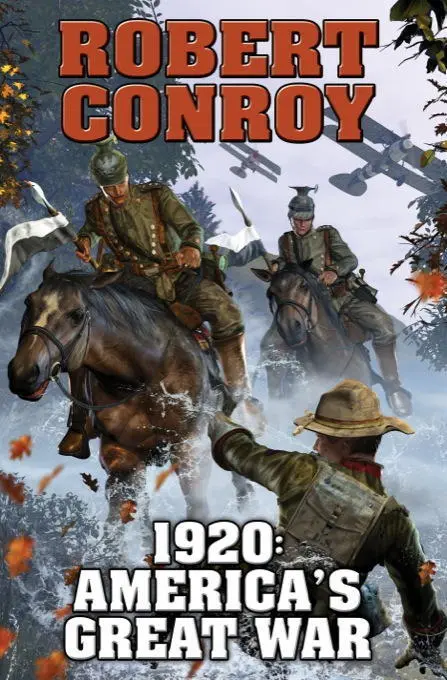
, a compelling alternate history thriller. After winning WW I, Germany invades America in 1920, marching through California and Texas as a desperate nation resists.
Consider another 1920: Imperial Germany has become the most powerful nation in the world. In 1914, she had crushed England, France, and Russia in a war that was short but entirely devastating.
By 1920, Kaiser Wilhelm II is looking for new lands to devour. The United States is fast becoming an economic super-power and the only nation that can conceivably threaten Germany. The U.S. is militarily inept, however, and is led by a sick and delusional president who wanted to avoid war at any price.Thus, Germany is able to ship a huge army to Mexico to support a puppet government.
Her real goal: the invasion and permanent conquest of California and Texas.
America desperately resists as the mightiest and most brutal army in the world in a battle fought on land, at sea, and in the air as enemy armies savagely marched up on California, and move north towards a second Battle of the Alamo. Only the indomitable spirit of freedom can answer the Kaiser’s challenge.
1920: America's Great War — читать онлайн бесплатно полную книгу (весь текст) целиком
Ниже представлен текст книги, разбитый по страницам. Система сохранения места последней прочитанной страницы, позволяет с удобством читать онлайн бесплатно книгу «1920: America's Great War», без необходимости каждый раз заново искать на чём Вы остановились. Поставьте закладку, и сможете в любой момент перейти на страницу, на которой закончили чтение.
Интервал:
Закладка:
“The man must have been exceptionally brave, or foolish,” the president said. “What is his status?”
“He is very seriously wounded,” March continued. “He is on his way to a hospital in Chicago. Frostbite has claimed both of his feet and he may lose a leg to wounds and infection. And this poses a question, sir. Since he was not in uniform, shall we hang him?”
Lansing paused. He had not been prepared for the question. Nor was he quite prepared to hang someone, in particular someone who was so bravely and obstinately doing his duty. “No, at least not yet. We will hold him as a possible future bargaining chip. Although,” he smiled, “if we should decide to hang him we will do so from a railroad trestle.”
The others laughed grimly. Nothing like a little macabre humor to brighten the day, Lansing thought.
General March interrupted. “The weapons and ammo are beginning to come off the assembly lines in quantity from Detroit and elsewhere. The original plan was to ship them by rail through the northern pass to Washington State and then down to California. With this out of the question for the foreseeable future, can we plan on using Canadian rail lines as a substitute?”
An interesting question, thought Lansing. He turned to his Secretary of State, “Any thoughts, Mr. Hughes?”
“We have spoken with both the governor general and the prime minister of Canada and they are reluctant to have large quantities of supplies shipped directly through Canada. They are afraid of retaliation from the German fleet if they are found out. However, they will allow humanitarian aid, such as food, and will assist us in evacuating civilians and wounded.”
“Better than nothing,” Lansing muttered.
Hughes continued. “I have directed our railroads to try to rent line space from the Canadians in the form of a detour north from the broken line, into Canada, and then south. If it is done as a private venture, without the direct collaboration of the Canadian government, we might get away with it until the bridge is rebuilt.”
“Will that happen?” Lansing asked.
“Not until the Canucks and the Brits are certain we can win and they’re on the right side, and right now they can’t be confident of that.”
Railroads were something always taken for granted. One could take a train from virtually anywhere in the United States to any other place in the large and sprawling nation. And, since the highways and roads were generally quite miserable, going by train was virtually the only viable way to travel any sort of distance. The disruption of the lines between California and the rest of the world had shocked everyone. Someday there would have to be paved highways connecting at least the major cities of the United States. Right now, most roads outside major cities were little more than the same dirt trails pioneers had traveled on in the previous century.
“And I’m sure you’re aware of the success we had in destroying their bomber fleet,” March said proudly. “I am recommending Major Eisenhower and Captain Martel each for a medal. It was exceedingly well done.”
Lansing beamed. “It indeed was.” The name Martel sounded familiar. Then he recalled the young officer who’d been with him that fateful night when he became president.
“And what of the Navy’s foray?” he asked.
“Successful,” said Navy Secretary Daniels. “Shots were exchanged, and the German fleet got stirred up and aggravated. They chased our ships back to the sound while the cruiser squadron slipped out unnoticed. After resupplying our subs at Catalina, the cruisers will sail forth as independent commerce raiders, while the destroyers will work in conjunction with the submarines.”
“Excellent,” said Lansing, “but too slow. We need something to inspire the American people. The delivery of supplies, however critical, is too prosaic. We need something dramatic.”
General March smiled. “Will you take Texas?”
“Sarge, what the hell did that sign say?”
Tim Randall yawned. He’d been sleeping soundly, something that hadn’t been happening all that much lately. The rocking of the train, however, was calming and helped him forget his personal agonies.
“What the hell do you think it said?” he answered grumpily. He had to teach these children who thought they were soldiers that you just don’t go around waking up sleeping sergeants. “You can read, can’t you?”
“Actually, he can’t read all that well, Sarge,” said one of the other men. “He’s from Poland. But the sign did say we’d just entered Texas, and that’s where we’ll be fighting, right?”
“It is,” Tim said, “but don’t get your knickers twisted. For those of you who’ve never seen a map, Texas is larger than most countries.”
“Jeez, Sarge, does that mean it’s larger than Camden?”
Tim stifled a grin. Every group had at least one smartass, and it looked like he had several. “Your sergeant requires sleep, so you do whatever you want. Just stay out of trouble, Private Asshole.”
Tim still couldn’t believe he was on a train, one of scores of them, rolling south through Texas. He had a squad of men and he was part of the Twelfth Infantry Division, which consisted of two Marine Corps regiments and two infantry regiments that had been cobbled together out of units from Pennsylvania and New Jersey. The regiments were all understrength as a result of the flu. A normal American division consisted of twenty thousand men. He’d heard that the Twelfth had fewer than fifteen thousand, all lightly trained and still lacking heavy weapons.
The flu. God, he wished he could forget about it. He’d stopped off in Camden to visit his family. He found his parents mourning the loss of their youngest son and leaving Tim with the vague feeling that they held him responsible for his brother’s death. On a whim and a need to get out of a house filled with despair and blame, he’d gone to visit Kathy Fenton. She had written him a couple of times while he was in training. She’d apologized to him for being so presumptuous their last night together and blamed it on the drink. He’d written back, apologizing for getting so stinking drunk and pawing her like a pig, although he’d phrased it a good deal more tactfully.
Kathy was in mourning too. Like Tim, she’d survived a touch of the flu, although it had been late in the season and fairly mild. However, she’d lost her sister and a cousin to the disease. She had lost a lot of weight, and was pale and grey. Her eyes looked haunted. He’d sat on her couch with her head on his shoulder while she cried. Then she’d looked in his eyes, seen his pain, and put his head on her shoulder, holding him tightly, like a baby, while he wept bitterly. Later, they parted. They’d kissed each other on the cheek and hugged. Yes, they said, they would continue to write. Tim wondered just where this would ever go.
He now commanded ten men on their way to kill other people. He knew he was inexperienced but what was truly frightening was the fact that his men were even rawer than he was. Some had only fired their rifles a couple of times. He wondered if the men in charge of the Army and the country had any idea what they were getting their men into. He’d read enough about the Civil War to know that inexperienced generals often get their men slaughtered. Pershing commanded the entire Texas Front army, while some Marine named Lejeune commanded the division. That too was funny. What the hell was a Marine doing in charge of an Army division?
“Sarge, any idea where the hell we’re going in this godawful big state?” Private Asshole asked.
“No,” he said, “but I’ll bet there’ll be Mexicans around.”
D.W. Griffith worked the projector. He barely glanced at Elise who smiled at being ignored. She was history. Griffith was in his element. The screen on the wall showed the German crossing of the Salinas River at San Luis Obispo.
Читать дальшеИнтервал:
Закладка:
Похожие книги на «1920: America's Great War»
Представляем Вашему вниманию похожие книги на «1920: America's Great War» списком для выбора. Мы отобрали схожую по названию и смыслу литературу в надежде предоставить читателям больше вариантов отыскать новые, интересные, ещё непрочитанные произведения.






Обсуждение, отзывы о книге «1920: America's Great War» и просто собственные мнения читателей. Оставьте ваши комментарии, напишите, что Вы думаете о произведении, его смысле или главных героях. Укажите что конкретно понравилось, а что нет, и почему Вы так считаете.