Robert Conroy - 1920 - America's Great War
Здесь есть возможность читать онлайн «Robert Conroy - 1920 - America's Great War» весь текст электронной книги совершенно бесплатно (целиком полную версию без сокращений). В некоторых случаях можно слушать аудио, скачать через торрент в формате fb2 и присутствует краткое содержание. Город: New York, Год выпуска: 2013, ISBN: 2013, Издательство: Baen Books, Жанр: prose_military, Альтернативная история, на английском языке. Описание произведения, (предисловие) а так же отзывы посетителей доступны на портале библиотеки ЛибКат.
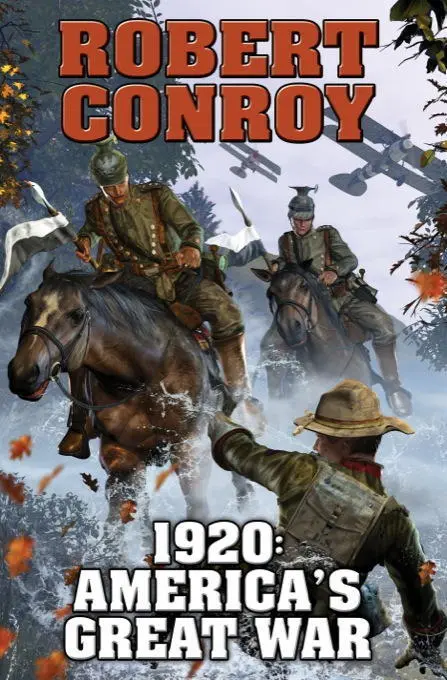
- Название:1920: America's Great War
- Автор:
- Издательство:Baen Books
- Жанр:
- Год:2013
- Город:New York
- ISBN:978-1-4516-3931-5
- Рейтинг книги:3 / 5. Голосов: 1
-
Избранное:Добавить в избранное
- Отзывы:
-
Ваша оценка:
1920: America's Great War: краткое содержание, описание и аннотация
Предлагаем к чтению аннотацию, описание, краткое содержание или предисловие (зависит от того, что написал сам автор книги «1920: America's Great War»). Если вы не нашли необходимую информацию о книге — напишите в комментариях, мы постараемся отыскать её.
and
, a compelling alternate history thriller. After winning WW I, Germany invades America in 1920, marching through California and Texas as a desperate nation resists.
Consider another 1920: Imperial Germany has become the most powerful nation in the world. In 1914, she had crushed England, France, and Russia in a war that was short but entirely devastating.
By 1920, Kaiser Wilhelm II is looking for new lands to devour. The United States is fast becoming an economic super-power and the only nation that can conceivably threaten Germany. The U.S. is militarily inept, however, and is led by a sick and delusional president who wanted to avoid war at any price.Thus, Germany is able to ship a huge army to Mexico to support a puppet government.
Her real goal: the invasion and permanent conquest of California and Texas.
America desperately resists as the mightiest and most brutal army in the world in a battle fought on land, at sea, and in the air as enemy armies savagely marched up on California, and move north towards a second Battle of the Alamo. Only the indomitable spirit of freedom can answer the Kaiser’s challenge.
1920: America's Great War — читать онлайн бесплатно полную книгу (весь текст) целиком
Ниже представлен текст книги, разбитый по страницам. Система сохранения места последней прочитанной страницы, позволяет с удобством читать онлайн бесплатно книгу «1920: America's Great War», без необходимости каждый раз заново искать на чём Вы остановились. Поставьте закладку, и сможете в любой момент перейти на страницу, на которой закончили чтение.
Интервал:
Закладка:
“And what will you do this time besides send out search parties, Mr. Olson?”
“Captain, if you’ve got a better idea, I’d love to hear it. You want me to hang a prisoner or two to make a point, I’ll do it, but the prisoners are surly enough now. I don’t think they’ll take to having some of them being strung up, especially in payment for a dead Mexican that they couldn’t possibly have hurt.”
Steiner’s response was silence. The American prisoners of war worked slowly at best, and neither man felt that a retaliatory execution would be a motivator. They needed the Yanks, however slowly they worked, to keep supplies flowing north to a hungry and thirsty German Army. The American prisoners had gotten over their shock of defeat and imprisonment and now their eyes were filled with hate. They seemed on the verge of bloody insurrection. No, it was better they work a little than not at all.
“I’m almost a hundred percent certain it’s Lew Dubbins,” Olson said. “He’s the last of the brothers alive and the only one with half a brain.”
“Maybe more than half by the way he’s eluded your men.”
“Maybe,” Olson admitted. “Dubbins was raised here, so he knows every place to hide. He could be fifty feet from here, laughing at us while we send patrols into the mountains that come back with squat.”
“So where is he?” Steiner asked.
“Probably in a hole in the ground, preferably in the shade. He’s likely got a full canteen and his head is covered with a dusty brown blanket. We could walk within ten feet of him and not see him. And the son of a bitch is definitely taunting us. He could have killed the four Mexicans he murdered earlier with a rifle, but he’s chosen to do it with clubs or knives.”
Olson shuddered. The first two’d had their throats slit, while the third, like the latest, had his skull turned to red and gray pulp.
Steiner disagreed. “If he’d used a rifle, it’d give us a direction and distance so we’d stand a chance of tracking and chasing him. No, by killing like he does, this Dubbins creature gives away nothing. Strange, but I did not visualize any of those unwashed Dubbins cretins as being great American patriots.”
Now Olson was on firmer ground. “They aren’t, Captain. Lew Dubbins is out for revenge for his brothers, nothing more than that. He’ll keep killing until he’s caught, or until you and I are both dead. Killing the Mexicans are just ways of keeping us on our toes and up all night.”
Olson mentioned that he’d found a scrawled and misspelled note on the latest victim saying that he and Steiner would be killed, too.
To Olson’s delight, Steiner looked nervous and glanced around. “Send out your patrols, Olson. The fool could not have gone too far.”
He hadn’t. Lew Dubbins was in a storeroom in the back of one of Roy Olson’s warehouses. Through a crack in the wall, he could see the two men conversing and they looked pissed. Good.
He heard a key turn in the door and he grabbed his rifle. He would go down fighting.
It was Martina Flores, Roy Olson’s mistress. She laughed at him. “Put down your weapon.”
Dubbins grinned at her. She’d brought food and water. Better, she’d brought him something else. She pushed him over on his back and unbuttoned his pants. She hiked up her skirts and put one of Roy Olson’s expensive condoms on Lew’s erection, then straddled his manhood. She smiled down at him. It felt good to betray Roy Olson by fucking this ignorant savage.
Martina had known for some time that her husband was dead and that Olson was using her. Maybe Dubbins would kill Olson, just like he bragged he would. In the meantime, she would reward him for each enemy soldier, Mexican or German, that he killed.
She had first seen Dubbins when his brother was executed. She had seen the rage in his face and knew that he would help her. She had made contact through one of the women in the village, an older woman who understood her situation and felt sorry for her.
Dubbins wasn’t much of a lover. After pawing her breasts and thighs a few times, he grunted and relaxed. “God, that was good,” he said.
Martina smiled warmly. To her, his exertions were far less than average. But it was a good reward for Dubbins. Someday, when the time was right, she’d get him to kill Olson for her and maybe even Steiner. In the meantime, he could stay in the storeroom for a couple of days until the patrols came back from their fruitless endeavors. Then she would smuggle him out of the camp and he could rest and wait for his next target of opportunity.
Winter in the mountains was unpleasant at best, even to an expert like Klaus Wulfram. He was cold, miserable, and alone. He felt numbness in his fingers that presaged frostbite. The last of his men had abandoned him. He still had some dynamite on his pack horse, though, and planned to use it.
After blowing the bridges he’d been assigned, Wulfram and his crew had hidden in an abandoned barn for a few days. Then they had simply taken an eastbound train to St. Louis, this time as Swedish businessmen. Fortunately, Wulfram’s ID was good, his Swedish language skills passable, and his cartoonish Swedish accent good enough to be accepted. He harbored some wild thought that he could destroy the bridges across the Mississippi, but quickly ascertained that the now aroused United States was watching them like a hawk. Also, there were more bridges than he could handle, but in the north where the great river wasn’t quite so wide.
In St. Louis he received a coded telegram saying that the bridges in the northern pass had not been sufficiently damaged, if they had been damaged at all. He was saddened by the obvious fact that a team of men he knew quite well had simply disappeared. His new orders said that he would try to rectify the situation.
A simple look around St. Louis showed how necessary destruction of the northern rail line was. Military supplies were beginning to pile up by the hundreds of tons, and there were literally thousands of men in uniform. They would not be anywhere near as good as a German soldier, but there were so many that they could possibly overwhelm a German force or, worse yet, successfully defend against the German advance on San Francisco. The northern pass must not reopen until after San Francisco fell and the American Army in California was destroyed, at which time it would be a moot point.
Money talked and ten dollars got him on a train to Spokane. There he changed to a train headed towards Seattle, where the railway was blocked by snow. The conductor told him the delay was temporary and that crews were shoveling as they talked. When no one was looking, he got off and began hiking into the woods. This time he was nowhere near as well equipped or armed as before and the tracks were being guarded.
He wished the others were with him, but he’d given them the choice of volunteering to stay with him or try to make their way south to the German or Mexican lines as best they could. They’d all said no to staying with him. They’d had enough. He was disappointed, but didn’t blame them.
Still, American guards could not be everywhere. Wulfram rented two horses, one for him and one for his supplies, and trekked into the snowy passes.
He managed a wan grin when he saw how deep the drifts were and how America’s Pacific Northwest was cut off from the rest of the world until the tracks could be dug out. But, deep as they were, that wasn’t good enough. His orders were to extend the problem for an additional several months.
He rode his horse through the waist-deep snow and wondered how far he could go before he had to admit failure and turn back. Then, just as he was about to give up, he found a bridge. A beautiful bridge, and it was over a wide and fast running branch of the Columbia River. It would more than do. The tracks on it were the only remaining link between the United States and California.
Читать дальшеИнтервал:
Закладка:
Похожие книги на «1920: America's Great War»
Представляем Вашему вниманию похожие книги на «1920: America's Great War» списком для выбора. Мы отобрали схожую по названию и смыслу литературу в надежде предоставить читателям больше вариантов отыскать новые, интересные, ещё непрочитанные произведения.







Обсуждение, отзывы о книге «1920: America's Great War» и просто собственные мнения читателей. Оставьте ваши комментарии, напишите, что Вы думаете о произведении, его смысле или главных героях. Укажите что конкретно понравилось, а что нет, и почему Вы так считаете.