Robert Conroy - 1920 - America's Great War
Здесь есть возможность читать онлайн «Robert Conroy - 1920 - America's Great War» весь текст электронной книги совершенно бесплатно (целиком полную версию без сокращений). В некоторых случаях можно слушать аудио, скачать через торрент в формате fb2 и присутствует краткое содержание. Город: New York, Год выпуска: 2013, ISBN: 2013, Издательство: Baen Books, Жанр: prose_military, Альтернативная история, на английском языке. Описание произведения, (предисловие) а так же отзывы посетителей доступны на портале библиотеки ЛибКат.
- Название:1920: America's Great War
- Автор:
- Издательство:Baen Books
- Жанр:
- Год:2013
- Город:New York
- ISBN:978-1-4516-3931-5
- Рейтинг книги:3 / 5. Голосов: 1
-
Избранное:Добавить в избранное
- Отзывы:
-
Ваша оценка:
1920: America's Great War: краткое содержание, описание и аннотация
Предлагаем к чтению аннотацию, описание, краткое содержание или предисловие (зависит от того, что написал сам автор книги «1920: America's Great War»). Если вы не нашли необходимую информацию о книге — напишите в комментариях, мы постараемся отыскать её.
and
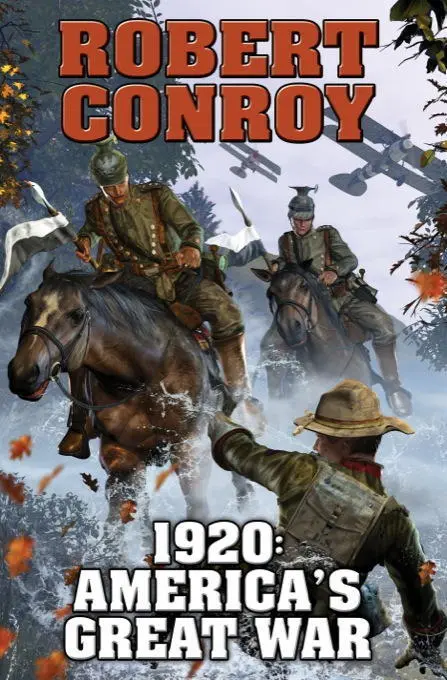
, a compelling alternate history thriller. After winning WW I, Germany invades America in 1920, marching through California and Texas as a desperate nation resists.
Consider another 1920: Imperial Germany has become the most powerful nation in the world. In 1914, she had crushed England, France, and Russia in a war that was short but entirely devastating.
By 1920, Kaiser Wilhelm II is looking for new lands to devour. The United States is fast becoming an economic super-power and the only nation that can conceivably threaten Germany. The U.S. is militarily inept, however, and is led by a sick and delusional president who wanted to avoid war at any price.Thus, Germany is able to ship a huge army to Mexico to support a puppet government.
Her real goal: the invasion and permanent conquest of California and Texas.
America desperately resists as the mightiest and most brutal army in the world in a battle fought on land, at sea, and in the air as enemy armies savagely marched up on California, and move north towards a second Battle of the Alamo. Only the indomitable spirit of freedom can answer the Kaiser’s challenge.
1920: America's Great War — читать онлайн бесплатно полную книгу (весь текст) целиком
Ниже представлен текст книги, разбитый по страницам. Система сохранения места последней прочитанной страницы, позволяет с удобством читать онлайн бесплатно книгу «1920: America's Great War», без необходимости каждый раз заново искать на чём Вы остановились. Поставьте закладку, и сможете в любой момент перейти на страницу, на которой закончили чтение.
Интервал:
Закладка:
Marshall had coerced a reluctant Henry Ford into manufacturing a thousand army trucks and more were coming. An additional two hundred were armor plated and awaited the machine guns or small cannon that would give them a lethal mobility like the German armored vehicles had. Other, smaller, automobile companies, like General Motors, were also supplying vehicles, and Harley Davidson was providing motorcycles, some with a sidecar that could also hold a machine gun.
Warehouses in Kansas City were stuffed with uniforms and other paraphernalia, including helmets, underwear, overcoats, boots, and socks. The Springfield Arsenal in Massachusetts had supplied a quarter of a million of the rifles that bore its name along with millions of rounds of ammunition. There were assurances that machine guns and the new Browning Automatic Rifles were on the way as well as artillery, but no one had seen anything yet. The factories were still tooling up. Production would begin soon, whenever the hell soon meant. Everyone knew that when the wheels of industry began to roll, there’d be weapons and ammunition galore, just not quite yet.
Even more frustrating, so much of the precious supplies they did have were just sitting there, out in a field, and gradually being covered with snow. With only one rail line working through the mountains to the northwestern states and then south to California, the bottleneck was enormous. And now it was the middle of the winter and a series of blizzards had struck, temporarily overwhelming any efforts to keep the tracks clear.
All three generals had come to the reluctant conclusion that significant aid to California might not be possible until late spring. General Liggett and the entire Pacific Coast Command were on their own until then. They could only hope and pray that Liggett could hold onto San Francisco. Or, barring that, at least maintain a military presence south of Portland. Or at least Seattle. Experts and intelligence said the Germans had no plans to go that far north, but who knew what the Germans would decide to do if San Francisco fell.
“If we can do nothing about California at this time, then we will move on Mexico,” Pershing said and March nodded. Marshall looked away. He clearly didn’t care which enemy was struck at first. He just wanted the supplies used against at least one of America’s enemies.
“We have to do something,” Pershing added, “and also be seen to be doing something. The American people are utterly frustrated by our lack of response and I cannot blame them for their anger. Between the lack of supplies, the lack of transportation, and the pneumonia in our camps, the American people are outraged. If we cannot cross into California, then we will have to take on the Mexicans and relieve the Texans.”
Fighting in Texas now centered on San Antonio where a state of siege existed. The Mexicans were finding the Texans a hard nut to crack and National Guard units from nearby states had already reinforced the hard-fighting but beleaguered Texans. It was felt that Mexico was vulnerable to a strong counterattack.
A soldier on a motorcycle drove up to them, dismounted, saluted, and handed General March an envelope. March read it and paled.
“What we do may not matter at all,” he said. “The disease striking our training camps has been identified as a particularly virulent form of influenza. It has apparently originated in the United States and not in Europe or Asia like epidemics normally do. Surgeon General Cumming believes this is the case because the influenza has only now begun to strike Europe. He has ordered all military facilities quarantined until further notice. All training must cease and no new recruits will be admitted. He now feels that perhaps a quarter of our army will die of this influenza; therefore, all emphasis must be on the survival of those who have not yet gotten the flu.”
He crumpled the note and threw it on the ground where a puff of wind took it and spun it. “If the surgeon general is correct, we could suffer hundreds of thousands of dead without firing a shot!”
Marshall looked at the mountains of supplies and the acres of parked vehicles. Was it possible that there would be no one to use them?
 CHAPTER 9
Work or get out of San Francisco was the gist of the blunt directive signed jointly by General Liggett and Admiral Sims. Despite the fact that thousands of people had been evacuated from San Francisco, many tens of thousands more had arrived from the south. The already tight situation regarding food and shelter was rapidly becoming critical. Useless mouths had to be sent away. Anyone who wished to enlist in the military or get to work on the city’s defenses was welcome to stay. Others had to leave unless they could prove themselves to be useful to the defense forces.
This did not go over well with some of the population. Those who’d just arrived as refugees were exhausted, often sick, and had no inclination to flee further. Like refugees everywhere, they often had little in the way of clothing, furniture, and had no idea where to stay. Those who had been living in San Francisco had survived earthquakes and fires, and didn’t feel that any damned army had the right to make them leave. There were confrontations and violence. Mayor Rolph didn’t like having his power usurped and let everyone know it. A couple of newspapers, in particular Hearst’s San Francisco Examiner , printed editorials saying the military administration was illegal and called for Californians to resist what it called an unlawful and unconstitutional occupation. General Liggett solved that problem by arresting an astonished Hearst and shutting down the Examiner . Skulls got cracked and a couple of people were killed by the military police. Finally, people began to get the message.
Kirsten thought the phrase “work or get out” had a marvelous ring to it. Right after arriving and getting settled in Elise’s small apartment, she had volunteered to work in food distribution. That it was pretty much what Roy Olson and the Germans had been forcing the people Raleigh to live with was a bit of irony that was not lost on her.
Before going to work, however, she’d presented a handful of drafts drawn on the Bank of Italy to its San Francisco office. The bank wasn’t in Italy, of course, it was in San Francisco and had been founded by a man named A.P. Giannini. It had survived the earthquake of 1906 and Kirsten had felt that made it a solid choice for her savings, which included the proceeds from her late husband’s insurance policies. She’d taken out some cash which enabled her to help Elise with some furniture issues as well as buying suitable clothing for herself. Both furniture and clothing were readily available at distressed prices.
Kirsten and a number of other clerks worked at tables in San Francisco’s massive Civic Center Auditorium. It had one hundred and twenty-two thousand square feet of floor space. The vast auditorium had been the site of the Republican Convention that had nominated the disgraced Warren Harding the previous summer. She could only wonder what might have happened had Harding won the presidency.
Kirsten confronted a very long line of confused and sometimes belligerent people. The people were hungry, tired, and confused, and why not? They’d been uprooted from their homes by an invading army that threatened to imprison them at best, murder and rape them at worst. This sort of thing just didn’t happen in California. Several refugees had actually told this to Kirsten, as if she could personally do something about it.
Her job was to register their names and issue appropriate ration cards. The “useless mouths” received temporary cards good for one week. At the end of that week it was hoped they’d be in another city and somebody else’s problem. They would get second cards only in the case of emergencies. She’d heard that Mayor Rolph and General Liggett were not in agreement over this, but political infighting was none of her concern.
Читать дальшеИнтервал:
Закладка:
Похожие книги на «1920: America's Great War»
Представляем Вашему вниманию похожие книги на «1920: America's Great War» списком для выбора. Мы отобрали схожую по названию и смыслу литературу в надежде предоставить читателям больше вариантов отыскать новые, интересные, ещё непрочитанные произведения.





Обсуждение, отзывы о книге «1920: America's Great War» и просто собственные мнения читателей. Оставьте ваши комментарии, напишите, что Вы думаете о произведении, его смысле или главных героях. Укажите что конкретно понравилось, а что нет, и почему Вы так считаете.