Robert Conroy - 1920 - America's Great War
Здесь есть возможность читать онлайн «Robert Conroy - 1920 - America's Great War» весь текст электронной книги совершенно бесплатно (целиком полную версию без сокращений). В некоторых случаях можно слушать аудио, скачать через торрент в формате fb2 и присутствует краткое содержание. Город: New York, Год выпуска: 2013, ISBN: 2013, Издательство: Baen Books, Жанр: prose_military, Альтернативная история, на английском языке. Описание произведения, (предисловие) а так же отзывы посетителей доступны на портале библиотеки ЛибКат.
- Название:1920: America's Great War
- Автор:
- Издательство:Baen Books
- Жанр:
- Год:2013
- Город:New York
- ISBN:978-1-4516-3931-5
- Рейтинг книги:3 / 5. Голосов: 1
-
Избранное:Добавить в избранное
- Отзывы:
-
Ваша оценка:
1920: America's Great War: краткое содержание, описание и аннотация
Предлагаем к чтению аннотацию, описание, краткое содержание или предисловие (зависит от того, что написал сам автор книги «1920: America's Great War»). Если вы не нашли необходимую информацию о книге — напишите в комментариях, мы постараемся отыскать её.
and
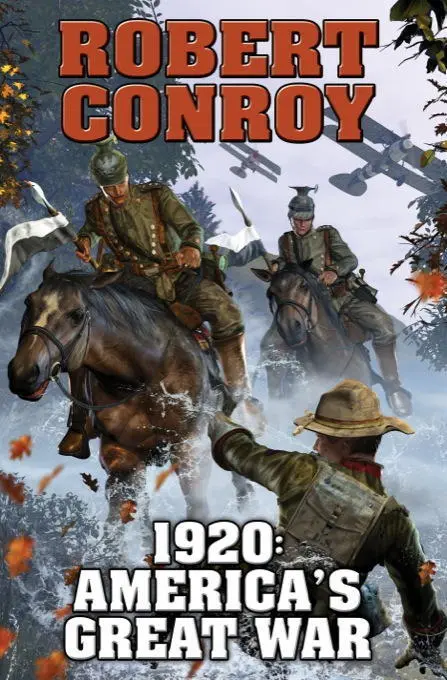
, a compelling alternate history thriller. After winning WW I, Germany invades America in 1920, marching through California and Texas as a desperate nation resists.
Consider another 1920: Imperial Germany has become the most powerful nation in the world. In 1914, she had crushed England, France, and Russia in a war that was short but entirely devastating.
By 1920, Kaiser Wilhelm II is looking for new lands to devour. The United States is fast becoming an economic super-power and the only nation that can conceivably threaten Germany. The U.S. is militarily inept, however, and is led by a sick and delusional president who wanted to avoid war at any price.Thus, Germany is able to ship a huge army to Mexico to support a puppet government.
Her real goal: the invasion and permanent conquest of California and Texas.
America desperately resists as the mightiest and most brutal army in the world in a battle fought on land, at sea, and in the air as enemy armies savagely marched up on California, and move north towards a second Battle of the Alamo. Only the indomitable spirit of freedom can answer the Kaiser’s challenge.
1920: America's Great War — читать онлайн бесплатно полную книгу (весь текст) целиком
Ниже представлен текст книги, разбитый по страницам. Система сохранения места последней прочитанной страницы, позволяет с удобством читать онлайн бесплатно книгу «1920: America's Great War», без необходимости каждый раз заново искать на чём Вы остановились. Поставьте закладку, и сможете в любой момент перейти на страницу, на которой закончили чтение.
Интервал:
Закладка:
The planes banked and came on the train from the other side. One plane veered and attacked the engine. The boiler exploded in a plume of white steam that billowed skyward. The engine rolled off the tracks with a maniacal howl, pulling the other cars with it.
Kirsten knew horror as the car she was in tilted to her left and slid down a small embankment with scores of people screaming. It stopped abruptly on its side, and the car was filled with dust and smoke, blinding her. She clawed her way upward, thankful that the train had fallen on its left side and not the right where she had been sitting looking out the window. There were people below her and she felt them pulling at her, trying in panic to climb over her. The smoke and dust choked her. She didn’t want to burn to death.
The dust and smoke settled a bit and, with the help of others, she got the window open wide enough for people to crawl out. People pushed and tried to claw their way past her. A heavyset man succeeded and kicked her in the face. She spat blood, and somehow managed to pull a hat pin from her purse. She jabbed it into his thigh, but he didn’t notice.
Finally, she climbed out and stood shakily on the side of the train. People were pouring out of the train like ants from a disturbed hill. The two German planes had disappeared. Their horrible work was done. The train was destroyed and the line itself had been damaged. No more trains would be traveling from Los Angeles to San Francisco, at least not on these tracks, for some time.
Where were Ella and Maria? She helped some people out through the window that had been by her seat while others climbed out other windows. Some were injured and bloody from bullet wounds and the crash, and a few were dead. Fortunately, most only looked stunned. Finally, Maria emerged through the window, pulling the limp form of Ella.
With help from other survivors, they got her out and down onto the ground. Ella was pale and not moving and her head was tilted in a strange position. Kirsten felt for a pulse and checked if she was breathing. Nothing.
“I tried,” said Maria, “but everything was crazy and she got crushed. She couldn’t defend herself against the panic.”
Ella was dead. Her neck was broken. Of course she couldn’t defend herself. She didn’t even know what world she was in. Kirsten wanted to cry but she was too angry. Nor was Ella the only fatality. Many other bodies lay limp, bloody and broken as good Samaritans pulled everyone from the cars. Many of the dead were women and children and Kirsten had a hard time fathoming what she was seeing. She could now really understand Ella’s withdrawal from reality. It was so tempting to run and hide in a world where sights like this were blocked out.
Mercifully, there had been no real fires, so everyone was spared that horror. Soon everyone, living and dead, had been taken from the train.
Some farmers came by with wagons and Kirsten could see they were appalled by the extent of the carnage. They loaded the injured onto the wagons and later came back for the dead. That evening, they buried Ella by a dirt road alongside a farmer’s field. Kirsten willed herself to remember the grave’s location. Thankfully, the farmer placed some rocks on the grave and logged her name and the place of her grave in a notebook. Someday they’d come back and give her a proper burial. She and Ella hadn’t always gotten along, far from it, but the woman deserved the decency in death she was denied at the end of her life.
Maria raised her eyes and looked at Kirsten. Now what, she was asking. Kirsten answered. “We have no choice but to go north and continue to San Francisco. The Germans aren’t going to stop at Los Angeles.”
It was almost four hundred miles from Los Angeles to San Francisco and they’d traveled maybe fifty of that distance before the disaster. Earlier, she had scoffed at the idea of walking to San Francisco. Now it seemed like the only viable alternative. She and Maria had a lot of walking ahead of them.
The crown prince was elated. His army had taken two major American ports, San Diego and Los Angeles, and a number of cities in between to be used as bases for future operations. He was certain his father, the emperor, would be proud of him and he was equally proud of his generals and his men.
And now the German Navy had arrived. He watched as the line of battleships and cruisers majestically entered Los Angeles harbor and anchored. A motor launch departed from the battleship Westfalen , the temporary flagship of the recently designated Pacific Fleet. The Pacific Fleet was the largest offshoot of the High Seas Fleet which remained in German waters and under the command of Admiral Scheer. The High Seas Fleet confronted England and the Royal Navy’s Home Fleet as it had for more than six years. The Pacific Fleet was commanded by Admiral Franz von Hipper, a fifty-seven-year-old professional. Like his subordinate, von Trotha, he’d felt cheated that there’d been no major battles in the 1914 war with the British. Von Hipper normally flew his flag from the Bayern , but that mighty battleship was on blockade duty off Puget Sound.
The two men greeted each other with warmth and mutual salutes. The Crown Prince suggested they go indoors for refreshments and the admiral happily agreed. When courtesies were over, they went to Wilhelm’s office in what had been Los Angeles’ city hall. A picture of Woodrow Wilson stared down at them as if in disapproval.
Hipper offered Wilhelm a cigar. “It’s Cuban, and most exquisite. I have to ask, your highness, just what is that acrid stench in the air?”
Wilhelm sighed. “What the Americans couldn’t take with them, they destroyed. Unfortunately, what you smell are the remains of the oil industry in Los Angeles. We have taken hostages and executed a number of them in reprisal for the damage that was caused to the refineries and storage facilities.”
Hipper sat upright, shock on his face. “What? How bad was the damage?”
“Quite complete, Admiral,” Wilhelm said, surprised at Hipper’s reaction. “The storage tanks and the refineries are very much ruined. Why?”
“Because, sir, we were counting on that oil, the diesel in particular. My ships swallow prodigious amounts of it and we had planned to refuel here at Los Angeles. After all, the Los Angeles area currently produces nearly a quarter of the world’s oil! My ships’ fuel tanks are almost empty after steaming from Germany to California and we were only able to take so much in the holds of accompanying tankers, and from storage depots in Indo-China.”
“Good God,” the crown prince said.
“Your highness, I must ask—did you receive word that every effort was to be made to take those refineries and storage tanks as intact as possible?”
Wilhelm flushed and mentally cursed himself. No, he had not been told. Berlin’s bureaucracy and the eternal rivalry between the Army and the Navy had probably raised its ugly head and someone had managed to “lose” the message. Some bureaucrat probably decided it would be great good fun if the upstart Navy ran out of fuel and was embarrassed. Of course he should have known about the fleet’s fuel and other logistical requirements without being told. A modern navy needed oil. Only a few years ago, the German Navy ran on coal, which was available in many places, but oil, however abundant, had to be refined before it could be used.
The prince’s own army needed oil, but in the form of gasoline which was rather more available than diesel. Cars and trucks used gas and there were many small storage facilities and gas stations to use to fill the army’s trucks and other vehicles. Of course the fact that the army also used tens of thousands of horses meant they had alternatives should the supply of gas dry up.
Читать дальшеИнтервал:
Закладка:
Похожие книги на «1920: America's Great War»
Представляем Вашему вниманию похожие книги на «1920: America's Great War» списком для выбора. Мы отобрали схожую по названию и смыслу литературу в надежде предоставить читателям больше вариантов отыскать новые, интересные, ещё непрочитанные произведения.






Обсуждение, отзывы о книге «1920: America's Great War» и просто собственные мнения читателей. Оставьте ваши комментарии, напишите, что Вы думаете о произведении, его смысле или главных героях. Укажите что конкретно понравилось, а что нет, и почему Вы так считаете.