Robert Conroy - 1920 - America's Great War
Здесь есть возможность читать онлайн «Robert Conroy - 1920 - America's Great War» весь текст электронной книги совершенно бесплатно (целиком полную версию без сокращений). В некоторых случаях можно слушать аудио, скачать через торрент в формате fb2 и присутствует краткое содержание. Город: New York, Год выпуска: 2013, ISBN: 2013, Издательство: Baen Books, Жанр: prose_military, Альтернативная история, на английском языке. Описание произведения, (предисловие) а так же отзывы посетителей доступны на портале библиотеки ЛибКат.
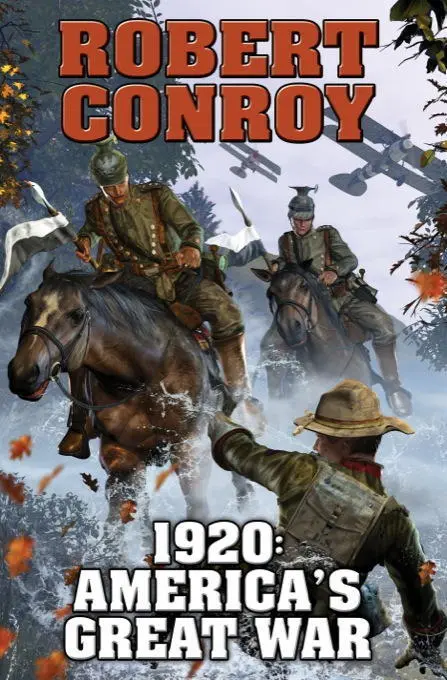
- Название:1920: America's Great War
- Автор:
- Издательство:Baen Books
- Жанр:
- Год:2013
- Город:New York
- ISBN:978-1-4516-3931-5
- Рейтинг книги:3 / 5. Голосов: 1
-
Избранное:Добавить в избранное
- Отзывы:
-
Ваша оценка:
1920: America's Great War: краткое содержание, описание и аннотация
Предлагаем к чтению аннотацию, описание, краткое содержание или предисловие (зависит от того, что написал сам автор книги «1920: America's Great War»). Если вы не нашли необходимую информацию о книге — напишите в комментариях, мы постараемся отыскать её.
and
, a compelling alternate history thriller. After winning WW I, Germany invades America in 1920, marching through California and Texas as a desperate nation resists.
Consider another 1920: Imperial Germany has become the most powerful nation in the world. In 1914, she had crushed England, France, and Russia in a war that was short but entirely devastating.
By 1920, Kaiser Wilhelm II is looking for new lands to devour. The United States is fast becoming an economic super-power and the only nation that can conceivably threaten Germany. The U.S. is militarily inept, however, and is led by a sick and delusional president who wanted to avoid war at any price.Thus, Germany is able to ship a huge army to Mexico to support a puppet government.
Her real goal: the invasion and permanent conquest of California and Texas.
America desperately resists as the mightiest and most brutal army in the world in a battle fought on land, at sea, and in the air as enemy armies savagely marched up on California, and move north towards a second Battle of the Alamo. Only the indomitable spirit of freedom can answer the Kaiser’s challenge.
1920: America's Great War — читать онлайн бесплатно полную книгу (весь текст) целиком
Ниже представлен текст книги, разбитый по страницам. Система сохранения места последней прочитанной страницы, позволяет с удобством читать онлайн бесплатно книгу «1920: America's Great War», без необходимости каждый раз заново искать на чём Вы остановились. Поставьте закладку, и сможете в любой момент перейти на страницу, на которой закончили чтение.
Интервал:
Закладка:
The night before they were shipped to Camp Dix, Tim had actually managed to get kissed. Kathy Fenton was nineteen, pretty enough, and lived down the street. She was a cashier at a Woolworth’s. They’d gone out a couple of times before and he wondered if they had a future. They’d all gotten more than a little drunk on some home made beer. Prohibition wasn’t the law, yet, although some said it was coming. Home brew seemed like a good way to practice for it. It had tasted like bad piss but it did contain alcohol, which gave everyone a buzz.
At any rate, Tim and Kathy had gone into a closet and made out like bandits. He’d kissed her hard and gotten his tongue in her mouth. She’d even let him touch her breast but stopped him when he tried to unbutton her blouse.
“Nothing more until we’re married,” she’d gasped.
Married? What the hell was she thinking of? He kissed her again and cupped her breast, outside the dress as she insisted, and she ground her pelvis against his erection. He decided it was better than nothing. Married? He liked her, but Jesus, was he ready to get married?
Later, he picked up Wally, who was staggering drunk, and they went home, confident they’d have hellacious hangovers the next morning, which they did. It made the trip to Dix even more memorable as about half the young men on the train were in the same fix. After one guy got sick, almost everyone lost yesterday’s lunches, turning the train into a stinking mess.
For several days after their arrival and getting uniforms, nothing happened in Camp Dix. They ate, they slept, and they wondered. Finally they were called out to the parade ground, all two hundred of the NCOs in training. They noticed similar groups gathering in other areas of the sprawling base.
A little man in an impeccable khaki uniform stood in front of them and ordered them to sit down on the ground. He had a multitude of stripes on his sleeve. He was barely five feet tall and skinny and wrinkled. He could have been anywhere from thirty to eighty years in age.
Instinctively, Wally and Tim knew this little man was to be both respected and feared.
“Oy yam here to train you,” he said. His accent was unidentifiable but he was definitely speaking something resembling English.
“Oy yam Sergeant Smith,” he pronounced it “Smeeth.” “And you will obey me in all things, and you will do so without hesitation or question. What I teach you might just save your fookin’ lives. If you have any difficulty with my accent or the way I talk or some strange words oy might use, it is because oy am from a little ways from here.”
Wally sucked in his breath and poked Tim. “I’ll say he’s a ways from here. He’s British. Jesus, they brought in the British Army to train us.”
Sergeant “Smith” paused. He heard the murmurings as his young trainees figured out what he’d said and not said. It was true, he thought with a happiness he dared not let them see. Americans were an intelligent lot. Smith and his companions at Dix and many other camps were ready to begin training the recruits. So what if they were still short of rifles and other tools of war. They would somehow make sure the recruits were at least as well prepared as the men he’d led at the Marne in 1914, or against the Boers years earlier. He knew he could not give these men his years of experience, but he could damn sure see to it that they were as ready as they could be when they faced down the Kaiser’s hordes.
He glared at them and they met his look. They showed curiosity, even respect, but no fear. “Oy hate the fookin’ Germans. Hate them with a fookin’ passion.” He saw he had their attention.
“Men, oy will train you to the best of your abilities. I will train you to achieve things you never thought you could possibly do and then you will do some more.”
He paused. “I will train you to defeat the fookin’ Germans!” His voice didn’t quite rise, but it did gain in strength.
“I will train you to kill the fookin’ Germans, and I will train you to drive their fookin’ Kraut asses out of your country! Now get up and get started!”
There was silence, and Smith wondered if he’d gone too far, or maybe he’d scared them, or maybe they hadn’t understood his thick Yorkshire accent. Then all two hundred men stood up and started applauding, and the applause turned to cheers, and the cheers to howls. Yes, he thought, this was going to be most interesting, and God damn the fookin’ Germans.
 CHAPTER 8
Kirsten, Ella, and Maria were jammed into seats on a train that moved north from Los Angeles towards San Francisco at little more than a snail’s pace.
People filled every seat and the overflow sat in the aisle of the passenger car, while others were forced to stand wherever they could find a spot. There was no place to move. The air was thick with the stench of sweat, fear, and urine, and not all came from the children and infants. A couple of fools actually tried to light up cigarettes or cigars in the confined space, which had made more people sick. They had been shouted at until they put them out.
Many adults had relieved themselves where they stood or sat, and Kirsten wondered just when her turn would come as her bladder was getting uncomfortably full. She couldn’t stand if she wanted to, and several people had passed out. Some were still upright, unable to even fall.
There were several other passenger cars in the train and she assumed they were all as stuffed with humanity as this one. Nor was anyone interested in taking tickets. A man who actually had tickets complained that people were in his family’s seats; he had been beaten up by squatters while his wife and two children looked on in horror, shrieking and crying.
Kirsten wished she could talk to Ella, who had vomited on herself. In a way, Kirsten envied Ella, who seemed oblivious to the world around her. Of course, she did talk to Maria who was a wonderful woman, but, like so many like her, was undereducated and had limited interests. She simply wanted to get to family in the north, while Kirsten also wanted to talk to someone about the collapse of civilization that was going on around her. Was the world really coming to an end? And what were their real chances of survival?
She also wanted to talk to someone, anyone, about bathroom facilities, drinking water, and food. She felt sweaty and dirty, but these were the least of her worries. She estimated that the train was going maybe twenty miles an hour tops and most of the time at speeds far less than that. This meant many more hours of confinement. Of course, she could always get out and walk. But all the way to San Francisco? She’d stick with the train.
She wondered what was going on in Ella’s mind. Her cousin still hadn’t spoken a word since her ordeal. When she got to San Francisco, Kirsten would have to find a psychiatrist for her. If Ella didn’t get better, Kirsten dreaded the thought of having to care for her, although she dreaded even more the thought of putting her into an asylum. She’d visited one once and thought she’d go mad herself at the sight of the inmates. She prayed that Ella would get better.
At least Kirsten had a window. If the wind was blowing from the right, it meant fresh air. If the wind blew from the front it meant coal smoke, cinders, and people yelling at her to close the damn thing.
A pair of specks in the sky caught her attention. Were they large birds, she wondered? No, they were airplanes. She felt a shiver of fear. Only the Germans had planes. Surely they would leave a train full of refugees alone.
The two planes banked and approached the train side on. Others in the train saw them and began to scream. Gunfire rippled from the planes’ machine guns. Bullets tore through the wooden walls of the railroad car, finding packed flesh. Screams changed to howls of pain and panic, but the train rumbled on as people died and blood poured from the cars.
Читать дальшеИнтервал:
Закладка:
Похожие книги на «1920: America's Great War»
Представляем Вашему вниманию похожие книги на «1920: America's Great War» списком для выбора. Мы отобрали схожую по названию и смыслу литературу в надежде предоставить читателям больше вариантов отыскать новые, интересные, ещё непрочитанные произведения.









Обсуждение, отзывы о книге «1920: America's Great War» и просто собственные мнения читателей. Оставьте ваши комментарии, напишите, что Вы думаете о произведении, его смысле или главных героях. Укажите что конкретно понравилось, а что нет, и почему Вы так считаете.