Leo Tolstoy - Android Karenina
Здесь есть возможность читать онлайн «Leo Tolstoy - Android Karenina» весь текст электронной книги совершенно бесплатно (целиком полную версию без сокращений). В некоторых случаях можно слушать аудио, скачать через торрент в формате fb2 и присутствует краткое содержание. Жанр: Классическая проза, Фэнтези, на английском языке. Описание произведения, (предисловие) а так же отзывы посетителей доступны на портале библиотеки ЛибКат.
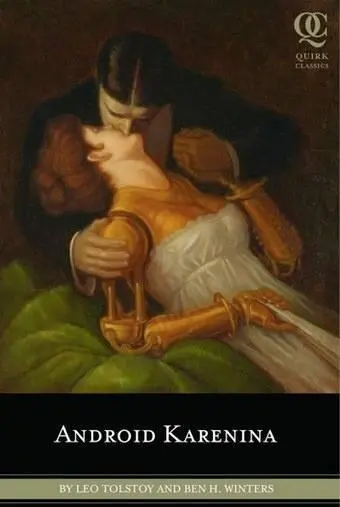
- Название:Android Karenina
- Автор:
- Жанр:
- Год:неизвестен
- ISBN:нет данных
- Рейтинг книги:5 / 5. Голосов: 1
-
Избранное:Добавить в избранное
- Отзывы:
-
Ваша оценка:
Android Karenina: краткое содержание, описание и аннотация
Предлагаем к чтению аннотацию, описание, краткое содержание или предисловие (зависит от того, что написал сам автор книги «Android Karenina»). Если вы не нашли необходимую информацию о книге — напишите в комментариях, мы постараемся отыскать её.
“Anna’s nightmare, one of the most famous passages in Anna Karenina, clearly anticipates the “steampunk‐inspired” atmosphere of Android Karenina… Tolstoy didn’t know about steampunk or cyborgs, but he did know about the nightmarishness of steam power, unruly machines, and the creepy half‐human status of the Russian peasant classes.” -Elif Batuman, author of The Possessed, via The New Yorker
“Whenever a truly pulpy trend reaches its apotheosis like this, I can’t help but wonder if we’ll get a new classic out of it.” -io9
“No word on whether she’ll [Anna] be bionically rebuilt following the ending, though. It’s good that this series is branching out to other authors…” -Entertainment Weekly
***
Android Karenina – Sense and Sensibility and Sea Monsters co-author Ben H. Winters is back with an all-new collaborator, legendary Russian novelist Leo Tolstoy, and the result is Android Karenina-an enhanced edition of the classic love story set in a dystopian world of robots, cyborgs, and interstellar space travel.
As in the original novel, our story follows two relationships: the tragic adulterous romance of Anna Karenina and Count Alexei Vronsky, and the much more hopeful marriage of Konstantin Levin and Kitty Shcherbatskaya.These four, yearning for true love, live in a steampunk-inspired 19th century of mechanical butlers, extraterrestrial-worshiping cults, and airborne debutante balls. Their passions alone would be enough to consume them-but when a secret cabal of radical scientific revolutionaries launches an attack on Russian high society's high-tech lifestyle, our heroes must fight back with all their courage, all their gadgets, and all the power of a sleek new cyborg model like nothing the world has ever seen.
Filled with the same blend of romance, drama, and fantasy that made the first two Quirk Classics New York Times best sellers, Android Karenina brings this celebrated series into the exciting world of science fiction.
Leo Tolstoy wrote two of the greatest novels in world literature: War and Peace and Anna Karenina.
Ben H. Winters is coauthor of Sense and Sensibility and Sea Monsters, which was hailed by The Onion A.V. Club as a "sheer delight" and by Library Journal as "strangely entertaining, like a Weird Al version of an opera aria." Mr. Winters lives in Brooklyn.
Android Karenina — читать онлайн бесплатно полную книгу (весь текст) целиком
Ниже представлен текст книги, разбитый по страницам. Система сохранения места последней прочитанной страницы, позволяет с удобством читать онлайн бесплатно книгу «Android Karenina», без необходимости каждый раз заново искать на чём Вы остановились. Поставьте закладку, и сможете в любой момент перейти на страницу, на которой закончили чтение.
Интервал:
Закладка:
“I am not acting in haste,” Alexei Alexandrovich said coldly, “but one cannot ask advice of anyone in such a matter. I have quite made up my mind.”
“This is awful!” said Stepan Arkadyich. “I would do one thing, Alexei Alexandrovich. I beseech you, do it!” he said. “No action has yet been taken, if I understand rightly. Before you take advice, see my wife, talk to her. She loves Anna like a sister, she loves you, and she’s a wonderful woman. For God’s sake, talk to her! Do me that favor, I beseech you! Do this, come and see my wife.”
“Well, we look at the matter differently,” said Alexei Alexandrovich coldly. “However, we won’t discuss it.”
“No, but why shouldn’t you come today to dine, anyway? My wife’s expecting you. Please, do come. And, above all, talk it over with her. She’s a wonderful woman. For God’s sake, on my knees, I implore you!”
“If you so much wish it, I will come,” said Alexei Alexandrovich, sighing.
“Believe me, I appreciate it, and I hope you won’t regret it,” answered Stepan Arkadyich, smiling. “Come, Small Stiva,” he said. Then, putting on his coat as he went, he cast one last nervous glance at the Class IV, patted Alexei Alexandrovich’s II/Footman/74 on the head, chuckled, and went out.
Alexei stood, shaking his head with irritation. He thought the word engage , and the eyes of the Class IV glowed to life. He thought the word reduce , and in the next instant the chair on which Stiva had perched burst into flames and burned quickly away to ash.
OH SO MANY THINGSsaid the Face, and Karenin’s mind echoed with terrible, cackling laughter.
CHAPTER 5
IT WAS PAST FIVE, and several guests had already arrived at the Oblonskys’ for dinner, before the host himself got home. He went in together with the intellectuals, Sergey Ivanovitch Koznishev and Pestsov, two men respected for their education and erudition, and widely known for their strong opinions on the Robot Question. Koznishev and Pestsov respected each other, but were in complete and hopeless disagreement upon almost every fine point of the subject, for each had his own special shade of opinion. Both men were leading exponents of what was known broadly as the Advancement Theory, holding that servomechanisms must and should grow in their intelligence and abilities. Koznishev believed that this process should be carefully overseen by the appropriate branches of the Ministry at each step, in order that robot capabilities remained carefully understood and contained. Koznishev considered himself an acolyte of the Jewish scholar Abraham Ber Ozimov, a rye merchant turned machine theorist from Petrovichi whose theories had inspired the Iron Laws, anticipating the need to safeguard against any future “rebellion of the machines.” Pestsov dismissed this idea of mechanical revolt as a fairy tale, the sort ofthing used to scare children into obeying their II/Governess/7s. He argued that the gadgetmen should go wherever their experimentation led them, and that their charges should be allowed to socialize more freely with each other, and with humankind. In this way, said Pestsov and his supporters, they could learn and grow in a natural and organic process.
Since no difference is less easily overcome than the difference of opinion about semi-abstract questions, the two intellectuals never agreed in any opinion, and had long, indeed, been accustomed to jeer without anger, each at the other’s incorrigible aberrations.
In the drawing room there were already sitting Prince Alexander Dmitrievich Shcherbatsky, Turovtsin, Kitty, and the stiff figure of Karenin, his telescoping oculus scanning the room.
Oblonsky worked his sociable magic on the assemblage in the drawing room, beginning them in innocuous but spirited conversation, and then, in the dining room he was met by Konstantin Levin and the familiar, angular figure of Socrates.
“I’m not late?”
“Of course we’re late. We were invited for half past seven, and at present the exact -”
“You can never help being late!” said Stepan Arkadyich, taking Levin’s arm and wagging a merry finger at Socrates.
“Have you a lot of people? Who’s here?” asked Levin, unable to help blushing, as his beloved-companion took his cap and carefully knocked the snow off it.
“All our own set. Kitty’s here. Come along, I’ll introduce you to Karenin.”
Stepan Arkadyich was well aware that to meet Karenin, a man of the Higher Branches, was sure to be felt as a flattering distinction, and so treated his best friends to this honor. But at that instant Konstantin Levin was not in a condition to feel all the gratification of making such an acquaintance. He had not seen Kitty since that memorable evening when he met Vronsky, not counting, that is, the moment when he had had a glimpse of her on the highroad, in her luminescent semiconscious state as she emerged from suspended animation. He had known at the bottom of his heart that he would see her here today. But now, when he heard that she was here, he was suddenly conscious of such delight, and at the same time of such dread, that his breath failed him and he could not utter what he wanted to say.
“Oh, please, introduce me to Karenin,” Levin brought out with an effort, and with a desperately determined step he walked into the drawing room and beheld her. And as he walked, Socrates, walking one step behind, said precisely what he was thinking, anxiously whispering the words into the nape of his neck, just above the level of thought: “What is she like, what is she like? Like what she used to be, or like what she was in the carriage? What if Darya Alexandrovna told the truth? Why shouldn’t it be the truth?”
She was not the same as she used to be, nor was she as she had been in the carriage; she was quite different.
She was scared, shy, shame-faced, and still more charming from it. She saw him the very instant he walked into the room. She had been expecting him. She was delighted, and so confused at her own delight that there was a moment, the moment when he went up to her sister and glanced again at her, when she, and he, and Dolly, who saw it all, thought she would break down and would begin to cry. She crimsoned, turned white, crimsoned again, and grew faint, waiting with quivering lips for him to come to her. Tatiana, her once-ignored, now-beloved Class III, sat beside her, gently massaging her knee. Levin went up to them, bowed, and held out his hand without speaking. Except for the slight quiver of her lips and the moisture in her eyes that made them brighter, her smile was almost calm as she said:
“How long it is since we’ve seen each other!” and with desperate determination she pressed his hand with her cold hand. Socrates bowed low to the charming Tatiana, who burbled coquettishly in return.
“You’ve not seen me, but I’ve seen you,” said Levin, with a radiant smile of happiness. “I saw you when you were driving from the railway station to Ergushovo: you were only just emerging from suspended animation, and what a lovely picture you did make.”
“When?” she asked, wondering.
“You were driving to Ergushovo,” said Levin, feeling as if he would sob with the rapture that was flooding his heart. He glanced with teary eyes at Socrates, as if to say: How dared I associate a thought of anything not innocent with this touching creature? Socrates’ eyebank flashed in warm understanding.
When it was time to be seated for dinner, quite without attracting notice, Stepan Arkadyich put Levin and Kitty side by side.
“Oh, you may as well sit there,” he said to Levin.
The dinner was as choice as the china, of which Stepan Arkadyich was a connoisseur. The soupe Marie-Louise was a splendid success; the tiny pies eaten with it melted in the mouth and were irreproachable. Small Stiva, acting the role of waiter in a charming little white cravat, did his duty with the dishes and wines unobtrusively, quietly, and swiftly. On the material side the dinner was a success; it was no less so on the immaterial. The conversation, at times general and at times between individuals, never paused, and toward the end the company was so lively that the men rose from the table without stopping speaking.
Читать дальшеИнтервал:
Закладка:
Похожие книги на «Android Karenina»
Представляем Вашему вниманию похожие книги на «Android Karenina» списком для выбора. Мы отобрали схожую по названию и смыслу литературу в надежде предоставить читателям больше вариантов отыскать новые, интересные, ещё непрочитанные произведения.







Обсуждение, отзывы о книге «Android Karenina» и просто собственные мнения читателей. Оставьте ваши комментарии, напишите, что Вы думаете о произведении, его смысле или главных героях. Укажите что конкретно понравилось, а что нет, и почему Вы так считаете.