Leo Tolstoy - Android Karenina
Здесь есть возможность читать онлайн «Leo Tolstoy - Android Karenina» весь текст электронной книги совершенно бесплатно (целиком полную версию без сокращений). В некоторых случаях можно слушать аудио, скачать через торрент в формате fb2 и присутствует краткое содержание. Жанр: Классическая проза, Фэнтези, на английском языке. Описание произведения, (предисловие) а так же отзывы посетителей доступны на портале библиотеки ЛибКат.
- Название:Android Karenina
- Автор:
- Жанр:
- Год:неизвестен
- ISBN:нет данных
- Рейтинг книги:5 / 5. Голосов: 1
-
Избранное:Добавить в избранное
- Отзывы:
-
Ваша оценка:
Android Karenina: краткое содержание, описание и аннотация
Предлагаем к чтению аннотацию, описание, краткое содержание или предисловие (зависит от того, что написал сам автор книги «Android Karenina»). Если вы не нашли необходимую информацию о книге — напишите в комментариях, мы постараемся отыскать её.
“Anna’s nightmare, one of the most famous passages in Anna Karenina, clearly anticipates the “steampunk‐inspired” atmosphere of Android Karenina… Tolstoy didn’t know about steampunk or cyborgs, but he did know about the nightmarishness of steam power, unruly machines, and the creepy half‐human status of the Russian peasant classes.” -Elif Batuman, author of The Possessed, via The New Yorker
“Whenever a truly pulpy trend reaches its apotheosis like this, I can’t help but wonder if we’ll get a new classic out of it.” -io9
“No word on whether she’ll [Anna] be bionically rebuilt following the ending, though. It’s good that this series is branching out to other authors…” -Entertainment Weekly
***
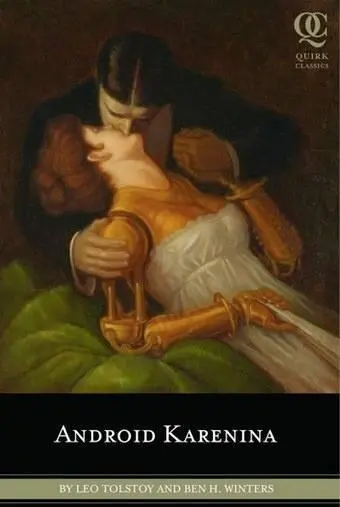
Android Karenina – Sense and Sensibility and Sea Monsters co-author Ben H. Winters is back with an all-new collaborator, legendary Russian novelist Leo Tolstoy, and the result is Android Karenina-an enhanced edition of the classic love story set in a dystopian world of robots, cyborgs, and interstellar space travel.
As in the original novel, our story follows two relationships: the tragic adulterous romance of Anna Karenina and Count Alexei Vronsky, and the much more hopeful marriage of Konstantin Levin and Kitty Shcherbatskaya.These four, yearning for true love, live in a steampunk-inspired 19th century of mechanical butlers, extraterrestrial-worshiping cults, and airborne debutante balls. Their passions alone would be enough to consume them-but when a secret cabal of radical scientific revolutionaries launches an attack on Russian high society's high-tech lifestyle, our heroes must fight back with all their courage, all their gadgets, and all the power of a sleek new cyborg model like nothing the world has ever seen.
Filled with the same blend of romance, drama, and fantasy that made the first two Quirk Classics New York Times best sellers, Android Karenina brings this celebrated series into the exciting world of science fiction.
Leo Tolstoy wrote two of the greatest novels in world literature: War and Peace and Anna Karenina.
Ben H. Winters is coauthor of Sense and Sensibility and Sea Monsters, which was hailed by The Onion A.V. Club as a "sheer delight" and by Library Journal as "strangely entertaining, like a Weird Al version of an opera aria." Mr. Winters lives in Brooklyn.
Android Karenina — читать онлайн бесплатно полную книгу (весь текст) целиком
Ниже представлен текст книги, разбитый по страницам. Система сохранения места последней прочитанной страницы, позволяет с удобством читать онлайн бесплатно книгу «Android Karenina», без необходимости каждый раз заново искать на чём Вы остановились. Поставьте закладку, и сможете в любой момент перейти на страницу, на которой закончили чтение.
Интервал:
Закладка:
Joining him, she pressed his hand tightly.
“You’re not angry that I sent for you? I absolutely had to see you,” she said; and the serious and set line of her lips, which he saw under the veil, transformed his mood at once.
“I, angry?” he stammered, taken aback by her somber demeanor. “Of course not! But-how have you come, where from?”
“Never mind,” she said, laying her hand on his. “I must talk to you.”
She and Android Karenina were standing beneath a flowering tree, of a kind that Vronsky had never seen before, with large, overhanging emerald petals. The tree had an unfamiliar and vaguely foreboding appearance, which seemed in keeping with Anna’s expression. Vronsky saw clearly that something had happened, and that the rendezvous would not be a joyous one. For all the elation he had felt just a minute before, in her presence he had no will of his own: without knowing the grounds of her distress, he already felt the same distress unconsciously passing over him. He felt like a robot who’d had a burst of rainwater splashed violently behind its faceplate, shorting out his ability to reason and rendering him a useless, immobile hunk of man-shaped debris.
“What is it? What?” he asked her, squeezing her hand with his elbow, and trying to read her thoughts in her face.
She waited a few steps in silence, leaning against the trunk of the peculiar tree, gathering her courage; then suddenly she stopped.
“Yesterday,” she began, breathing quickly and painfully, “coming home with Alexei Alexandrovich I told him everything… told him I could not be his wife, that… and told him everything.”
He heard her, unconsciously bending his whole figure down to her as though hoping in this way to soften the hardness of her position for her. But as soon as she had said this he suddenly drew himself up, and a proud and hard expression came over his face.
“Yes, yes, that’s better, a thousand times better! I know how painful it was,” he said.
But she was not listening to his words; she was reading his thoughts from the expression of his face. She could not guess that that expression arose from the first idea that presented itself to Vronsky-that a duel was now inevitable. The idea of a duel had never crossed her mind, and so she put a different interpretation on this passing expression of hardness.
For Anna, when she got her husband’s communiqué, she knew at the bottom of her heart that everything would go on in the old way, that she would not have the strength of will to forego her position, to abandon her son, and to join her lover. But this talk with Vronsky was still of the utmost gravity for her. She had hoped that their conversation would transform her position, and save her. If on hearing this news he were to say to her resolutely, passionately, without an instant’s wavering: “Throw up everything and come with me!” she would give up her son and go away with him. But her news had not produced what she had expected in him; he simply seemed as though he were resenting some affront.
“It was not in the least painful to me. It happened of itself,” she said irritably, “and see… “With a brusque gesture, she directed Android Karenina to play the communiqué for Vronsky.
“I understand, I understand,” he interrupted her, ignoring the android’s display, not hearing Anna’s words, only trying to in vain to soothe her. As he held her in his arms he happened to glance above her head, and observed that one of the unusual tree’s emerald flowers had suddenly blossomed-at least, the flower was open, and he was certain, or thought he was certain, that only a moment ago it had been quite shut.
“Anna,” he began, but then drew silent, staring at the curious tree as it grew more curious still: A thin film had emerged from within the bell of the flower, and it descended slowly, pouring down over the sides, as if a child with a Class I toy were inside the plant, blowing a bubble.
Anna scowled at his distraction, and he shook his head and focused his eyes upon her. “The one thing I longed for,” he continued, “the one thing I prayed for, was to cut short this position, so as to devote my life to your happiness.”
“Why do you tell me that?” she said. “Do you suppose I can doubt it? If I doubted-”
A sudden noise made Vronsky start. “Who’s that coming?” he asked, pointing to two ladies walking toward them. “Perhaps they know us!” He abruptly took a step backward into the foliage.
“Oh, I don’t care!” Anna said, turning away from him. Her lips were quivering. And he fancied that her eyes looked with strange fury at him from under the veil. “Just see what he says to me. Watch the communiqué.” She cued Android Karenina to begin again.
Vronsky watched the display, and once again was unconsciously carried away by the sensations aroused in him by his own relation to the betrayed husband. Now he could not help picturing the challenge, which he would most likely find at home today or tomorrow, and the duel itself, in which, with the same cold and haughty expression that his face was assuming at this moment, he would await the injured husband’s shot, after having himself gallantly fired his smokers into the air. And at that instant there flashed across his mind the thought of what Serpuhovskoy had said to him, and what he had himself been thinking in the morning-that it was better not to bind himself-and he knew that this thought he could not tell her.
Neither Anna nor Vronsky, preoccupied by these thoughts and counter-thoughts running through their minds while the communiqué played, noticed what transpired directly above her head: the transparent film oozing from the odd flowering tree had silently ballooned outward to huge, though near-invisible, proportions. Now, like a soap bubble, it popped free of the tree and closed around Anna’s body, so thin and transparent as to be imperceptible even as it hardened into an impenetrable shell.
“You see the sort of man he is,” Anna said, with a shaking voice. “He…”
“I rejoice at this!” Vronsky said, speaking at the same time. Each was on their own side of the unseen sphere, and so neither could hear the other; and with Anna looking off into the distance, neither could even see that the other was speaking.
“Things can’t go on as they have,” Vronsky continued. “hope that now you will leave him. I hope that you will let me arrange and plan our life.”
Unaware, Anna carried on her own conversation: “… my child! I should have to leave him!”
Android Karenina looked around curiously. Lupo sniffed the air, with a dawning awareness that something was dreadfully amiss.
And so it went. Not hearing, both lovers simply assumed they knew what the other was thinking. When Vronsky finally looked away from Android Karenina’s monitor and raised his eyes to Anna, she did not know what caused them to seem so implacable; she knew only that, whatever he might say to her, he would not say all he thought. And she was certain her last hope had failed her. This was not what she had been reckoning on. And while these sickening thoughts chased themselves around in her mind, the sides of the near-invisible sheath drew taut under her feet like the cinching of a drawstring sack, and she lurched off the ground and up into the air.
“My God!” Vronsky shouted, noticing her for the first time:” Anna! You are floating!”
As if the strange conveyance that was carrying Anna into the air somehow knew it had been discovered, it accelerated the upward motion with which it was lifting her off her feet. Lupo leaped up on his powerful, pneumatic-actuated legs toward the mysterious conveyance, but it was already too high to be reached.
“Stay the thing, Lupo!” shouted Vronsky, reverting at once to his regimental training. Lupo, settling back on his haunches, made his wide, fierce mouth into a perfect O and howled out a resonating battle-cry, sending a precisely modulated echo wave toward the base of Anna’s airborne prison-steadying it against the wind and holding it in place. Vronsky searched furiously for a way to deliver Anna to safety, even as, in the back of his mind, he wondered: first a godmouth, and now this bubble-like cage of a prison? UnConSciya was trying to capture or kill Anna Karenina. But why?
Читать дальшеИнтервал:
Закладка:
Похожие книги на «Android Karenina»
Представляем Вашему вниманию похожие книги на «Android Karenina» списком для выбора. Мы отобрали схожую по названию и смыслу литературу в надежде предоставить читателям больше вариантов отыскать новые, интересные, ещё непрочитанные произведения.



Обсуждение, отзывы о книге «Android Karenina» и просто собственные мнения читателей. Оставьте ваши комментарии, напишите, что Вы думаете о произведении, его смысле или главных героях. Укажите что конкретно понравилось, а что нет, и почему Вы так считаете.