Derek Robinson - Damned Good Show
Здесь есть возможность читать онлайн «Derek Robinson - Damned Good Show» весь текст электронной книги совершенно бесплатно (целиком полную версию без сокращений). В некоторых случаях можно слушать аудио, скачать через торрент в формате fb2 и присутствует краткое содержание. Город: New York, Год выпуска: 2013, ISBN: 2013, Издательство: MacLehose Press, Жанр: Историческая проза, prose_military, на английском языке. Описание произведения, (предисловие) а так же отзывы посетителей доступны на портале библиотеки ЛибКат.
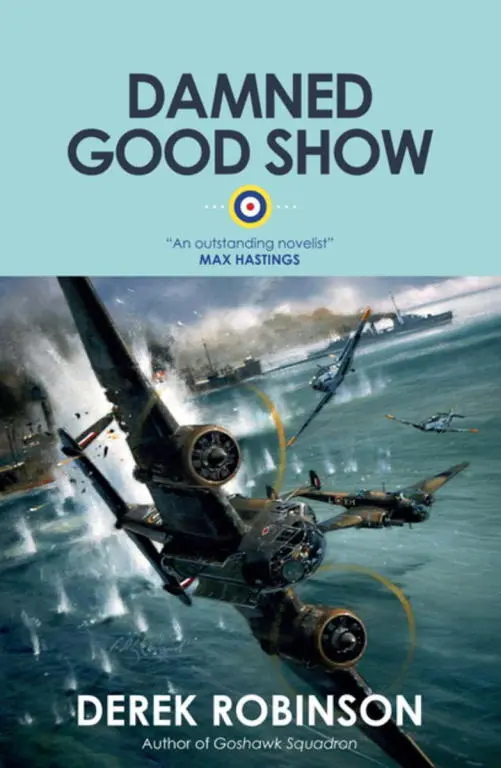
- Название:Damned Good Show
- Автор:
- Издательство:MacLehose Press
- Жанр:
- Год:2013
- Город:New York
- ISBN:978-1-62365-322-4
- Рейтинг книги:3 / 5. Голосов: 1
-
Избранное:Добавить в избранное
- Отзывы:
-
Ваша оценка:
Damned Good Show: краткое содержание, описание и аннотация
Предлагаем к чтению аннотацию, описание, краткое содержание или предисловие (зависит от того, что написал сам автор книги «Damned Good Show»). Если вы не нашли необходимую информацию о книге — напишите в комментариях, мы постараемся отыскать её.
Robinson’s crooked salute to the dogged heroes of the R.A.F.’s early bombing campaign is a wickedly humourous portrait of men doing their duty in flying death traps, fully aware, in those dark days of war, there was nothing else to do but dig in and hang on.
Damned Good Show — читать онлайн бесплатно полную книгу (весь текст) целиком
Ниже представлен текст книги, разбитый по страницам. Система сохранения места последней прочитанной страницы, позволяет с удобством читать онлайн бесплатно книгу «Damned Good Show», без необходимости каждый раз заново искать на чём Вы остановились. Поставьте закладку, и сможете в любой момент перейти на страницу, на которой закончили чтение.
Интервал:
Закладка:
At first the bomber was overdue; then missing. “Sitting in their dinghy, I expect,” Pixie Hunt said. “Who knows?” Germany Calling claimed to know. The announcer—already famous as Lord Haw-Haw—stated in his bogus upper-class drawl that the German navy had destroyed a Hampden bomber. “Easily said,” Hunt grunted. Later, Lord Haw-Haw gave the serial number of the bomber, found on wreckage floating in the Baltic. “Gentlemen of the RAF stationed at Kindrick in Lincolnshire should not trespass in German waters,” he added. Hunt had nothing to say about that.
The next day, Langham drove home through a perfect, placid, warm English spring morning. The top of the Frazer-Nash was down. Healthy country smells blew in and out of the car. His backside still ached, his eyes itched and wouldn’t stop blinking, his mouth remembered the taste of oxygen, and he was happy to be alive. A rabbit fled ahead, and he touched the brakes until it found safety in a hole in the hedge. Well done, bunny.
Zoë came out to meet him. “Look,” she said. Their apple tree was in blossom.
“What a clever girl you are.”
She put her hands on his shoulders and examined his face. The impressions left by his helmet and oxygen mask were very faint but she knew where to look. “Did you have a good night at the office, darling?”
“Usual routine, sweetie. Took off, stooged about, landed.”
It was what they always said.
He sat at the garden table and ate an enormous breakfast: eggs, bacon, mushrooms, fried potatoes, pork sausagemeat, racks of toast, coffee in a half-pint tankard. She snacked from his plate and told him the local gossip. He smiled and nodded. Part of his mind was still five hundred miles away, near the Danish port of Middelfart, good for a laugh at briefing but no joke when D-Dog broke cloud at six hundred feet and the rain was so heavy that Jonty Brown couldn’t tell if they were over land or water. The flak batteries didn’t hesitate. They splattered the night with red and yellow shellbursts. Jonty saw gun-flashes reflected in water. “There’s the channel!” he shouted. “Not bloody likely,” Langham said. His right hand opened the throttles as his left hand hauled back the stick. D-Dog raised her nose and climbed through the scattered fragments of a dying shellburst. The turmoil of air rocked the wings and shrapnel punched ragged holes in the cockpit Perspex. Rain howled past observer and pilot. Then D-Dog was back in the clouds. Eventually Jonty found an unguarded stretch of channel, they dropped their mines and flew home, sometimes in drenching rain, sometimes above the weather where the air was arctic and ice formed inside the cockpit. Always Langham was sitting in a raging gale.
And now here he was, drowsy in the sunlight, tossing bits of toast for sparrows brave enough to swoop on the table, and admiring his wife’s splendid legs while he wished his left arm would stop twitching. He put his left hand in his pocket and told it to behave. Zoë was talking about a clever seamstress who was making her some heavenly tweed slacks for the country.
“What’s wrong with your jodhpurs?”
“Everyone’s wearing jodhpurs, darling. And they don’t suit everyone. Haven’t you noticed?”
His fingers found a spiky lump of metal in his pocket and he took it out. “I thought you might like to have this. Sort of keepsake.” She fingered it and made a face. “Just shrapnel,” he said. “Found it on the floor of the cockpit when we landed.”
“It’s so ugly. It’s vicious.”
“I suppose so. That’s its job, to be vicious.” He took it back and held it against the sun, between finger and thumb, like a gem. “Missed me, though.”
She saw the sharp, twisted metal so near his face. “It’s hateful,” she said. “Get rid of it.” He threw it, hard, out of the garden, into a bramble patch. “Best place for it,” he said.
They went to bed, as they always did when he came back from a night op, and he was asleep while she was still closing the curtains. He awoke alone. She heard him moving about, and came upstairs. They went back to bed and held each other, skin against skin. She could feel his heart beating. Nothing aroused him; nothing. “Never mind,” she said.
“I must have left it in Denmark. It’s a tragedy. Like Hamlet.”
“No, it’s not. It’s nothing like that.”
He put his head deep under the bedclothes. “You’re absolutely right,” he said. “Doesn’t look a bit like Hamlet. In fact it bears rather a close resemblance to Polonius. Wrinkled and bent.”
“Be patient, my love. Next time will be twice the fun.”
They lay side by side. She stroked his leg with the sole of her foot. “Happy Hall got the chop,” he said.
“Oh. Did I meet him?”
“He was at the wedding. He was a good type.”
There was nothing more to be said about that. She listened to the frightful silence of Lincolnshire and wished it was London. He realized that his left arm had stopped twitching, and was glad.
NO IMPROVEMENT
April ended. Langham’s problem did not. He blamed the strain of nightly Gardening ops. Zoë gave him iron tablets to suck.
The fight for Norway was obviously lost. Many of 409’s crews were not sorry to see it end. The Danish Narrows had become too hot. The North Sea was a long haul for a Hampden trudging home with flak-damage and casualties on board; and sometimes the casualties, wrapped in parachutes against the freezing air howling down the fuselage, died before the Hampden landed.
409 got stood down. Langham took Silk in the Frazer-Nash to a country pub, the Black Swan. They sat beside a canal and drank beer and read newspapers. “What a monumental cock-up,” Silk said.
“Censored, too. The truth must be worse. If possible.”
“I’ll tell you what’s worse. I’ve been given a different navigator. Gilchrist. The matinée idol.”
“He can’t be as bad as that bloke you sacked. Name like a fairy.”
“Nimble. He wasn’t stupid, he was duff. Flak made him freeze. This Gilchrist’s a Brylcreem boy. He should be flying Spits.”
“You don’t like him.”
“He hasn’t got the balls for bombers.”
“He stood up to Rafferty, though. That took balls.”
“No, it took galloping stupidity. He hadn’t been here ten minutes and he put up a black! Who needs a comedian for a nav? Gilchrist’s been kicked from kite to kite. He’s a bloody jinx. Now the Wingco’s dumped him on me. The Wingco hates me.”
“Christ Almighty,” Langham said. “You’re in a foul stinking temper today, Silko.”
Silk grunted. He was leaning forward, elbows on knees. He watched a pair of wild ducks fly along the canal, lower their flaps and undercarriage, and make a perfectly greased landing. “Wish I could do that,” he said. “Yesterday I bounced like a bloody kangaroo.”
“Everybody has bad days.”
“Yeah. What worries me is, I didn’t care. Shitty landing, and I didn’t give a tiny toss.” He took out a coin. “And here is the tiny toss I didn’t give. Remember this?”
“That’s your lucky penny.”
“It’s been on every op I’ve done.” He spun it and caught it. “Heads or tails? What are the odds?”
“Evens, of course. Fifty-fifty.”
“Yeah. But suppose you call heads nine times in a row and you win all nine. Now…” He tossed again, and covered the penny with his hand. He looked Langham in the eyes. “Still fifty-fifty?”
“Logic says yes, but…”
“But you’re not convinced.” Silk threw the penny in the canal. “Fuck luck. The chop is the chop is the chop. End of story.”
They finished their beer and walked along the towpath. “You need some leave,” Langham said.
Читать дальшеИнтервал:
Закладка:
Похожие книги на «Damned Good Show»
Представляем Вашему вниманию похожие книги на «Damned Good Show» списком для выбора. Мы отобрали схожую по названию и смыслу литературу в надежде предоставить читателям больше вариантов отыскать новые, интересные, ещё непрочитанные произведения.





Обсуждение, отзывы о книге «Damned Good Show» и просто собственные мнения читателей. Оставьте ваши комментарии, напишите, что Вы думаете о произведении, его смысле или главных героях. Укажите что конкретно понравилось, а что нет, и почему Вы так считаете.