Heinrich Gerlach - Breakout at Stalingrad
Здесь есть возможность читать онлайн «Heinrich Gerlach - Breakout at Stalingrad» весь текст электронной книги совершенно бесплатно (целиком полную версию без сокращений). В некоторых случаях можно слушать аудио, скачать через торрент в формате fb2 и присутствует краткое содержание. Город: London, Год выпуска: 2018, ISBN: 2018, Издательство: Head of Zeus, Жанр: Историческая проза, prose_military, на английском языке. Описание произведения, (предисловие) а так же отзывы посетителей доступны на портале библиотеки ЛибКат.
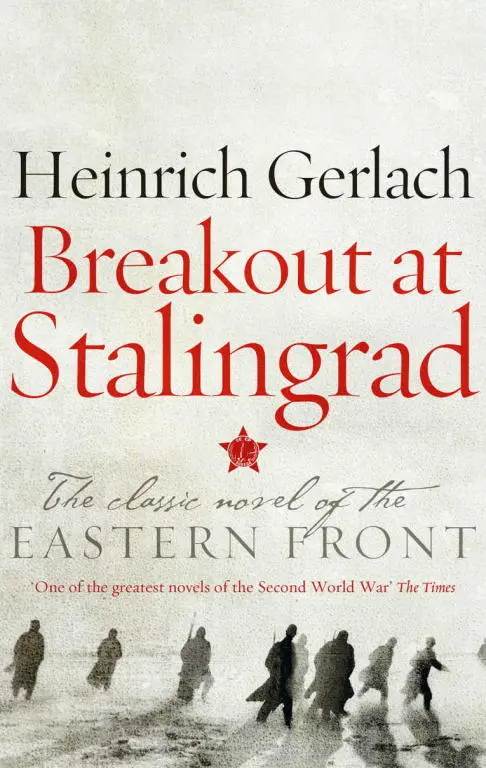
- Название:Breakout at Stalingrad
- Автор:
- Издательство:Head of Zeus
- Жанр:
- Год:2018
- Город:London
- ISBN:978-1-786-69062-3
- Рейтинг книги:3 / 5. Голосов: 1
-
Избранное:Добавить в избранное
- Отзывы:
-
Ваша оценка:
Breakout at Stalingrad: краткое содержание, описание и аннотация
Предлагаем к чтению аннотацию, описание, краткое содержание или предисловие (зависит от того, что написал сам автор книги «Breakout at Stalingrad»). Если вы не нашли необходимую информацию о книге — напишите в комментариях, мы постараемся отыскать её.
Lieutenant Breuer dreams of returning home for Christmas. Since August, the Germans have been fighting the Soviets for control of the city on the Volga. Next spring, when battle resumes, the struggle will surely be decided in Germany’s favour. Between 19 and 23 November, however, a Soviet counterattack encircles the Sixth Army. Some 300,000 German troops will endure a hellish winter on the freezing steppe, decimated by Soviet incursions, disease and starvation. When Field Marshal Paulus surrenders on 2 February 1943, just 91,000 German soldiers remain alive.
A remarkable portrayal of the horrors of war, Breakout at Stalingrad also has an extraordinary story behind it. Its author, Heinrich Gerlach, fought at Stalingrad and was imprisoned by the Soviets. In captivity, he wrote a novel based on his experiences, which the Soviets confiscated before releasing him. Gerlach resorted to hypnosis to remember his narrative, and in 1957 it was published as The Forsaken Army. Fifty-five years later Carsten Gansel, an academic, came across the original manuscript of Gerlach’s novel in a Moscow archive. This first translation into English of Breakout at Stalingrad includes the story of Gansel’s sensational discovery.
Written when the battle was fresh in its author’s mind, Breakout at Stalingrad offers a raw and unvarnished portrayal of humanity in extremis, allied to a sympathetic depiction of soldierly comradeship. After seventy years, a classic of twentieth-century war literature can at last be enjoyed in its original version.
Breakout at Stalingrad — читать онлайн бесплатно полную книгу (весь текст) целиком
Ниже представлен текст книги, разбитый по страницам. Система сохранения места последней прочитанной страницы, позволяет с удобством читать онлайн бесплатно книгу «Breakout at Stalingrad», без необходимости каждый раз заново искать на чём Вы остановились. Поставьте закладку, и сможете в любой момент перейти на страницу, на которой закончили чтение.
Интервал:
Закладка:
‘Extraordinary shape, isn’t it? Looks like the Crimea!’
‘More like the Free City of Danzig if you ask me! About the same size too!’
‘Well, I measured it just for the fun of it. It’s roughly sixty kilometres long by thirty-five wide, takes in an area of about thirteen hundred square kilometres and has a front totalling a hundred and fifty kilometres in length.’
‘And just a tiny speck in the vast Russian wasteland… Don’t know about you, but I’d rather be in Danzig right now!’
‘Now, now, gentlemen! No need to go losing our nerve quite yet! We’ve got twenty-two divisions and three hundred thousand men… what do we imagine is going to happen? We could break out from here any time we liked if we had to. But why would we want to do that! Think of it as a game! At this rate we’ll beat the endurance record of the Cholm Cauldron; then we’ll be the ones with bragging rights.’
Soon enough, though, it became anything but a game.
The short winter days were equally bleak for the men trapped in the Cauldron, no matter whether the sun rose like a glowing ball of fire in the east and, after a brief transit across the frost-spangled aluminium dome of the firmament, sank once more below rose-tinted snowfields, or whether the sky and the Earth merged together in a dirty grey. And the agonizing nights stretched on interminably, filled with the monotonous drone of aircraft engines, the chatter of machine guns and the dull rumble of artillery fire. Its bottomless blackness was rent time and again by the yellow flashes of gunfire, perforated by the bright pearl strings of tracer bullets and erased for minutes on end by the limelight of star shells and parachute flares. There was talk of ‘days of rest’. But the fighting never took time off. And hope bled to death on the frost-hard ground of real life.
A few kilometres west of the village of Pitomnik, on the road to Novo Alexeyevsky, stood a hamlet of three or four tumbledown houses, with a group of vehicles clustered around them like a herd of sheep. Above the door of one of the houses hung a rough-hewn wooden board bearing the legend ‘Regional Command’. Just at that moment, a man emerged, cast an anxious glance up at the sky (which, now it was three o’clock in the afternoon German time, was almost completely dark), turned up his coat collar and walked briskly away, adeptly picking his way down the treacherously icy road. The strong wind lifted the hem of his short, waisted fur jacket like a ballerina’s tutu. Sergeant Major Harras was immensely proud of his new wardrobe, particularly the white leather peaked cap with a lambswool lining, which the Staff HQ tailor, following Harras’s own instructions, had run up for him. Only today, a soldier from another unit had addressed him as ‘Captain’. Harras was in a hurry to get back to his bunker. It got a little spooky around the houses here once darkness fell. Captain Fackelmann, who had recently been appointed regional CO of Dubininsky (‘really prime location, don’t you think, this handful of hovels!’), had just shown him the place where the two bombs had landed last night, immediately behind the commander’s house. ‘Honestly, I ask you! A lorry and an armoured scout car completely destroyed, one wall of the house almost flattened, half the tiles blown off the roof, and of course all the windows shattered!’ Now they had to sit behind the boarded-up windows in candlelight, even during the daytime. The sergeant major turned off on to a side path that went north. There, a few hundred metres from the main road, an entire city of sizeable proportions had sprung up. Row upon row of snow-dusted dugouts, densely packed, with blackish smoke rising from them, and in between several rough-looking shacks, antenna masts, steaming field kitchens, and vehicles hastily camouflaged with limewash, either half-buried in the ground or with banks of snow built up around them to protect them from bomb splinters. In among this confused mess ran a spider’s web of driveable tracks and footpaths. Looking at this wintry army camp, Harras was always reminded of the polar research station he’d once seen in a documentary film. Even the infantrymen, swaddled in their winter gear and their felt boots, didn’t look much different from Eskimos. The only things missing were polar bears and dog sleds. Sergeant Major Harras pinned back his ears. He could clearly hear a noise somewhere between a rattle and a drone. Their first ‘sewing machine’! – that was the name the German troops gave the Russian ‘U2’ trainers, small biplanes that were sent out under cover of darkness to harass German positions. Towards the airfield at Pitomnik, a parachute flare suddenly lit up the night sky. It floated there virtually motionless, flooding the snowy landscape with a yellowish-red light. The dull thump of bombs drifted over. The remarkable thing was that the Russian pilots were leaving the polar settlement here almost unscathed. They’d probably mistaken the huge collection of lorries and other vehicles for some sort of junkyard. Besides, the nearby aerodrome acted as a lightning rod. In actual fact, it was pretty cosy here. They were right in the middle of the Cauldron, out of range of the Soviet artillery. It would surely be far more uncomfortable to be with the units fighting on the southern front.
‘Damn and blast it!’ Harras had tripped over something hard, lying directly across the path. It was a human body, pressed into the mud, still just about recognizable from the tatters of frozen-stiff brown cloth it was dressed in. Some Romanian or Russian who’d starved to death, or been run over or shot – who could say? Its bare feet, a sickly greenish hue, protruded from the snow, and its head had been flattened by the wheels of vehicles. The acting sergeant major’s sense of order was outraged at the sight. Incredible to leave a body lying around like this! When the thaw came, it’d stink to high heaven round here. He gave the corpse another kick. But it had merged with the frozen mud to become one inseparable unit, and refused to budge. Harras cast his eyes around. Was he even on the right path still? You were forever getting lost in this labyrinth. They really ought to put up some signs to help people find their way! But no sooner did these go up than they were stolen for firewood. He trudged on angrily. Ah, at least things were thinning out a bit now! He appeared to have reached the western fringe of the foxhole city. He stopped to get his bearings again. That black box shape over there, surely that was their unit’s bus, and that might well be the CO’s car behind it, and where the old jalopy was, the intelligence officer’s bunker couldn’t be far off… All of a sudden, Harras tensed, his head straining forward like a predator waiting to pounce. No doubt about it, a figure was squatting right next to the low roof of the bunker! A naked backside, turned to the wind, stood out palely against a dark frame of clothing. Just you wait, you pig, I’ll have you! Like a stooping hawk, Harras shot towards the crouching lump of humanity.
‘Are you out of your tiny mind?’ he shouted. The figure rose, holding up his trousers with his left hand, and trying with his right to cover as best he could the place where, on a respectable soldier, the rear seam of his trouser seat would be.
‘Well, well, what a surprise!’ drawled Harras, relishing every word. ‘Herr Lakosch – of course, it had to be you! Don’t you know it’s against regulations to defecate within fifty metres of the bunker?’
‘Yes, sir, Sar’nt-Major, sir!’
‘So what do you think you’re playing at?’ By now, the biting easterly wind had chilled Lakosch to the marrow, and his teeth were chattering violently. Harras took it to be the effect of his commanding personality. But the little driver’s response soon put him wise on that score.
Читать дальшеИнтервал:
Закладка:
Похожие книги на «Breakout at Stalingrad»
Представляем Вашему вниманию похожие книги на «Breakout at Stalingrad» списком для выбора. Мы отобрали схожую по названию и смыслу литературу в надежде предоставить читателям больше вариантов отыскать новые, интересные, ещё непрочитанные произведения.





Обсуждение, отзывы о книге «Breakout at Stalingrad» и просто собственные мнения читателей. Оставьте ваши комментарии, напишите, что Вы думаете о произведении, его смысле или главных героях. Укажите что конкретно понравилось, а что нет, и почему Вы так считаете.