Heinrich Gerlach - Breakout at Stalingrad
Здесь есть возможность читать онлайн «Heinrich Gerlach - Breakout at Stalingrad» весь текст электронной книги совершенно бесплатно (целиком полную версию без сокращений). В некоторых случаях можно слушать аудио, скачать через торрент в формате fb2 и присутствует краткое содержание. Город: London, Год выпуска: 2018, ISBN: 2018, Издательство: Head of Zeus, Жанр: Историческая проза, prose_military, на английском языке. Описание произведения, (предисловие) а так же отзывы посетителей доступны на портале библиотеки ЛибКат.
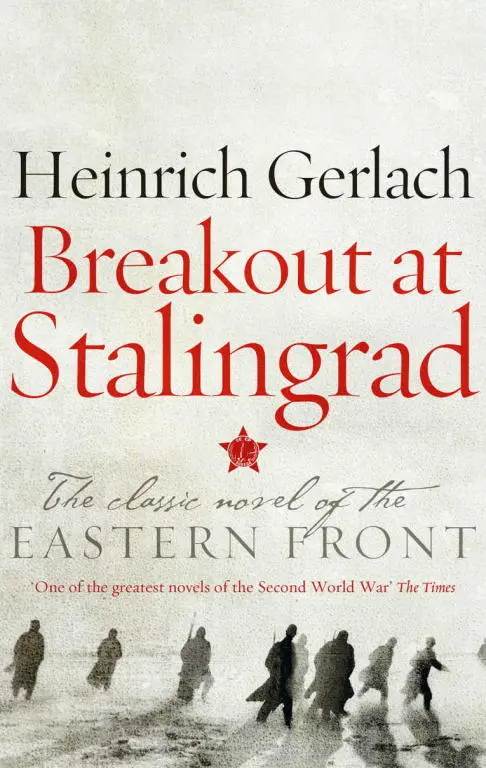
- Название:Breakout at Stalingrad
- Автор:
- Издательство:Head of Zeus
- Жанр:
- Год:2018
- Город:London
- ISBN:978-1-786-69062-3
- Рейтинг книги:3 / 5. Голосов: 1
-
Избранное:Добавить в избранное
- Отзывы:
-
Ваша оценка:
Breakout at Stalingrad: краткое содержание, описание и аннотация
Предлагаем к чтению аннотацию, описание, краткое содержание или предисловие (зависит от того, что написал сам автор книги «Breakout at Stalingrad»). Если вы не нашли необходимую информацию о книге — напишите в комментариях, мы постараемся отыскать её.
Lieutenant Breuer dreams of returning home for Christmas. Since August, the Germans have been fighting the Soviets for control of the city on the Volga. Next spring, when battle resumes, the struggle will surely be decided in Germany’s favour. Between 19 and 23 November, however, a Soviet counterattack encircles the Sixth Army. Some 300,000 German troops will endure a hellish winter on the freezing steppe, decimated by Soviet incursions, disease and starvation. When Field Marshal Paulus surrenders on 2 February 1943, just 91,000 German soldiers remain alive.
A remarkable portrayal of the horrors of war, Breakout at Stalingrad also has an extraordinary story behind it. Its author, Heinrich Gerlach, fought at Stalingrad and was imprisoned by the Soviets. In captivity, he wrote a novel based on his experiences, which the Soviets confiscated before releasing him. Gerlach resorted to hypnosis to remember his narrative, and in 1957 it was published as The Forsaken Army. Fifty-five years later Carsten Gansel, an academic, came across the original manuscript of Gerlach’s novel in a Moscow archive. This first translation into English of Breakout at Stalingrad includes the story of Gansel’s sensational discovery.
Written when the battle was fresh in its author’s mind, Breakout at Stalingrad offers a raw and unvarnished portrayal of humanity in extremis, allied to a sympathetic depiction of soldierly comradeship. After seventy years, a classic of twentieth-century war literature can at last be enjoyed in its original version.
Breakout at Stalingrad — читать онлайн бесплатно полную книгу (весь текст) целиком
Ниже представлен текст книги, разбитый по страницам. Система сохранения места последней прочитанной страницы, позволяет с удобством читать онлайн бесплатно книгу «Breakout at Stalingrad», без необходимости каждый раз заново искать на чём Вы остановились. Поставьте закладку, и сможете в любой момент перейти на страницу, на которой закончили чтение.
Интервал:
Закладка:
And to what end? No one could say. Somewhere out there, far in the distance, lay Germany. The colonel, though, gives no outward sign of his irritable mood. He gives his troops pep talks, gees them up, and prevents any rash and senseless actions by giving clear orders.
The route is lined with silent reminders of those who have gone before them: abandoned vehicles, dying horses, discarded equipment, smashed crates, scattered papers; signs of coercion, of defeat. ‘A trial of endurance,’ muses the colonel, ‘physical and psychological. It’s vital we get through it.’
As night falls, fires of destruction flicker in the surrounding fields, beacons of impending victory for the enemy! The colonel has forbidden his men from indulging in this pointless torching. He knows only too well the corrosive effect of an orgy of destruction sanctioned by military order. Horses plod by, breathing heavily, with long white needles of ice hanging from their mouths and nostrils. The carts are loaded with the wounded, as the proper ambulances are already full to bursting. Behind them come the infantry’s field guns, drawn by teams of men, twenty harnessed to each gun. With cries of ‘Heave… ho!’ the men strain to pick up the slack on the ropes. In their wake, the heavy artillery rumbles slowly along, the white-caked steel of the wheels squeaking as it cuts into the drifts of snow. Slave labour! Spurring them on is their belief that this senseless task has some sense, their blind faith in their commanders.
‘So far so good, Colonel!’ shouts the sergeant. ‘If only those gun tractors would turn up soon!’ The gun tractors from the quartermaster’s unit – they were supposed to be here ages ago!
The colonel drives on, past other vehicles and squads of marching men. From somewhere in the darkness, a Stalin organ fires rockets in a high arc, shooting with a venomous hiss across the night sky and trailing comet tails behind them. The distant noise of a firefight from behind, the rearguard defending the column. A faint rumbling is also coming from up front, somewhere to the left. The northern fortified position! A bicycle company wheels its machines past through the snow; the exhaled breath of the panting men hangs over them like a cloud of steam. Medical orderlies come by with stretchers, or drag travois behind them carrying wounded men. Infantrymen drag along heavy machine guns and cases of ammunition, clinging on to them for grim death. As long as they’ve still got guns and equipment, order will prevail. Their heavy burden is sheer torment for the body, but a psychological crutch for the soul. Ahead, a lorry has slewed across the road, blocking the way. A jam starts to form. The lorry’s axle is broken, and the driver’s lying drunk in the cab. The troops swarm over the truck like ants, rummaging through its load with furtive glances. Nobody makes any move to clear the obstruction. A bottle starts to circulate among a group of men standing off to one side. An officer steps in, his young voice rising to a shrill pitch.
‘Get rid of that alcohol this instant! Do you want to catch hypothermia? Lend a hand here! Put your shoulders into it, you shitheads!’ The colonel has stepped out of his car.
‘Calm down, Schneider, calm down!’ he tells the young lieutenant. He knows that the men will see sense. They’ll rally round all right. But this isn’t the way to deal with them, not tonight.
‘Okay, lads, let’s shift this thing, right?’ he calls out, grabbing hold of the back of the truck and bracing himself. ‘There’ll be plenty of time for a drink later, when we’ve got to where we’re going!’
His words break the spell. The lorry is manhandled off the road, leaving the way clear again. The colonel takes the driver with him into the Volkswagen and wraps him up in blankets. He’s a young man who’s tried to drink himself into oblivion and has no idea how close he came to death. His nose and cheeks are already showing signs of frostbite. Presently, the road starts to descend a steep hill. Another of those damned balkas ! [2] Balkas – the balka , an eroded valley forming a steep-sided gorge or gully, was a characteristic feature of the terrain around the River Volga near Stalingrad.
The slope down the gorge is covered in ice. The men slip and slide down it in long chains. The vehicles have to be winched down on ropes. While this is going on, a high-pitched voice rises above the general hubbub:
‘Hold it… Hold it, will you! Over to the right a bit! And put the brakes on, man, for Christ’s sake!’
It’s the company commander of the First. He’s got a bullet wound through his shoulder. He didn’t manage to get airlifted out in time, so the unit’s become his home and hospital. Without warning, a gun breaks loose and, tumbling over with a thunderous roar, cartwheels down into a knot of men, a steel avalanche. The air is filled with screams and moans… The night has claimed its first victims. And then they spot them – the two gun tractors they’ve been hoping to see all along! One of them has broken through the weak bridge at the bottom of the gorge. It’s firmly wedged there, blocking their path. The other one’s marooned helplessly on the far bank. The frozen surface of the river won’t bear such a huge weight. Sergeant Strack jumps up on the running board of the colonel’s car. He gives Steigmann an imploring look, but his voice fails him. He’s at his wits’ end.
‘Blow up the lot!’ the colonel snaps. Suddenly he looks old and haggard. The sergeant stays rooted to the spot in seeming incomprehension. So was all this in vain, all this superhuman effort? He can see himself having to file loss reports, and face court-martial proceedings for losing a gun… Is he supposed to just destroy his own artillery, and the world will carry on as normal?
‘Blow it up?’ he asks in disbelief. ‘Our guns? What, all of them?’
In his six years of service, he’s never questioned an order in this way. But extraordinary events change people. The colonel understands.
‘No questions, Strack!’ he says, in an almost fatherly tone. ‘Even I can’t question orders.’
Finally, they make it to a larger road.
‘Stop! Sto-op!’
Are they at their destination? No, not yet, not by a long chalk. It’s just a rest stop. The glowing remains of a burned village in the first light of dawn. Amid the smoke of the ruined houses, on the verge between fire and ice, they drift into sleep, men and horses all packed together, showered with crackling sparks from the flames.
A message comes in from the rearguard. ‘The enemy are still in pursuit, but keeping their distance. We’ve taken out two of their tanks!’
Two T-34s destroyed! A murmur ripples through the ranks. They haven’t got us yet! We’re still in the game, we’re still up for a scrap! After a few minutes’ pause, the column sets off again. They’ve got everything with them, including the wounded and even the dead. Only their heavy guns are missing, and their armoured ammunition tractor, which is trying to find a passable way through across the fields. They’ve made it through the first terrible night, they’ve survived their trial of endurance. They’re still managing to keep it all together.
The colonel motors slowly past the tightly packed column. His face now no longer conceals his grave concern or the immense strain he’s under. Sergeant Strack approaches him again.
‘We’ve made it through after all, Colonel!’ he calls. ‘It was hard, mind… And our beautiful guns! Oh well, couldn’t be helped. Things like that don’t happen for nothing, I suppose!’
The colonel doesn’t reply; his face has taken on a stony expression. No, he thinks, not for nothing. Hopefully not for nothing.
The crossing over the Don. The line of marching men, baggage trucks, tanks and guns snaked endlessly over the high ground, wound its way down to the wide river, traversed the wooden bridge, passed through the village of Peskovatka on the east bank and was swallowed up in the vast steppe leading to the city of Stalingrad. Their worst fears had not been realized. Spared by the Russian artillery (which had kept the northern river crossing at Vertyachi under constant bombardment) and largely untroubled by the occasional bombing by Soviet planes, the task of getting the army across the Don was accomplished in a calm and collected way and without major incident. This regained sense of order also brought with it a new-found confidence that the crisis had been overcome.
Читать дальшеИнтервал:
Закладка:
Похожие книги на «Breakout at Stalingrad»
Представляем Вашему вниманию похожие книги на «Breakout at Stalingrad» списком для выбора. Мы отобрали схожую по названию и смыслу литературу в надежде предоставить читателям больше вариантов отыскать новые, интересные, ещё непрочитанные произведения.





Обсуждение, отзывы о книге «Breakout at Stalingrad» и просто собственные мнения читателей. Оставьте ваши комментарии, напишите, что Вы думаете о произведении, его смысле или главных героях. Укажите что конкретно понравилось, а что нет, и почему Вы так считаете.