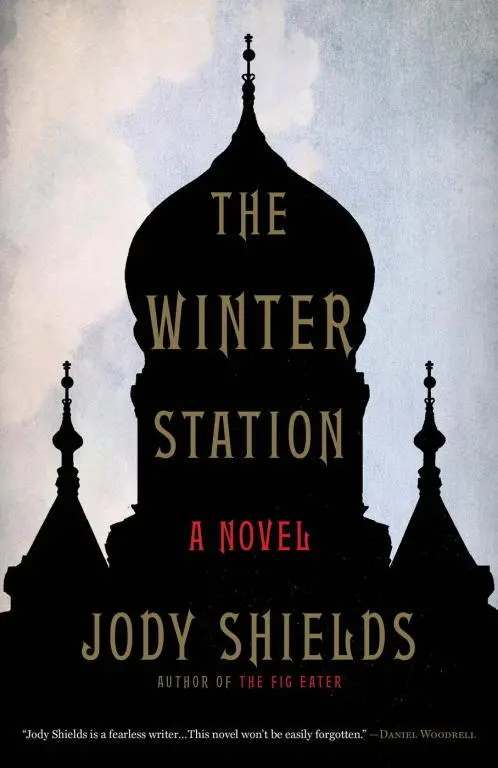
Jody Shields - The Winter Station
Здесь есть возможность читать онлайн «Jody Shields - The Winter Station» весь текст электронной книги совершенно бесплатно (целиком полную версию без сокращений). В некоторых случаях можно слушать аудио, скачать через торрент в формате fb2 и присутствует краткое содержание. Город: New York, Год выпуска: 2018, ISBN: 2018, Издательство: Little, Brown and Company, Жанр: Историческая проза, thriller_medical, на английском языке. Описание произведения, (предисловие) а так же отзывы посетителей доступны на портале библиотеки ЛибКат.
- Название:The Winter Station
- Автор:
- Издательство:Little, Brown and Company
- Жанр:
- Год:2018
- Город:New York
- ISBN:978-0-316-38532-9
- Рейтинг книги:5 / 5. Голосов: 1
-
Избранное:Добавить в избранное
- Отзывы:
-
Ваша оценка:
The Winter Station: краткое содержание, описание и аннотация
Предлагаем к чтению аннотацию, описание, краткое содержание или предисловие (зависит от того, что написал сам автор книги «The Winter Station»). Если вы не нашли необходимую информацию о книге — напишите в комментариях, мы постараемся отыскать её.
1910: people are mysteriously dying at an alarming rate in the Russian-ruled city of Kharbin, a major railway outpost in Northern China. Strangely, some of the dead bodies vanish before they can be identified.
During a dangerously cold winter in a city gripped by fear, the Baron, a wealthy Russian aristocrat and the city’s medical commissioner, is determined to stop this mysterious plague. Battling local customs, an occupying army, and a brutal epidemic with no name, the Baron is torn between duty and compassion, between Western medical science and respect for Chinese tradition. His allies include a French doctor, a black marketeer, and a charismatic Chinese dwarf. His greatest refuge is the intimacy he shares with his young Chinese wife—but she has secrets of her own.
Based on a true story that has been lost to history, set during the last days of imperial Russia, THE WINTER STATION is a richly textured and brilliant novel about mortality, fear and love.
The Winter Station — читать онлайн бесплатно полную книгу (весь текст) целиком
Ниже представлен текст книги, разбитый по страницам. Система сохранения места последней прочитанной страницы, позволяет с удобством читать онлайн бесплатно книгу «The Winter Station», без необходимости каждый раз заново искать на чём Вы остановились. Поставьте закладку, и сможете в любой момент перейти на страницу, на которой закончили чтение.
Интервал:
Закладка:
“The infected have few symptoms—fever, racing pulse, blue lips, bloody expectoration—until shortly before death. So the infection swiftly passes from person to person like a secret.” Messonier held up the glasses. “How does it spread? Contact with blood? Is it in the air? On the skin? Here, let me pour.”
“That’s the puzzle. One thing is certain. There’s no point at which the infection can be stopped. Except for it not to start.” The Baron made a gesture of benediction. “It’s a diabolical maze. We can only quarantine the infected from the uninfected.”
“If you can find them in time. At first cough.” Messonier stared into the sharp clear liquid in his glass. “If there’s no successful vaccine or treatment, what do we have to work with? Nothing but fever and blood and bodies. Where’s our crutch, our staff? We’re outwitted and outmaneuvered.” He swallowed the vodka in a single gulp, then loudly exhaled. “There’s little protection for us if the situation spirals out of control. Maybe it’s the end of the world.”
“No. That isn’t true. According to Wu, the plague cure has been delivered by Haffkine.”
“I admire that you can challenge Wu.”
The Baron frowned. “He’s young enough to be my son. But that doesn’t matter. I’ve watched him with patients. Arrogance is his flaw. We’re expected to blindly obey him when there’s nothing solid, no real information behind his decisions. It’s all false hope. Wu has authority only from the Chinese. It’s certainly not from his experience. Or his fine English tweed suits.”
Messonier’s usual caution was jagged from drinking. “Still, our positions depend on Wu’s favor.” He poured two fresh shots of vodka.
“Everyone’s at risk in the hospital. I speak up only because I still have General Khorvat’s support. If I become less valuable as a translator and an inspector of inns, he could send me into exile. His soldiers would deliver me straight to the train without a hearing.”
“They could do worse.”
The Baron fixed him with a quizzical look.
“He could throw you in quarantine.”
“If that should happen, swear you won’t search for me.”
“I swear.” Messonier’s promise wasn’t made in good faith.
The Baron embraced Messonier and left the office. At the end of the corridor, a young nurse crouched on the floor by the supply closet, her back shaking with sobs.
“What’s wrong?”
The nurse didn’t respond. The Baron stooped to comfort her but first peered at the cloth in her hand to see if she was coughing blood. He recognized his transformation. Fear had become automatic.
“Wang Xiang’an is dead.” Her face was wet, splotched red from crying.
“Mother of God.”
She hiccuped violently. He helped her stand, half-carried her to a chair, and shouted for someone to bring water. Or vodka.
It was fifteen below zero when the Baron left the hospital. As soon as he took one step out the door, cold was a pressure against the two exposed inches of his face; the moisture in his skin stiffened like sap, the inside of his nostrils stuck together, his hair crackled. Skin turned white when it was frostbitten. Once bitten, it eventually blackened. But the dark areas of skin could be cut away and the body would heal.
Wang’s death was a blackness that couldn’t be excised. Only calligraphy, the writing of characters, was a refuge, blank tunnel, the infinite edge of a line made by his hand.
That night, the Baron sat facing a blank paper spread on the table. The hard carved chair was a knot at his back, the brush a pressure in his hand. The paper was a waiting white abyss. Grinding the dry ink stick into the water on the stone released a faint scent of soot.
Now.
He struggled not to direct the brush but continued its movement, stroking characters on the paper. It was a paradox, this disengaging. For a brief instant, he didn’t question or interpret what he’d written. He felt suspended above the four corners of the paper, and the black characters became a floating pattern below him. Exhilaration filled him like breath. He knew the brush and his hand held the entire work that would follow.
He had kept vigil in the Russian hospital’s quarantine ward most of the night, arriving home at daybreak. A messenger came to the house, handed the Baron a summons from General Khorvat. It was eight o’clock in the morning. He dressed quickly and returned to the hospital.
He crossed the lobby, recognized by the char lady as chumore, a plague doctor. The woman moved away, shifting even her gaze to avoid him. As he passed, she muttered and crossed herself, invoking the holy against harm, against the death figure who walked the corridor, carrying sickness, stinking of disinfectant.
General Khorvat, Wu, Zabolotny, Messonier, Haffkine, and Lebedev were seated around the conference table and barely looked up when he entered the room. Tension was woven around them. The doctors’ protective masks, wrinkled strips of white cotton, lay on the table like surrendered weapons. How had it fallen to these six men and one woman to stop a catastrophic epidemic? Their knowledge was nothing but theories and guesswork propelled by fear. Their efforts were so puny. A fist against a wave, a wall of brick.
The group at the table were the most dangerous people in Kharbin. Was someone among them already infected with plague, their symptoms hidden? Could a single unprotected breath, a cough, infect everyone around them, cause their deaths? The Baron imagined one of them coughing, a droplet of infected blood spattering on the table, bubbling as if heated, magically condensing into infected smoke that rose and forced itself into the others’ bodies, entering their throats, their moist lungs.
He was relieved when a young Chinese nurse carried around a tray with small folded towels, and they each cleaned their hands with one of the formalin-soaked cloths while she waited behind their chairs. The strong smell revived him.
Khorvat impatiently tapped the table and the nurse bowed her head, scurried from the room with the crumpled towels. “Good morning. Dr. Wu, will you kindly start the meeting.”
“Thank you, General Khorvat. First, I regret to announce that all the Chinese doctors in the Fuchiatien hospital died with their patients. Every one of them.”
“The fools.” Zabolotny broke the silence after Wu’s statement. “I knew their hospital was rubbish. Chinese medicine is nothing but quackery and folklore. Bear bile and children’s urine aren’t cures. This tragic failure is proof.”
“God rest their souls.” The Baron had secretly hoped Chinese medicine would be effective against the plague, humiliating the Russian doctors.
Even after an expression of grace, Zabolotny was relentless. “The Chinese are against us. Sabotaging our fight against the epidemic. The patients refuse to give information about how they were infected. Or name others who are sick. We’re only trying to cure these people. What’s the advantage in lying?”
“The Chinese tell the truth when it suits them,” said Wu. “It’s characteristic passive resistance.”
“It doesn’t help that the Chinese hide their sick.” Khorvat glanced around the table for confirmation. “Entire families become infected. We’ve found inns filled with bodies. My men also found hidden corpses.” He grimaced. “The corpses are frozen as solid as marble. Then the Chinese wrap them in blankets and hide them in wagons or under stacks of firewood or in the stable. They sew bodies into bags and bury them in snowdrifts.”
“In the face of death, desperate people will try anything.” Maria Lebedev tried to ease the tension, although her frustration was obvious. “Are we so different with our trial injections?”
Читать дальшеИнтервал:
Закладка:
Похожие книги на «The Winter Station»
Представляем Вашему вниманию похожие книги на «The Winter Station» списком для выбора. Мы отобрали схожую по названию и смыслу литературу в надежде предоставить читателям больше вариантов отыскать новые, интересные, ещё непрочитанные произведения.










Обсуждение, отзывы о книге «The Winter Station» и просто собственные мнения читателей. Оставьте ваши комментарии, напишите, что Вы думаете о произведении, его смысле или главных героях. Укажите что конкретно понравилось, а что нет, и почему Вы так считаете.