Jacob Burckhardt - The Civilisation of the Renaissance in Italy
Здесь есть возможность читать онлайн «Jacob Burckhardt - The Civilisation of the Renaissance in Italy» — ознакомительный отрывок электронной книги совершенно бесплатно, а после прочтения отрывка купить полную версию. В некоторых случаях можно слушать аудио, скачать через торрент в формате fb2 и присутствует краткое содержание. Жанр: foreign_prose, История, foreign_edu, foreign_antique, на английском языке. Описание произведения, (предисловие) а так же отзывы посетителей доступны на портале библиотеки ЛибКат.
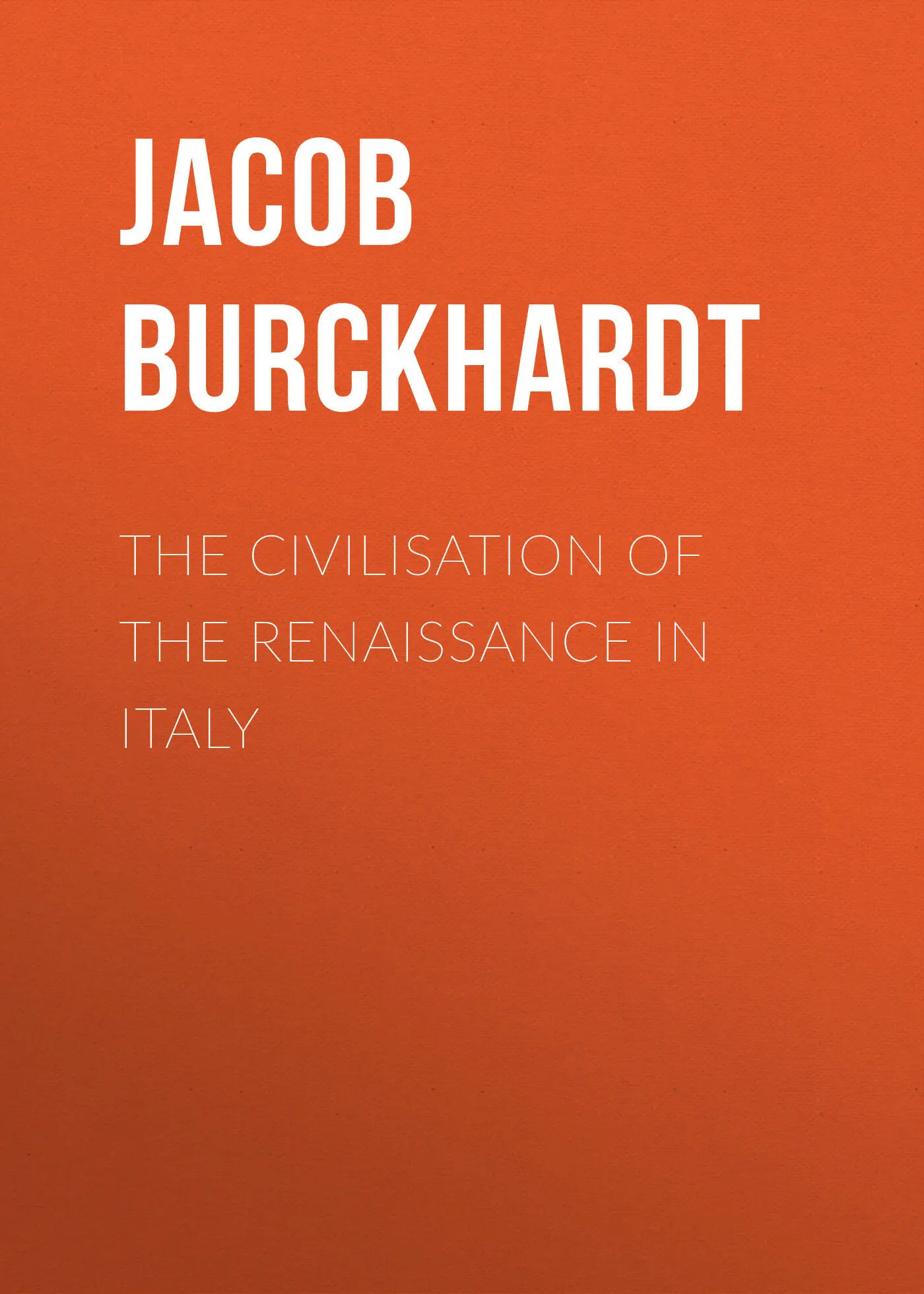
- Название:The Civilisation of the Renaissance in Italy
- Автор:
- Жанр:
- Год:неизвестен
- ISBN:нет данных
- Рейтинг книги:5 / 5. Голосов: 1
-
Избранное:Добавить в избранное
- Отзывы:
-
Ваша оценка:
The Civilisation of the Renaissance in Italy: краткое содержание, описание и аннотация
Предлагаем к чтению аннотацию, описание, краткое содержание или предисловие (зависит от того, что написал сам автор книги «The Civilisation of the Renaissance in Italy»). Если вы не нашли необходимую информацию о книге — напишите в комментариях, мы постараемся отыскать её.
The Civilisation of the Renaissance in Italy — читать онлайн ознакомительный отрывок
Ниже представлен текст книги, разбитый по страницам. Система сохранения места последней прочитанной страницы, позволяет с удобством читать онлайн бесплатно книгу «The Civilisation of the Renaissance in Italy», без необходимости каждый раз заново искать на чём Вы остановились. Поставьте закладку, и сможете в любой момент перейти на страницу, на которой закончили чтение.
Интервал:
Закладка:
243
Corio, fol. 450. Malipiero, Ann. Veneti, Arch. Stor. vii. i. p. 318. The rapacity of the whole family can be seen in Malipiero, among other authorities, l. c. p. 565. A ‘nipote’ was splendidly entertained in Venice as papal legate, and made an enormous sum of money by selling dispensations; his servants, when they went away, stole whatever they could lay their hands on, including a piece of embroidered cloth from the high altar of a church at Murano.
244
This in Panvinio alone among contemporary historians (Contin. Platinæ, p. 339), ‘insidiis Cæsaris fratris interfectus … connivente … ad scelus patre,’ and to the same effect Jovius, Elog. Vir. Ill. p. 302. The profound emotion of Alexander looks like a sign of complicity. After the corpse was drawn out of the Tiber, Sannazaro wrote ( Opera Omnia Latine Scripta 1535, fol. 41 a ):
‘Piscatorem hominum ne te non, Sixte, putemus
Piscaris natum retibus, ecce, tuum.’
Besides the epigram quoted there are others (fol. 36 b , 42 b , 47 b , 51 a , b —in the last passage 5) in Sannazaro on, i.e. against, Alexander. Among them is a famous one, referred to in Gregorovius i. 314, on Lucrezia Borgia:
Ergo te semper cupiet Lucretia Sextus?
O fatum diri nominis: hic pater est?
Others execrate his cruelty and celebrate his death as the beginning of an era of peace. On the Jubilee (see below, p. 108, note 1), there is another epigram, fol. 43 b . There are others no less severe (fol. 34 b , 35 a , b , 42 b , 43 a ) against Cæsar Borgia, among which we find in one of the strongest:
Aut nihil aut Cæsar vult dici Borgia; quidni?
Cum simul et Cæsar possit, et esse nihil.
(made use of by Bandello, iv. nov. 11). On the murder of the Duke of Gandia, see especially the admirable collection of the most original sources of evidence in Gregorovius, vii. 399-407, according to which Cæsar’s guilt is clear, but it seems very doubtful whether Alexander knew, or approved, of the intended assassination.
245
Macchiavelli, Opere , ed. Milan, vol. v. pp. 387, 393, 395, in the Legazione al Duca Valentino .
246
Tommaso Gar, Relazioni della Corte di Roma , i. p. 12, in the Rel. of P. Capello . Literally: ‘The Pope has more respect for Venice than for any other power in the world.’ ‘E però desidera, che ella (Signoria di Venezia) protegga il figliuolo, e dice voler fare tale ordine, che il papato o sia suo, ovvero della signoria nostra.’ The word ‘suo’ can only refer to Cæsar. An instance of the uncertainty caused by this usage is found in the still lively controversy respecting the words used by Vasari in the Vita di Raffaello : ‘A Bindo Altoviti fece il ritratto suo, &c.’
247
Strozzii Poetae , p. 19, in the ‘Venatio’ of Ercole Strozza: ’ … cui triplicem fata invidere coronam.’ And in the Elegy on Cæsar’s death, p. 31 sqq.: ‘Speraretque olim solii decora alta paterni.’
248
Ibid. Jupiter had once promised
‘Affore Alexandri sobolem, quæ poneret olim
Italiæ leges, atque aurea sæcla referret,’ etc.
249
Ibid.
‘Sacrumque decus majora parantem deposuisse.’
250
He was married, as is well known, to a French princess of the family of Albret, and had a daughter by her; in some way or other he would have attempted to found a dynasty. It is not known that he took steps to regain the cardinal’s hat, although (acc. to Macchiavelli, l. c. p. 285) he must have counted on the speedy death of his father.
251
Macchiavelli, l. c. p. 334. Designs on Siena and eventually on all Tuscany certainly existed, but were not yet ripe; the consent of France was indispensable.
252
Macchiavelli, l. c. pp. 326, 351, 414; Matarazzo, Cronaca di Perugia, Arch. Stor. xvi. ii. pp. 157 and 221. He wished his soldiers to quarter themselves where they pleased, so that they gained more in time of peace than of war. Petrus Alcyonius, De Exilio (1522), ed. Mencken, p. 19, says of the style of conducting war: ‘Ea scelera et flagitia a nostris militibus patrata sunt quæ ne Scythæ quidem aut Turcæ, aut Pœni in Italia commisissent.’ The same writer ( p. 65) blames Alexander as a Spaniard: ‘Hispani generis hominem, cujus proprium est, rationibus et commodis Hispanorum consultum velle, non Italorum.’ See above, p. 109.
253
To this effect Pierio Valeriano, De Infelicitate Literat. ed. Mencken, p. 282, in speaking of Giovanni Regio: ‘In arcano proscriptorum albo positus.’
254
Tommaso Gar, l. c. p. 11. From May 22, 1502, onwards the Despatches of Giustiniani , 3 vols. Florence, 1876, edited by Pasquale Villari, offer valuable information.
255
Paulus Jovius, Elogia , Cæsar Borgia. In the Commentarii Urbani of Ralph. Volaterianus, lib. xxii. there is a description of Alexander VI., composed under Julius II., and still written very guardedly. We here read: ‘Roma … nobilis jam carneficina facta erat.’
256
Diario Ferrarese , in Muratori, xxiv. col. 362.
257
Paul. Jovius, Histor. ii. fol. 47.
258
See the passages in Ranke, Röm. Päpste ; Sämmtl. Werke, Bd. xxxvii. 35, and xxxix. Anh. Abschn. 1, Nro. 4, and Gregorovius, vii. 497, sqq. Giustiniani does not believe in the Pope’s being poisoned. See his Dispacci , vol. ii. pp. 107 sqq.; Villari’s Note, pp. 120 sqq., and App. pp. 458 sqq.
259
Panvinius, Epitome Pontificum , p. 359. For the attempt to poison Alexander’s successor, Julius II., see p. 363. According to Sismondi, xiii. p. 246, it was in this way that Lopez, Cardinal of Capua, for years the partner of all the Pope’s secrets, came by his end; according to Sanuto (in Ranke, Popes , i. p. 52, note), the Cardinal of Verona also. When Cardinal Orsini died, the Pope obtained a certificate of natural death from a college of physicians.
260
Prato, Arch. Stor. iii. p. 254; comp. Attilio Alessio, in Baluz. Miscell. , iv. p. 518 sqq.
261
And turned to the most profitable account by the Pope. Comp. Chron. Venetum , in Murat. xxiv. col. 133, given only as a report: ‘E si giudiceva, che il Pontefice dovesse cavare assai danari di questo Giubileo, che gli tornerà molto a proposito.
262
Anshelm, Berner Chronik , iii. pp. 146-156. Trithem. Annales Hirsaug. tom. ii. pp. 579, 584, 586.
263
Panvin. Contin. Platinae , p. 341.
264
Hence the splendour of the tombs of the prelates erected during their lifetime. A part of the plunder was in this way saved from the hands of the Popes.
265
Whether Julius really hoped that Ferdinand the Catholic would be induced to restore to the throne of Naples the expelled Aragonese dynasty, remains, in spite of Giovio’s declaration ( Vita Alfonsi Ducis ), very doubtful.
Читать дальшеИнтервал:
Закладка:
Похожие книги на «The Civilisation of the Renaissance in Italy»
Представляем Вашему вниманию похожие книги на «The Civilisation of the Renaissance in Italy» списком для выбора. Мы отобрали схожую по названию и смыслу литературу в надежде предоставить читателям больше вариантов отыскать новые, интересные, ещё непрочитанные произведения.











Обсуждение, отзывы о книге «The Civilisation of the Renaissance in Italy» и просто собственные мнения читателей. Оставьте ваши комментарии, напишите, что Вы думаете о произведении, его смысле или главных героях. Укажите что конкретно понравилось, а что нет, и почему Вы так считаете.