Beryl Crane - Reflexology - The Definitive Practitioner's Manual - Recommended by the International Therapy Examination Council for Students and Practitoners
Здесь есть возможность читать онлайн «Beryl Crane - Reflexology - The Definitive Practitioner's Manual - Recommended by the International Therapy Examination Council for Students and Practitoners» — ознакомительный отрывок электронной книги совершенно бесплатно, а после прочтения отрывка купить полную версию. В некоторых случаях можно слушать аудио, скачать через торрент в формате fb2 и присутствует краткое содержание. Жанр: unrecognised, на английском языке. Описание произведения, (предисловие) а так же отзывы посетителей доступны на портале библиотеки ЛибКат.
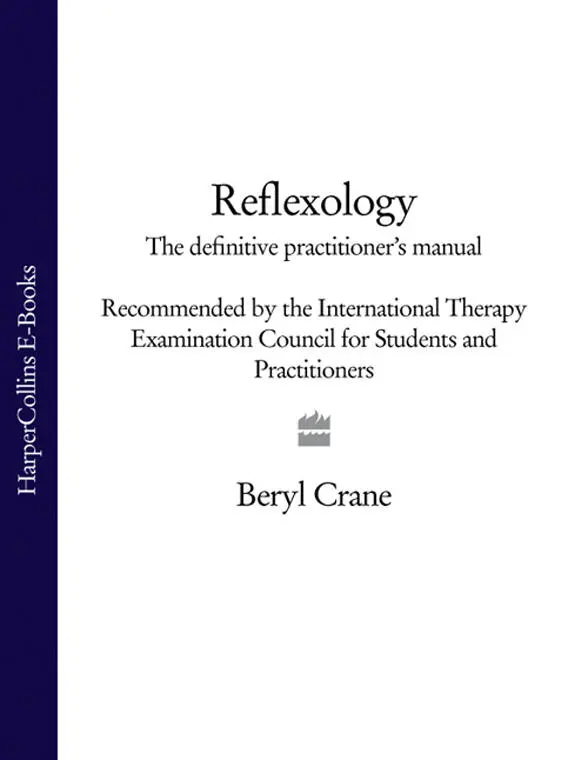
- Название:Reflexology: The Definitive Practitioner's Manual: Recommended by the International Therapy Examination Council for Students and Practitoners
- Автор:
- Жанр:
- Год:неизвестен
- ISBN:нет данных
- Рейтинг книги:5 / 5. Голосов: 1
-
Избранное:Добавить в избранное
- Отзывы:
-
Ваша оценка:
Reflexology: The Definitive Practitioner's Manual: Recommended by the International Therapy Examination Council for Students and Practitoners: краткое содержание, описание и аннотация
Предлагаем к чтению аннотацию, описание, краткое содержание или предисловие (зависит от того, что написал сам автор книги «Reflexology: The Definitive Practitioner's Manual: Recommended by the International Therapy Examination Council for Students and Practitoners»). Если вы не нашли необходимую информацию о книге — напишите в комментариях, мы постараемся отыскать её.
Reflexology: The Definitive Practitioner's Manual: Recommended by the International Therapy Examination Council for Students and Practitoners — читать онлайн ознакомительный отрывок
Ниже представлен текст книги, разбитый по страницам. Система сохранения места последней прочитанной страницы, позволяет с удобством читать онлайн бесплатно книгу «Reflexology: The Definitive Practitioner's Manual: Recommended by the International Therapy Examination Council for Students and Practitoners», без необходимости каждый раз заново искать на чём Вы остановились. Поставьте закладку, и сможете в любой момент перейти на страницу, на которой закончили чтение.
Интервал:
Закладка:
Box 1.1 Important Events in the Development of Reflexology
C2500 BCChina – Beginnings of acupuncture in China
C2330 BCEgypt – Tomb of Ankhmahor built depicting representations of surgical operations, or treatment of hands and feet
C1558 BCChina – Acupuncture in China became more refined
C500 BCJapan – Acupuncture reached Japan
AD 420China – A bronze statue was cast showing the location of all the points of acupuncture
1582Europe – First book of zone therapy published by Doctors Adamus and A’tatis
1776Per Henrick Ling was noted for his gymnastics; lingism, as it was later known, was the treatment of disease with both active and passive moves
1800sBritain – Treatment by acupuncture was introduced into Britain and the term ‘reflex’ used by many medical men
Early 1800sJapan – Reiki, an ancient energy healing system based on very old Tibetan texts, arose from the teachings of Dr Mikao Usui; its theory was that the universal life energy was channelled through to the practitioner, who in turn conveyed it through the fingertips to those who needed it
1823Britain – First issue of the Lancet was printed. A case of acupuncture treatment was reported. Successful treatment was carried out by a Dr Tweedale of Lyme Regis
1827Britain – Acupuncture was used in the Royal Infirmary, Edinburgh and St Thomas’s Hospital, London
Early 1800sItaly – Filippo Pacini (1812–83), an anatomist, discovered Pacinian corpuscles: sensory receptors in the skin particularly sensitive to changes of pressure, also found in joints and tendons. Angelo Ruffini (1864–1929), an anatomist, discovered Ruffini corpuscles, which record dermal distortions; they are cylindrical sensory organs that respond to pressure and warmth, found in finger pads, joints, tendons and tendon sheaths
Early 1800sGermany – Johannes Peter Müller (1801–58), a physiologist, proposed the principle of the law of specific irritability, the principle that each nerve is excited via sense organs responsive to a specific form of energy, and its excitation, because of its connections, can give rise to only one modality of sensation, regardless of whether the nerve is electrically or mechanically excited. Karl Ludwig Merkel (1812–76), an anatomist, discovered Merkel’s discs, tactile end-organs; these are slow-acting mechanoreceptors, responding when the tissue is stretched. George Meissner (1829–1905), a histologist, discovered Meissner’s plexus, a fine network of nerves in the wall of the alimentary canal, also Meissner’s corpuscles, found in the fingertips and lips
1880Europe – Acupuncture was used in Europe. The connection could be the French Consul in China, Soulie de Morant, who became closely associated with Chinese philosophy. He studied the Chinese language and many ancient treatises on the subject. Many of them were thousands of years old and he translated them into French
Late 1800sEurope – From the latter part of the 1800s great strides were made by the medical profession in the study of reflexes. Many devices were used to deliver electrical stimuli to parts of the body. These were to establish the identity of nerves, such as whether they were sensory or motor. They also established, by the response raised, if a nerve or tract was damaged or absent. As these responsive actions indicate externally what is taking place within the body, it is my belief that we can send a message in on the same pathway
Late 1800sGermany – Mendel-Bekhterev reflex abnormal response was found showing dysfunction in the corticospinal tract; Kurt Mendel (1874–1946) was a neurologist. Hermann Oppenheim (1858–1936), a neurologist, found that when pressure is applied on the tibial crest there is a fanning of all the toes and an extension of the great toe. This is indicative of lesions within the pyramidal tract
Late 1800sUSA – Charles Gilbert Chaddock (1861–1936), a neurologist, found that reflex extension of the great toe was induced by percussion on the external malleolar region and this was indicative of pyramidal tract lesion. Alfred Gordon (1874–1953), a neurologist, found the knee jerk reflex and extensor plantar response evident in pyramidal tract disease; this was produced when squeezing the calf muscles
1886Russia – Vladimir Michailovich Bekhterev (1857–1927) led historical development in experimental methods of reflexology on animals and then the study of human behaviour
1886–7Russia – Ivan Petrovich Pavlov (1849–1936), a physiologist, studied conditioned reflex activity in dogs and received the Nobel Prize in 1904 by proving that there was a direct association between a stimulus and a response reflex action (see chapter 2)
Late 1800sRussia – Lyudvig Martinovitch Puussepp (1875–1942), a neurosurgeon, discovered that there is a slow abduction of the little toe in response to stroking the outer aspect of the foot, which is indicative of upper motor neuron disease. These abnormal reflexes are not present in healthy individuals
1892France – Dr Joseph François Felix Babinski (1857–1932), a neurologist, ascertained the plantar reflex ( see chapter 2, page 46)
1893England – Sir Henry Head (1861–1940), a neurologist, published research proving a direct relationship between pressure applied to the skin and its effect on internal organs. This was later clarified to be the effects of dermatomes ( see chapter 2, page 43)
1895United States – Dr William Fitzgerald (1872–1942) qualified at the University of Vermont, and was the originator of the theory of zone therapy (died 21 October 1942 in Stamford, Connecticut)
1897Egypt – Tomb of Ankhmahor at Saqqara discovered by V Loret depicting treatment of feet, hands and legs
1902Vienna – Fitzgerald studied and taught in Vienna
1906England – Sir Charles Scott Sherrington (1859–1952), an Oxford physiologist, proved that the whole nervous system responded to stimuli from proprioceptors, specialized sensory nerve endings that monitored internal changes in the body. He published his findings in The Integrative Action of the Nervous System
1907Russia – Bekhterev formed the Psychoneurological Institute, and later became the Director of the State Reflexological Institute for the study of the brain in Leningrad
1913–20Washington – Fitzgerald went to Washington to teach and lecture to Shelby-Riley students
1915United States – Edwin Bowers article published ‘To stop that toothache squeeze your toe’
1917United States – Edwin Bowers MD and William Fitzgerald MD published Zone Therapy. Many other books were published during this period
1919United States – Dr Joe Shelby-Riley published first of 12 books about zone therapy, the last being published in 1942
1928Russia – Bekhterev had his work translated into English
1938United States – Eunice Ingham (24 February 1889–10 December 1974) published Stories the Feet Can Tell
1945United States – Eunice Ingham published Stories the Feet Have Told
1949United States – Dr Roy S Ashton published The Fundamental System Bad Feet-Bad Spine showing the connection between foot abnormalities and the spine
Читать дальшеИнтервал:
Закладка:
Похожие книги на «Reflexology: The Definitive Practitioner's Manual: Recommended by the International Therapy Examination Council for Students and Practitoners»
Представляем Вашему вниманию похожие книги на «Reflexology: The Definitive Practitioner's Manual: Recommended by the International Therapy Examination Council for Students and Practitoners» списком для выбора. Мы отобрали схожую по названию и смыслу литературу в надежде предоставить читателям больше вариантов отыскать новые, интересные, ещё непрочитанные произведения.







Обсуждение, отзывы о книге «Reflexology: The Definitive Practitioner's Manual: Recommended by the International Therapy Examination Council for Students and Practitoners» и просто собственные мнения читателей. Оставьте ваши комментарии, напишите, что Вы думаете о произведении, его смысле или главных героях. Укажите что конкретно понравилось, а что нет, и почему Вы так считаете.