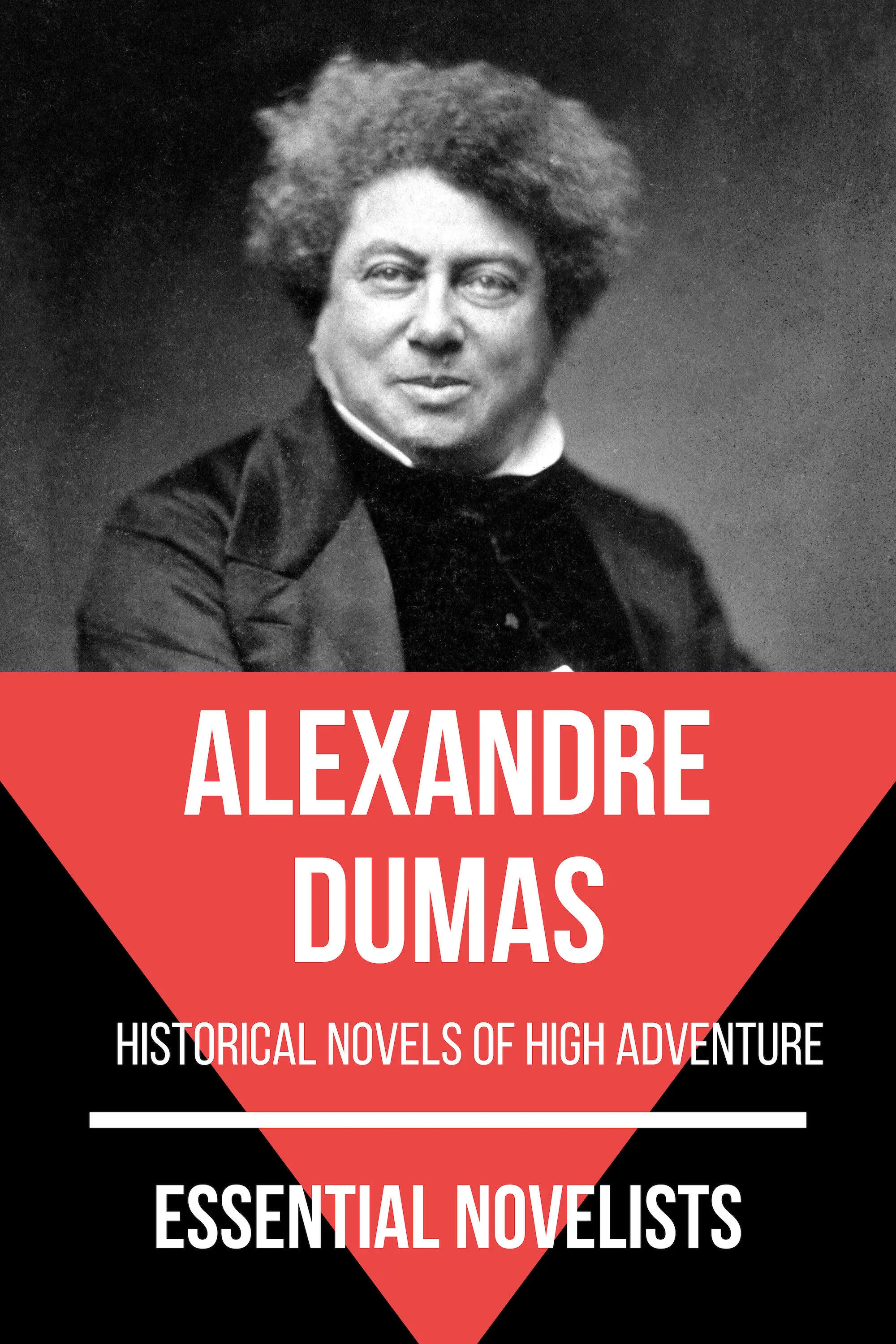
Alexandre Dumas - Essential Novelists - Alexandre Dumas
Здесь есть возможность читать онлайн «Alexandre Dumas - Essential Novelists - Alexandre Dumas» — ознакомительный отрывок электронной книги совершенно бесплатно, а после прочтения отрывка купить полную версию. В некоторых случаях можно слушать аудио, скачать через торрент в формате fb2 и присутствует краткое содержание. Жанр: unrecognised, на английском языке. Описание произведения, (предисловие) а так же отзывы посетителей доступны на портале библиотеки ЛибКат.
- Название:Essential Novelists - Alexandre Dumas
- Автор:
- Жанр:
- Год:неизвестен
- ISBN:нет данных
- Рейтинг книги:4 / 5. Голосов: 1
-
Избранное:Добавить в избранное
- Отзывы:
-
Ваша оценка:
Essential Novelists - Alexandre Dumas: краткое содержание, описание и аннотация
Предлагаем к чтению аннотацию, описание, краткое содержание или предисловие (зависит от того, что написал сам автор книги «Essential Novelists - Alexandre Dumas»). Если вы не нашли необходимую информацию о книге — напишите в комментариях, мы постараемся отыскать её.
For this book, the literary critic August Nemo has chosen the two most important and meaningful novels of Alexandre Dumas which are The Three Musketeersand The Count of Monte Cristo.
Alexandre Dumas is a celebrated French author best known for his historical adventure novels, including 'The Three Musketeers' and 'The Count of Monte Cristo.'
Novels selected for this book:
– The Three Musketeers
– The Count of Monte Cristo.
This is one of many books in the series Essential Novelists. If you liked this book, look for the other titles in the series, we are sure you will like some of the authors.
Essential Novelists - Alexandre Dumas — читать онлайн ознакомительный отрывок
Ниже представлен текст книги, разбитый по страницам. Система сохранения места последней прочитанной страницы, позволяет с удобством читать онлайн бесплатно книгу «Essential Novelists - Alexandre Dumas», без необходимости каждый раз заново искать на чём Вы остановились. Поставьте закладку, и сможете в любой момент перейти на страницу, на которой закончили чтение.
Интервал:
Закладка:
25 PORTHOS
––––––––
INSTEAD OF RETURNING directly home, d’Artagnan alighted at the door of M. de Treville, and ran quickly up the stairs. This time he had decided to relate all that had passed. M. de Treville would doubtless give him good advice as to the whole affair. Besides, as M. de Treville saw the queen almost daily, he might be able to draw from her Majesty some intelligence of the poor young woman, whom they were doubtless making pay very dearly for her devotedness to her mistress.
M de Treville listened to the young man’s account with a seriousness which proved that he saw something else in this adventure besides a love affair. When d’Artagnan had finished, he said, “Hum! All this savors of his Eminence, a league off.”
“But what is to be done?” said d’Artagnan.
“Nothing, absolutely nothing, at present, but quitting Paris, as I told you, as soon as possible. I will see the queen; I will relate to her the details of the disappearance of this poor woman, of which she is no doubt ignorant. These details will guide her on her part, and on your return, I shall perhaps have some good news to tell you. Rely on me.”
D’Artagnan knew that, although a Gascon, M. de Treville was not in the habit of making promises, and that when by chance he did promise, he more than kept his word. He bowed to him, then, full of gratitude for the past and for the future; and the worthy captain, who on his side felt a lively interest in this young man, so brave and so resolute, pressed his hand kindly, wishing him a pleasant journey.
Determined to put the advice of M. de Treville in practice instantly, d’Artagnan directed his course toward the Rue des Fossoyeurs, in order to superintend the packing of his valise. On approaching the house, he perceived M. Bonacieux in morning costume, standing at his threshold. All that the prudent Planchet had said to him the preceding evening about the sinister character of the old man recurred to the mind of d’Artagnan, who looked at him with more attention than he had done before. In fact, in addition to that yellow, sickly paleness which indicates the insinuation of the bile in the blood, and which might, besides, be accidental, d’Artagnan remarked something perfidiously significant in the play of the wrinkled features of his countenance. A rogue does not laugh in the same way that an honest man does; a hypocrite does not shed the tears of a man of good faith. All falsehood is a mask; and however well made the mask may be, with a little attention we may always succeed in distinguishing it from the true face.
It appeared, then, to d’Artagnan that M. Bonacieux wore a mask, and likewise that that mask was most disagreeable to look upon. In consequence of this feeling of repugnance, he was about to pass without speaking to him, but, as he had done the day before, M. Bonacieux accosted him.
“Well, young man,” said he, “we appear to pass rather gay nights! Seven o’clock in the morning! PESTE! You seem to reverse ordinary customs, and come home at the hour when other people are going out.”
“No one can reproach you for anything of the kind, Monsieur Bonacieux,” said the young man; “you are a model for regular people. It is true that when a man possesses a young and pretty wife, he has no need to seek happiness elsewhere. Happiness comes to meet him, does it not, Monsieur Bonacieux?”
Bonacieux became as pale as death, and grinned a ghastly smile.
“Ah, ah!” said Bonacieux, “you are a jocular companion! But where the devil were you gladding last night, my young master? It does not appear to be very clean in the crossroads.”
D’Artagnan glanced down at his boots, all covered with mud; but that same glance fell upon the shoes and stockings of the mercer, and it might have been said they had been dipped in the same mud heap. Both were stained with splashes of mud of the same appearance.
Then a sudden idea crossed the mind of d’Artagnan. That little stout man, short and elderly, that sort of lackey, dressed in dark clothes, treated without ceremony by the men wearing swords who composed the escort, was Bonacieux himself. The husband had presided at the abduction of his wife.
A terrible inclination seized d’Artagnan to grasp the mercer by the throat and strangle him; but, as we have said, he was a very prudent youth, and he restrained himself. However, the revolution which appeared upon his countenance was so visible that Bonacieux was terrified at it, and he endeavored to draw back a step or two; but as he was standing before the half of the door which was shut, the obstacle compelled him to keep his place.
“Ah, but you are joking, my worthy man!” said d’Artagnan. “It appears to me that if my boots need a sponge, your stockings and shoes stand in equal need of a brush. May you not have been philandering a little also, Monsieur Bonacieux? Oh, the devil! That’s unpardonable in a man of your age, and who besides, has such a pretty wife as yours.”
“Oh, Lord! no,” said Bonacieux, “but yesterday I went to St. Mande to make some inquiries after a servant, as I cannot possibly do without one; and the roads were so bad that I brought back all this mud, which I have not yet had time to remove.”
The place named by Bonacieux as that which had been the object of his journey was a fresh proof in support of the suspicions d’Artagnan had conceived. Bonacieux had named Mande because Mande was in an exactly opposite direction from St. Cloud. This probability afforded him his first consolation. If Bonacieux knew where his wife was, one might, by extreme means, force the mercer to open his teeth and let his secret escape. The question, then, was how to change this probability into a certainty.
“Pardon, my dear Monsieur Bonacieux, if I don’t stand upon ceremony,” said d’Artagnan, “but nothing makes one so thirsty as want of sleep. I am parched with thirst. Allow me to take a glass of water in your apartment; you know that is never refused among neighbors.”
Without waiting for the permission of his host, d’Artagnan went quickly into the house, and cast a rapid glance at the bed. It had not been used. Bonacieux had not been abed. He had only been back an hour or two; he had accompanied his wife to the place of her confinement, or else at least to the first relay.
“Thanks, Monsieur Bonacieux,” said d’Artagnan, emptying his glass, “that is all I wanted of you. I will now go up into my apartment. I will make Planchet brush my boots; and when he has done, I will, if you like, send him to you to brush your shoes.”
He left the mercer quite astonished at his singular farewell, and asking himself if he had not been a little inconsiderate.
At the top of the stairs he found Planchet in a great fright.
“Ah, monsieur!” cried Planchet, as soon as he perceived his master, “here is more trouble. I thought you would never come in.”
“What’s the matter now, Planchet?” demanded d’Artagnan.
“Oh! I give you a hundred, I give you a thousand times to guess, monsieur, the visit I received in your absence.”
“When?”
“About half an hour ago, while you were at Monsieur de Treville’s.”
“Who has been here? Come, speak.”
“Monsieur de Cavois.”
“Monsieur de Cavois?”
“In person.”
“The captain of the cardinal’s Guards?”
“Himself.”
“Did he come to arrest me?”
“I have no doubt that he did, monsieur, for all his wheedling manner.”
“Was he so sweet, then?”
“Indeed, he was all honey, monsieur.”
“Indeed!”
“He came, he said, on the part of his Eminence, who wished you well, and to beg you to follow him to the Palais-Royal*.”
*It was called the Palais-Cardinal before Richelieu gave it to the King.
Читать дальшеИнтервал:
Закладка:
Похожие книги на «Essential Novelists - Alexandre Dumas»
Представляем Вашему вниманию похожие книги на «Essential Novelists - Alexandre Dumas» списком для выбора. Мы отобрали схожую по названию и смыслу литературу в надежде предоставить читателям больше вариантов отыскать новые, интересные, ещё непрочитанные произведения.








Обсуждение, отзывы о книге «Essential Novelists - Alexandre Dumas» и просто собственные мнения читателей. Оставьте ваши комментарии, напишите, что Вы думаете о произведении, его смысле или главных героях. Укажите что конкретно понравилось, а что нет, и почему Вы так считаете.