Museum Practice
Здесь есть возможность читать онлайн «Museum Practice» — ознакомительный отрывок электронной книги совершенно бесплатно, а после прочтения отрывка купить полную версию. В некоторых случаях можно слушать аудио, скачать через торрент в формате fb2 и присутствует краткое содержание. Жанр: unrecognised, на английском языке. Описание произведения, (предисловие) а так же отзывы посетителей доступны на портале библиотеки ЛибКат.
- Название:Museum Practice
- Автор:
- Жанр:
- Год:неизвестен
- ISBN:нет данных
- Рейтинг книги:5 / 5. Голосов: 1
-
Избранное:Добавить в избранное
- Отзывы:
-
Ваша оценка:
Museum Practice: краткое содержание, описание и аннотация
Предлагаем к чтению аннотацию, описание, краткое содержание или предисловие (зависит от того, что написал сам автор книги «Museum Practice»). Если вы не нашли необходимую информацию о книге — напишите в комментариях, мы постараемся отыскать её.
Museum Practice — читать онлайн ознакомительный отрывок
Ниже представлен текст книги, разбитый по страницам. Система сохранения места последней прочитанной страницы, позволяет с удобством читать онлайн бесплатно книгу «Museum Practice», без необходимости каждый раз заново искать на чём Вы остановились. Поставьте закладку, и сможете в любой момент перейти на страницу, на которой закончили чтение.
Интервал:
Закладка:
New Labour’s primary mechanisms for allocating expenditure, cost control, and performance measurement were the Biennial Spending Reviews (2000, 2002, 2004), which set fixed three-year departmental expenditure limits, and the Comprehensive Spending Reviews (1998, 2007), which represented longer- term and more fundamental reviews of government expenditure. The Spending Reviews defined “the key improvements that the public can expect from these resources” through Public Service Agreements, which marked individual departments’ agreements with Treasury. These agreements played “a vital role in galvanizing public service delivery and driving major improvements in outcomes” (HM Treasury 2010), and were conceived in terms of “evidence-based policy” (Cabinet Office 1999), that is to say the subsequent development of informed public policy on the basis of rigorously established objective evidence.
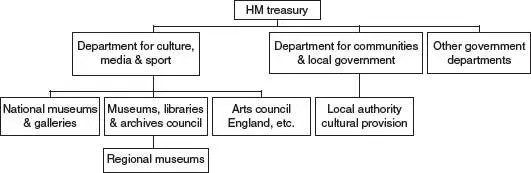
FIGURE 3.1 Policy, funding, and accountability cascade: a map of central government’s support for the cultural sector.
This unprecedented commitment to deliver necessarily impinged on DCMS’s sponsored bodies (see Figure 3.1). Their Funding Agreements obliged them to deliver on departmental objectives, and meet measurable efficiency and effectiveness targets. The desire to improve management across the sector was closely related to the government’s concern to enhance the integrity of official statistics. By 2007, DCMS was supporting 63 non-departmental public bodies, which accounted for the vast majority of its annual spend. In practice, these were also responsible for the outcomes of the department’s programs and, as such, were subject to unprecedented levels of scrutiny and accountability. Whereas, under the arm’s-length principle, performance measurement was previously considered inappropriate for cultural provision, after 2000 it became the norm, although in Blair’s second government some felt that the DCMS had to be about “going beyond targets” to “best capture the value of culture” (Jowell 2004). This theme was further developed by the McMaster Review of 1998 into concepts of excellence, and although this generated much debate it never materialized into sustained action (McMaster 2008).
From about 2002 New Labour increasingly referred to the notion of public value, borrowed from the standard work, Mark Moore’s Creating Public Value (1995). This focused on what might constitute “public” value – how the working practices of public servants might contribute to particular sorts of benefits found only in public services. This might simply comprise
new public services (extended library opening hours … ); increased trust in public institutions, (“I trust my library service more”) or a contribution to an established public good (“the library is open longer so I can read more books and be better educated“). (Oakley, Naylor, and Lee 2011, 3)
Public value appears to refer to public goods; services which are non-rivalrous and non-excludable, such as defense or street lighting, which are in the public interest or in the public domain. This has, in particular, informed its attitude to local government reform.
The Local Government Act 1999 introduced the best value service delivery regime and scrapped the widely disliked compulsory competitive tendering. Best value was designed to ensure continuous improvement in local government services by creating a series of performance indicators and associated targets, which could both, measure the progress of an individual service and compare it with others across the country. It is the bedrock of a commitment to making services transparently accountable to local people. The Local Government Act 2000 was the controversial piece of legislation that introduced mayors and cabinets alongside a new legal framework that allows councils to do anything that will contribute to the social, environmental, or economic well-being of their communities, which might of course include supporting museums or museum initiatives.
New Labour was the party of regionalism. It reintroduced regional development agencies and generally claimed that it wished to devolve powers to the English regions and the nations. There was, however, never complete agreement upon how regionalism and the need for strong central government to drive New Labour election-winning policies could be successfully reconciled. The issue focused around the distinction between “regional government” and “government in the regions.” Regional Development Agencies were launched in eight English regions in 1999; the ninth in London in 2000, following the establishment of the Greater London Authority. They were intended to coordinate regional economic development and competitiveness. A number of other regional bodies advised them or looked to them for funding – including government regional offices, English Partnerships, and the Rural Development Commission. For museums with ambitious capital projects they were to be key sources of funding.
A New Cultural Framework introduced regional Cultural Consortiums in 1999 – non-executive advisory bodies for each of the English regions, except London where the function sat with the Cultural Strategy Group, established by the mayor. The consortiums included representation from all cultural activities including museums. Each was charged with producing cross-cutting strategies for each region, which were expected to inform the Regional Development Agencies. Regional support structures were highly important to the museums sector, where the majority of local museums were small and often had no paid professional staff. Area Museum Councils, collaborative bodies sustained by subscriptions and a small grant from MLA’s predecessor, the Museums and Galleries Commission, were very influential. But from 2001 they were replaced by cross-cutting MLA’s regional agencies, intended to reflect and be more controllable by MLA itself.
Regional government reached its high-water mark in 2004 when a referendum about the creation of a Regional Assembly was held in the Northeast. The rejection of the offer of devolved power in one of the most partisan of all the English regions effectively killed off regional government as a policy objective and left its organs vulnerable to retrenchment or changes in central government. After New Labour lost power in 2010, virtually all the English regional bodies were disbanded, though the devolved Scottish Parliament and Welsh Assembly survived.
New Labour had high expectations of museums and galleries, given that a sizeable percentage of DCMS’s operational spend and activity was dedicated to museums. Most of the policy initiatives were either applied to museums or they were indirectly deeply affected by them (as in local government, for example). Specific initiatives identified in A New Cultural Framework (DCMS 1998) included the creation of a new strategic agency for museums, archives, and libraries (Resource, subsequently MLA), the imposition of public service agreements, and the establishment of a watchdog, QUEST (the Quality, Efficiency and Standards Team). But it was two other initiatives, discussed below, that headlined: the introduction of free admission to all national museums and galleries and the unprecedented funding of regional museums following the Renaissance in the Regions report (RMTF 2001).
The Coalition Government, 2010–
Previous sections have highlighted the evolution of museum policy, the sector’s regulatory frameworks and the impact of legislation over the past 30 or so years. Many of the changes introduced appeared to have been driven by ideological differences. Access-for-all policies (as manifest in free admission) have been promoted by planning for a better society, while an absence of policy reflects a belief in allowing the market to determine what happens. However, the increasing centrism of British politics means differences between the Left and Right are now much less stark than they once were – something that is perhaps reflected in the current Coalition’s cultural policies and the case studies that follow.
Читать дальшеИнтервал:
Закладка:
Похожие книги на «Museum Practice»
Представляем Вашему вниманию похожие книги на «Museum Practice» списком для выбора. Мы отобрали схожую по названию и смыслу литературу в надежде предоставить читателям больше вариантов отыскать новые, интересные, ещё непрочитанные произведения.










Обсуждение, отзывы о книге «Museum Practice» и просто собственные мнения читателей. Оставьте ваши комментарии, напишите, что Вы думаете о произведении, его смысле или главных героях. Укажите что конкретно понравилось, а что нет, и почему Вы так считаете.