Museum Practice
Здесь есть возможность читать онлайн «Museum Practice» — ознакомительный отрывок электронной книги совершенно бесплатно, а после прочтения отрывка купить полную версию. В некоторых случаях можно слушать аудио, скачать через торрент в формате fb2 и присутствует краткое содержание. Жанр: unrecognised, на английском языке. Описание произведения, (предисловие) а так же отзывы посетителей доступны на портале библиотеки ЛибКат.
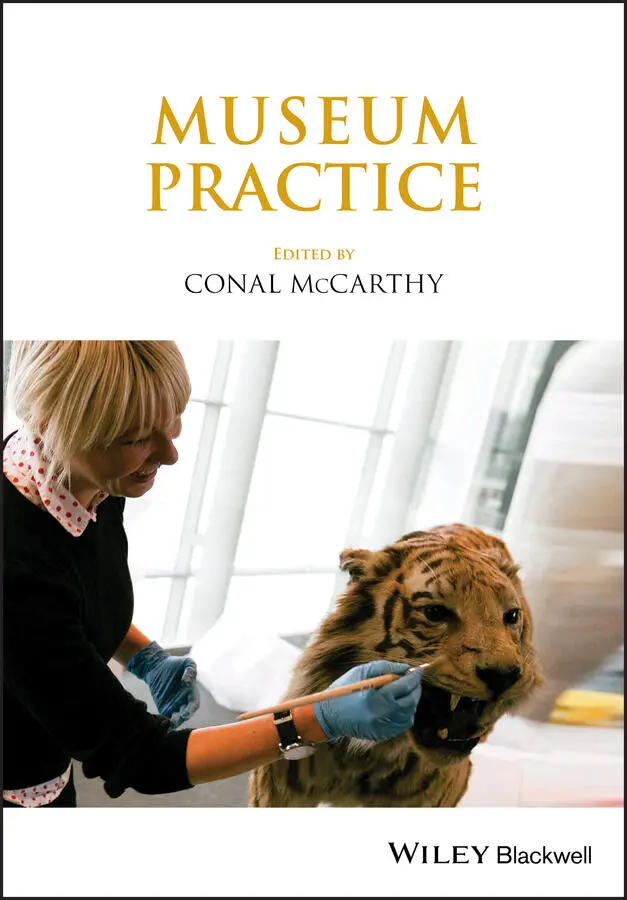
- Название:Museum Practice
- Автор:
- Жанр:
- Год:неизвестен
- ISBN:нет данных
- Рейтинг книги:5 / 5. Голосов: 1
-
Избранное:Добавить в избранное
- Отзывы:
-
Ваша оценка:
Museum Practice: краткое содержание, описание и аннотация
Предлагаем к чтению аннотацию, описание, краткое содержание или предисловие (зависит от того, что написал сам автор книги «Museum Practice»). Если вы не нашли необходимую информацию о книге — напишите в комментариях, мы постараемся отыскать её.
Museum Practice — читать онлайн ознакомительный отрывок
Ниже представлен текст книги, разбитый по страницам. Система сохранения места последней прочитанной страницы, позволяет с удобством читать онлайн бесплатно книгу «Museum Practice», без необходимости каждый раз заново искать на чём Вы остановились. Поставьте закладку, и сможете в любой момент перейти на страницу, на которой закончили чтение.
Интервал:
Закладка:
Further complexity in governance can arise when the museum is part of a cultural complex. A cultural district may be simply an area within a city where a number of independent cultural attractions are located; or it may be a deliberately planned complex, as on Abu Dhabi’s Saadiyat Island in the United Arab Emirates, or in Hong Kong’s West Kowloon Cultural District. The Louvre Abu Dhabi, the Guggenheim Abu Dhabi, and the National Zayed Museum are currently under construction on Saadiyat Island, with a Maritime Museum also planned, while at West Kowloon a multidisciplinary museum named M+ is planned, along with an exhibition center and a range of performing arts venues.
The governance of each component of a complex – which may individually be line departments, “arm’s length” institutions, not-for-profit organizations, or private sector attractions – may need to be planned in relation to a central authority for the complex, if there is to be one. The concern is to respect the independence of each constituent while realizing advantages due to their association, such as common marketing, joint purchasing, security, or in some cases shared facilities. Our company has assisted with both the Abu Dhabi and Hong Kong projects, where final decisions as to governance are still under consideration, as government agencies – the Tourism Development and Investment Corporation (TDIC) of the United Arab Emirates (UAE) and the West Kowloon Cultural District Authority in Hong Kong – serve as at least interim, possibly longer-term governance for these developing projects.
Collaboration to realize advantages of scale can even be negotiated among the governing bodies of long-standing independent institutions. Several years ago our firm helped the Cleveland Museum of Natural History, the Cleveland Botanic Garden, and the Western Reserve Historical Society, all of which were independent not-for-profit associations located in one sector of Cleveland’s Museum Circle, to form the Cleveland Cultural Collaborative, aimed at achieving efficiencies of scale by combining purchasing, support staff, and services where possible.
Still another governance challenge arises for museums that are also responsible for colleges or schools. Every variety of relationship may be observed here: from the complete integration of staff appointments where curators are also professors at the American Museum of Natural History and its graduate school in New York; over to complete separation, as at the Portland (Oregon) Art Museum, which founded the school that became the Pacific Northwest College of Art in 1909 but separated from it in 1994, with the college relocating four years later so that the museum could expand. Even where the museum and the school are in the same building or physically connected, as at the Art Institute of Chicago, museum and college may have separate governance. At the time of writing our firm was working with the Corcoran Gallery and College of Art and Design 1 in Washington, DC, which formerly had separate boards for each, but for some years now has been trying to administer both gallery and college with the board of one independent not-for-profit association. State or provincial university museums in the United States, Canada, and elsewhere can often simplify these relationships, since both college and museum usually report as line departments to a central university board or senate. Such university museums often benefit by receiving allocations that are part of a much larger state education budget.
Whether operating independently or as part of a larger system, however, government line department museums around the world too often suffer from cutbacks in funding, inadequate programming resources, virtually no acquisition budgets, and top-down administrations that may be ill-informed about or indifferent to the museum’s needs. Such an institution has great difficulty answering the call to participate as an economic generator of cultural tourism, or even as an educational resource. As a result, the past few decades have seen a worldwide trend toward setting many government line department museums at a distance sufficient to facilitate other means of revenue generation – creating the second common governance type, often called “arm’s-length” museums.
“Arm’s-length” museums
Arm’s-length museums are so called because they operate at some distance from the “head,” the central governing agency. This “arm’s length” may be longer or shorter, but in all cases is intended to encourage greater financial independence and freedom from political or corporate control, even though the “head” organization retains ultimate authority. The “arm’s length” may be established in various ways:
Boards of trustees for arm’s-length institutions may be given real authority and responsibility as governing boards, sometimes within certain limits. The governing authority – government department, university administration, or corporation – is usually represented on the board, with the rest of its members appointed to include collectors, concerned interest groups, or the general public. Although the collection and buildings are still publicly owned, the board is said to hold the collections in a public trust.
Budgets are usually based on annual grants (as distinguished from departmental budget allocations), with the understanding that these grants will not meet all costs, so that the board of trustees has responsibility for raising the balance, through private donations, self-generated revenues, and grants from other levels or branches of government.
Museums are enfranchised to benefit directly from their self-generated revenues – admission fees, retail, rentals, food services, or other sources of funding.
Staff may remain civil servants, or may be employed directly by the museum, often granted status and benefits equivalent to or better than civil service conditions of employment.
Arm’s-length institutions are usually more successful than government line department museums at attracting donations, developing membership programs, recruiting Friends’ organizations and enlisting volunteer activities.
Not all of these features are found in every arm’s-length institution. During the 1980s in the United Kingdom Margaret Thatcher’s government gave a great impetus in this direction to Britain’s national museums, with most of the emphasis on the individual institution’s responsibility for its own fund-raising and ability to profit from its own enterprise. In Paris the Louvre is now solidly established as an arm’s-length institution, having developed a series of grands projets and currently participating, along with eight other French national institutions, in France Museums , a consortium that is providing long-term loans and short-term exhibitions from their collections to the Louvre Abu Dhabi on Saadiyat Island, in exchange for substantial funds that are being used primarily for conservation of France’s national collections. In 2003 the Prado in Madrid became an arm’s-length institution, still strongly linked to government but with its own board and a long-range goal of reducing its reliance on government funding from 80 to 50 percent of its budget. Several years ago we undertook a study for Hong Kong’s Leisure and Cultural Services Department that considered the extent to which an arm’s-length model might benefit government- operated museums there.
Independent not-for-profit associations
The independent not-for-profit association, the governance model that is almost exclusively the subject of much of the literature on the subject, is found in its most typical form in the United States, and to a lesser degree in Canada, Australia, and elsewhere. In most jurisdictions these museums qualify for exemption from taxes on the grounds that they are dedicating their earnings to charitable or educational purposes. Their governing boards, with new trustees recruited and appointed by the present board, assume legal and financial responsibility for the museum, and are responsible for several key functions:
Читать дальшеИнтервал:
Закладка:
Похожие книги на «Museum Practice»
Представляем Вашему вниманию похожие книги на «Museum Practice» списком для выбора. Мы отобрали схожую по названию и смыслу литературу в надежде предоставить читателям больше вариантов отыскать новые, интересные, ещё непрочитанные произведения.





Обсуждение, отзывы о книге «Museum Practice» и просто собственные мнения читателей. Оставьте ваши комментарии, напишите, что Вы думаете о произведении, его смысле или главных героях. Укажите что конкретно понравилось, а что нет, и почему Вы так считаете.