Charles G. Harper - The Old Inns of Old England
Здесь есть возможность читать онлайн «Charles G. Harper - The Old Inns of Old England» — ознакомительный отрывок электронной книги совершенно бесплатно, а после прочтения отрывка купить полную версию. В некоторых случаях можно слушать аудио, скачать через торрент в формате fb2 и присутствует краткое содержание. Жанр: unrecognised, на английском языке. Описание произведения, (предисловие) а так же отзывы посетителей доступны на портале библиотеки ЛибКат.
- Название:The Old Inns of Old England
- Автор:
- Жанр:
- Год:неизвестен
- ISBN:нет данных
- Рейтинг книги:3 / 5. Голосов: 1
-
Избранное:Добавить в избранное
- Отзывы:
-
Ваша оценка:
The Old Inns of Old England: краткое содержание, описание и аннотация
Предлагаем к чтению аннотацию, описание, краткое содержание или предисловие (зависит от того, что написал сам автор книги «The Old Inns of Old England»). Если вы не нашли необходимую информацию о книге — напишите в комментариях, мы постараемся отыскать её.
Volume 1:
Introductory
The Ancient History of Inns
General History of Inns
The Eighteenth Century
Latter Days
Pilgrims' Inns and Monastic Hostels
Historic Inns
Inns of Old Romance
Pickwickian Inns
Dickensian Inns
Highwaymen's Inns
Volume 2:
A Posy of Old Inns
The Old Inns of Cheshire
Inns Retired from Business
Inns with Relics and Curiosities
Tavern Rhymes and Inscriptions
The Highest Inns in England
Gallows Signs
Signs Painted by Artists
Queer Signs in Quaint Places
Rural Inns
The Evolution of a Country Inn
Ingle-nooks
Innkeepers' Epitaphs
Inns with Odd Privileges
Inns in Literature
Visitors' Books
The Old Inns of Old England — читать онлайн ознакомительный отрывок
Ниже представлен текст книги, разбитый по страницам. Система сохранения места последней прочитанной страницы, позволяет с удобством читать онлайн бесплатно книгу «The Old Inns of Old England», без необходимости каждый раз заново искать на чём Вы остановились. Поставьте закладку, и сможете в любой момент перейти на страницу, на которой закончили чтение.
Интервал:
Закладка:
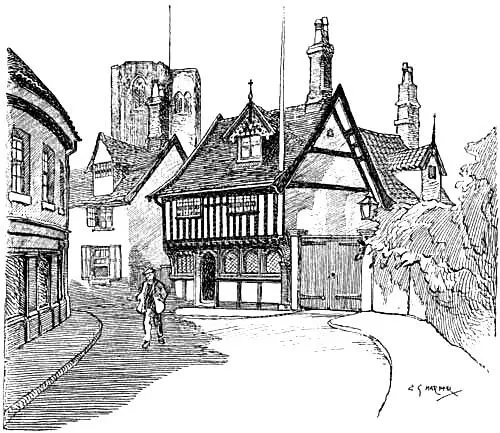
THE “GREEN DRAGON,” WYMONDHAM.
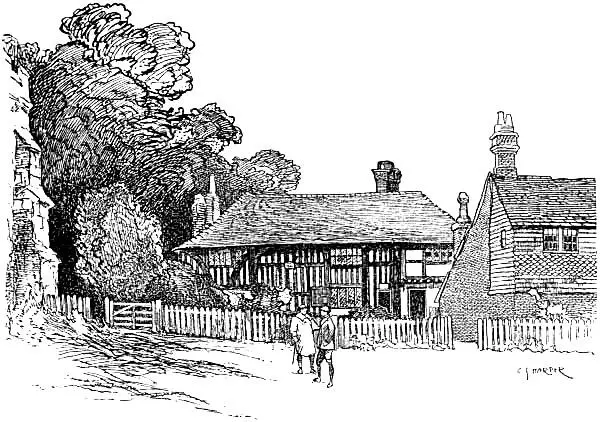
THE PILGRIMS’ HOSTEL, BATTLE.
The old pilgrims’ hospice of Battle Abbey still remains outside the great gateway, and now offers refreshments to those modern pilgrims who flock in thousands, by chars-à-banc, on cycles, or afoot, to Battle in search of the picturesque; or merely, in many cases, to complete the conventional round of sight-seeing prescribed for visitors to Hastings. It is a typically Sussexian building of domestic appearance, framed in stout oak timbering, and filled with plaster and rubble, and was probably built early in the fifteenth century.
The so-called “New” Inn, at Gloucester, when actually new, the matter of four hundred and fifty years ago, was erected especially for the accommodation of pilgrims flocking to the tomb of the murdered King Edward the Second, who, by no means a saintly character in life, was in death raised by popular sentiment to the status of something very like a holy martyr. He had been weak and vicious, but those who on September 21st, 1327, put him to a dreadful death in the dungeons of Berkeley Castle acted on behalf of others worse than he, and the horror and the injustice of it had the not unnatural effect of almost canonising the slain monarch.
The Abbot of St. Peter’s at Gloucester, John Thokey, when all others, fearing the vengeance of the murderers, dared not give the King’s body burial, begged it and buried it, with much reverence, within the Abbey walls. His Abbey, now the Cathedral of Gloucester, reaped unexpected benefits from the humane instincts of that good and pitiful man, for “miracles” were wrought at the “martyr’s” tomb, and abundant thank-offerings continued to flow in, and at last enabled the great Abbey to be rebuilt.

THE “NEW INN,” GLOUCESTER.
It became eventually a pressing need to provide housing outside the Abbot’s lodgings for the stream of pilgrims, and accordingly the New Inn was built in the middle of the fifteenth century (1450–1457) by John Twynning, a monk of that establishment, of whom we know little or nothing else than that he was, according to the records of his time, a “laudable man.” It remained until quite recent years the property of the Dean and Chapter of Gloucester.
The inn is reached through an archway in Northgate Street, and is arranged, as usual in mediæval inns, around a courtyard. Still the old gables look down upon the yard and, as of yore, the ancient galleries, rescued from the decay and neglect of some seventy years ago, run partly around first and second floors. Existing side by side with those antique features, the quaint windowed bar of the coaching era is now itself a curiosity. In short, mediæval picturesqueness, Jacobean carved oak, commercial and coffee-rooms of the coaching age, and modern comforts conjoin at the New Inn, so that neither a wayworn pilgrim, were such an one likely to appear, nor a seventeenth century horseman, nor even a Georgian coachman, redolent of the rum-punch that was the favourite drink in coaching days, would seem out of place.
Summer and autumn transfigure the courtyard into the likeness of a rustic bower, for it is plentifully hung with virginia-creepers, from amidst whose leaves the plaster lion who mounts guard on the roof of the bar looks as though he were gazing forth from his native jungle.
I do not know in what way John Twynning—or Twining, as we should no doubt in modern times call him—was to be reckoned laudable, but if he were thought praiseworthy for anything outside his religious duties it was probably by reason of the skill with which he built this pilgrims’ hostel. You perceive little of his work from the street, for at that extraordinary period when stucco was fashionable and plaster all the rage, the timbered front of the building was covered up in that manner, and so remains. But the great building is still constructionally the house that fifteenth-century monk left, and how well and truly he built it, let its sound and stable condition, after four centuries and a half of constant use, tell.
Such modern touches as there are about this quaintly named “New” inn are the merest light clothing upon its ancient body, and the sitting-rooms and forty or so bedrooms, cosy and comfortable to us moderns, are but modern in their carpets and fittings, and in the paper that decorates their walls, in between the stout dark timber framing.
The house is built chiefly of chestnut, traditionally obtained from Highnam, some three miles from the city; and everywhere the enormous beams, in some places polished, in others rough, are to be seen. In their roughest, most timeworn condition, they overhang the narrow passage now called New Inn (formerly Pilgrims’) Lane, where, at the angle, a most ornately carved corner-post, very much injured, exhibits a mutilated angel holding a scroll, in the midst of fifteenth-century tabernacle-work.

COURTYARD, “NEW INN,” GLOUCESTER.
As usual in these ancient inns with courtyards and galleries, plays and interludes were formerly acted here, and it is said that the accession of Queen Elizabeth was proclaimed on these flagstones.
That galleries open to the air, with the bedrooms and others giving upon them, were not so inconvenient as generally nowadays supposed is evident enough here, where they are still in use, as they were centuries ago. The only difference is that they are carpeted nowadays, instead of being bare floors.
A staircase from the courtyard leads up to the first-floor gallery, still screened off by the old open-lattice gates reaching from floor to ceiling, originally intended to prevent stray dogs entering.
Portions of the “New Inn” let off in the days of its declining prosperity have in modern times been taken back again: among them the large dining-hall overlooking the lane, for many years used as a Sunday school for the children of St. Nicholas parish, and other rooms looking upon Northgate Street.
In short, the old “New” inn impresses the beholder with a very insistent sense of being a live institution, a “going concern.” Most ancient inns of this character are merely poor survivals; archæologically interesting, but wan veterans tottering to decay and long deserted by custom. Here, however, there is heavy traffic down in the yard: the ostler is busy in his “Ostry” (the name is painted over the door), bells are ringing, people and luggage coming and going; the big railway parcel-office is as full of parcels as it could have been when it was a coach-office; appetising scents come from glowing kitchens, and to and from private rooms are carried trays of as good things as ever pilgrims feasted upon, at the end of their pilgrimage.
There existed, until about 1859, another very notable “New” inn, probably the work of the Abbots of Sherborne, and intended for the reception of visitors to that beautiful Dorsetshire abbey. That splendid old hostelry, with a noble front of yellow sandstone, built in the Perpendicular style of architecture, probably about 1420, was the finest example of an inn of its period in England, but it was ruthlessly, and with incredible stupidity, demolished, and the only pictorial record of it appears to be an entirely inadequate, severe, and unsympathetic little wood-cut in Parker’s Domestic Architecture .[13] It figures in Mr. Thomas Hardy’s story of The Woodlanders as the “Earl of Wessex” inn at “Sherton Abbas.”
Читать дальшеИнтервал:
Закладка:
Похожие книги на «The Old Inns of Old England»
Представляем Вашему вниманию похожие книги на «The Old Inns of Old England» списком для выбора. Мы отобрали схожую по названию и смыслу литературу в надежде предоставить читателям больше вариантов отыскать новые, интересные, ещё непрочитанные произведения.









Обсуждение, отзывы о книге «The Old Inns of Old England» и просто собственные мнения читателей. Оставьте ваши комментарии, напишите, что Вы думаете о произведении, его смысле или главных героях. Укажите что конкретно понравилось, а что нет, и почему Вы так считаете.