Gerald Durrell - The Corfu Trilogy
Здесь есть возможность читать онлайн «Gerald Durrell - The Corfu Trilogy» весь текст электронной книги совершенно бесплатно (целиком полную версию без сокращений). В некоторых случаях можно слушать аудио, скачать через торрент в формате fb2 и присутствует краткое содержание. Год выпуска: 2006, ISBN: 2006, Издательство: Penguin Books, Жанр: Природа и животные, Биографии и Мемуары, на английском языке. Описание произведения, (предисловие) а так же отзывы посетителей доступны на портале библиотеки ЛибКат.
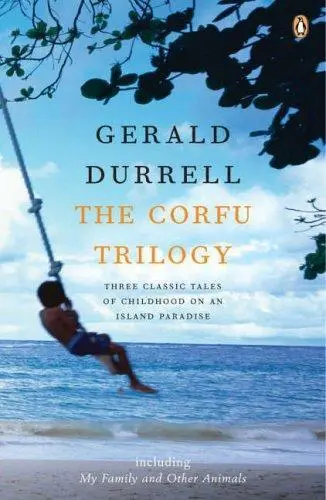
- Название:The Corfu Trilogy
- Автор:
- Издательство:Penguin Books
- Жанр:
- Год:2006
- ISBN:978–0–141–91113–7
- Рейтинг книги:4 / 5. Голосов: 3
-
Избранное:Добавить в избранное
- Отзывы:
-
Ваша оценка:
The Corfu Trilogy: краткое содержание, описание и аннотация
Предлагаем к чтению аннотацию, описание, краткое содержание или предисловие (зависит от того, что написал сам автор книги «The Corfu Trilogy»). Если вы не нашли необходимую информацию о книге — напишите в комментариях, мы постараемся отыскать её.
Durrell dedicated his life to the conservation of wildlife and it is through his efforts that creatures such as the Mauritius pink pigeon and the Mallorcan midwife toad have avoided extinction. Over his lifetime he wrote thirty-seven books, went on dozens of animal-collecting trips and presented numerous tv shows. He founded the Durrell Wildlife Conservation Trust in 1959 as a centre for the conservation of endangered species – of which his wife Lee is still Honorary Director. He was awarded the OBE in 1982.
The Corfu Trilogy
My Family and Other Animals
Birds, Beasts, and Relatives
The Garden of the Gods
The Corfu Trilogy — читать онлайн бесплатно полную книгу (весь текст) целиком
Ниже представлен текст книги, разбитый по страницам. Система сохранения места последней прочитанной страницы, позволяет с удобством читать онлайн бесплатно книгу «The Corfu Trilogy», без необходимости каждый раз заново искать на чём Вы остановились. Поставьте закладку, и сможете в любой момент перейти на страницу, на которой закончили чтение.
Интервал:
Закладка:
‘Another curious thing about them,’ Theodore continued, happily piling miracle upon miracle, ‘is that at certain times, er… you know, if it is a hot summer or something like that and the pond is liable to dry up, they go down to the bottom and form a sort of hard shell round themselves. It’s a sort of suspended animation , for the pond can dry up for, er… um… let us say seven or eight years, and they will just lie there in the dust. But as soon as the first rain falls and fills the pond, they come to life again.’
Again we moved forward, sweeping our nets through the balloon-like masses of frogs’ spawn and the trailing necklace-like strings of the toad spawn.
‘Here is, er… if you just take the glass a minute and look… an exceptionally fine hydra.’
Through the glass there sprang to life a tiny fragment of weed to which was attached a long slender coffee-coloured column, at the top of which was a writhing mass of elegant tentacles. As I watched, a rotund and earnest cyclops, carrying two large and apparently heavy sacks containing pink eggs, swam in a series of breathless jerks too close to the writhing arms of the hydra. In a moment it was engulfed. It gave a couple of violent twitches before it was stung to death. I knew, if you watched long enough, you could watch the cyclops being slowly and steadily engulfed and passing, in the shape of a bulge, down the column of the hydra.
Presently the height and the heat of the sun would tell us that it was lunch-time, and we would make our way back to our olive trees and sit there eating our food and drinking our ginger beer to the accompaniment of the sleepy zithering of the first-hatched cicadas of the year and the gentle, questioning coos of the collared doves.
‘In Greek,’ Theodore said, munching his sandwich methodically, ‘the name for collared dove is dekaoctur – “eighteener,” you know. The story goes that when Christ was… um… carrying the cross to Calvary, a Roman soldier, seeing that He was exhausted, took pity on Him. By the side of the road there was an old woman selling… um… you know… milk , and so the Roman soldier went to her and asked her how much a cupful would cost. She replied that it would cost eighteen coins. But the soldier had only seventeen. He… er… you know… pleaded with the woman to let him have a cupful of milk for Christ for seventeen coins, but the woman avariciously held out for eighteen. So, when Christ was crucified, the old woman was turned into a turtle dove and condemned to go about for the rest of her days repeating dekaocto , dekaocto – “eighteen, eighteen.” If ever she agrees to say deka-epta , seventeen, she will regain her human form. If, out of obstinacy, she says deka-ennaea , nineteen, the world will come to an end.’
In the cool olive shade the tiny ants, black and shiny as caviare, would be foraging for our left-overs among last year’s discarded olive leaves that the past summer’s sun had dried and coloured a nut-brown and banana-yellow. They lay there as curled and as crisp as brandy-snaps. On the hillside behind us a herd of goats passed, the leader’s bell clonking mournfully. We could hear the tearing sound of their jaws as they ate, indiscriminately, any foliage that came within their reach. The leader paced up to us and gazed for a minute with baleful, yellow eyes, snorting clouds of thyme-laden breath at us.
‘They should not, er… you know, be left unattended,’ said Theodore, prodding the goat gently with his stick. ‘Goats do more damage to the countryside than practically anything else.’
The leader uttered a short sardonic ‘bah’ and then moved away, with his destructive troop following him.
We would lie for an hour or so, drowsing, and digesting our food, staring up through the tangled olive branches at a sky that was patterned with tiny white clouds like a child’s finger-prints on a blue, frosty, winter window.
‘Well,’ Theodore would say at last, getting to his feet, ‘I think perhaps we ought to… you know… just see what the other side of the lake has to offer.’
So once more we would commence our slow pacing of the rim of the shore. Steadily our test tubes, bottles, and jars would fill with a shimmer of microscopic life, and my boxes and tins and bags would be stuffed with frogs, baby terrapins, and a host of beetles.
‘I suppose,’ Theodore would say at last, reluctantly, glancing up at the sinking sun, ‘I suppose… you know… we ought to be getting along home.’
And so we would laboriously hoist our now extremely heavy collecting boxes onto our shoulders and trudge homeward on weary feet, Roger, his tongue hanging out like a pink flag, trotting soberly ahead of us. Reaching the villa, our catches would be moved to more capacious quarters. Then Theodore and I would relax and discuss the day’s work, drinking gallons of hot, stimulating tea and gorging ourselves on golden scones, bubbling with butter, fresh from Mother’s oven.
It was when I paid a visit to this lake without Theodore that I caught, quite by chance, a creature that I had long wanted to meet. As I drew my net up out of the waters and examined the tangled weed mass it contained, I found crouching there, of all unlikely things, a spider. I was delighted, for I had read about this curious beast, which must be one of the most unusual species of spider in the world, for it lives a very strange aquatic existence. It was about half an inch long and marked in a rather vague sort of way with silver and brown. I put it triumphantly into one of my collecting tins and carried it home tenderly.
Here I set up an aquarium with a sandy floor and decorated it with some small dead branches and fronds of water-weed. Putting the spider on one of the twigs that stuck up above the water-level, I watched to see what it would do. It immediately ran down the twig and plunged into the water, where it turned a bright and beautiful silver, owing to the numerous minute air bubbles trapped in the hairs on its body. It spent five minutes or so running about below the surface of the water, investigating all the twigs and water-weed before it finally settled on a spot in which to construct its home.
Now the water-spider was the original inventor of the diving-bell, and sitting absorbed in front of the aquarium, I watched how it was done. First the spider attached several lengthy strands of silk from the weeds to the twigs. These were to act as guy ropes. Then, taking up a position roughly in the centre of these guy ropes, it proceeded to spin an irregular oval-shaped flat web of a more or less conventional type, but of a finer mesh, so that it looked more like a cobweb. This occupied the greater part of two hours. Having got the structure of its home built to its satisfaction, it now had to give it an air supply. This it did by making numerous trips to the surface of the water and into the air. When it returned to the water its body would be silvery with air bubbles. It would then run down and take up its position underneath the web and, by stroking itself with its legs, rid itself of the air bubbles, which rose and were immediately trapped underneath the web. After it had done this five or six times, all the tiny bubbles under the web had amalgamated into one big bubble. As the spider added more and more air to this bubble and the bubble grew bigger and bigger, its strength started to push the web up until eventually the spider had achieved success. Firmly anchored by the guy ropes between the weed and the twigs was suspended a bell-shaped structure full of air. This was now the spider’s home in which it could live quite comfortably without even having to pay frequent visits to the surface, for the air in the bell would, I knew, be replenished by the oxygen given up by the weeds, and the carbon monoxide given out by the spider would soak through the silky walls of its house.
Читать дальшеИнтервал:
Закладка:
Похожие книги на «The Corfu Trilogy»
Представляем Вашему вниманию похожие книги на «The Corfu Trilogy» списком для выбора. Мы отобрали схожую по названию и смыслу литературу в надежде предоставить читателям больше вариантов отыскать новые, интересные, ещё непрочитанные произведения.



Обсуждение, отзывы о книге «The Corfu Trilogy» и просто собственные мнения читателей. Оставьте ваши комментарии, напишите, что Вы думаете о произведении, его смысле или главных героях. Укажите что конкретно понравилось, а что нет, и почему Вы так считаете.