Gerald Durrell - The Corfu Trilogy
Здесь есть возможность читать онлайн «Gerald Durrell - The Corfu Trilogy» весь текст электронной книги совершенно бесплатно (целиком полную версию без сокращений). В некоторых случаях можно слушать аудио, скачать через торрент в формате fb2 и присутствует краткое содержание. Год выпуска: 2006, ISBN: 2006, Издательство: Penguin Books, Жанр: Природа и животные, Биографии и Мемуары, на английском языке. Описание произведения, (предисловие) а так же отзывы посетителей доступны на портале библиотеки ЛибКат.
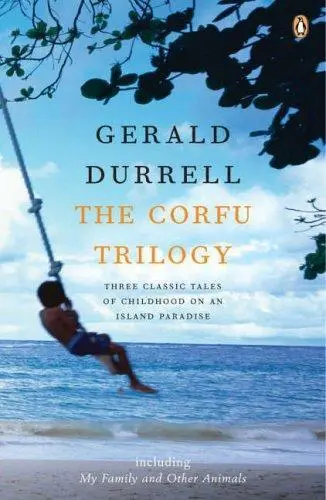
- Название:The Corfu Trilogy
- Автор:
- Издательство:Penguin Books
- Жанр:
- Год:2006
- ISBN:978–0–141–91113–7
- Рейтинг книги:4 / 5. Голосов: 3
-
Избранное:Добавить в избранное
- Отзывы:
-
Ваша оценка:
The Corfu Trilogy: краткое содержание, описание и аннотация
Предлагаем к чтению аннотацию, описание, краткое содержание или предисловие (зависит от того, что написал сам автор книги «The Corfu Trilogy»). Если вы не нашли необходимую информацию о книге — напишите в комментариях, мы постараемся отыскать её.
Durrell dedicated his life to the conservation of wildlife and it is through his efforts that creatures such as the Mauritius pink pigeon and the Mallorcan midwife toad have avoided extinction. Over his lifetime he wrote thirty-seven books, went on dozens of animal-collecting trips and presented numerous tv shows. He founded the Durrell Wildlife Conservation Trust in 1959 as a centre for the conservation of endangered species – of which his wife Lee is still Honorary Director. He was awarded the OBE in 1982.
The Corfu Trilogy
My Family and Other Animals
Birds, Beasts, and Relatives
The Garden of the Gods
The Corfu Trilogy — читать онлайн бесплатно полную книгу (весь текст) целиком
Ниже представлен текст книги, разбитый по страницам. Система сохранения места последней прочитанной страницы, позволяет с удобством читать онлайн бесплатно книгу «The Corfu Trilogy», без необходимости каждый раз заново искать на чём Вы остановились. Поставьте закладку, и сможете в любой момент перейти на страницу, на которой закончили чтение.
Интервал:
Закладка:
The myrtle forests were full of mantises some three inches long, with vivid green wings. They would sway through the myrtle branches on their slender legs, their wickedly barbed front arms held up in an attitude of hypocritical prayer, their little pointed faces with their bulbous straw-coloured eyes turning this way and that, missing nothing, like angular, embittered spinsters at a cocktail party. Should a cabbage white or a fritillary land on the glossy myrtle leaves, the mantises would approach them with the utmost caution, moving almost imperceptibly, pausing now and then to sway gently to and fro on their legs, beseeching the butterfly to believe they were really wind-ruffled leaves.
I once saw a mantis stalk and finally launch himself at a large swallow-tail which was sitting in the sun gently moving its wings and meditating. At the last minute, however, the mantis missed its footing and instead of catching the swallow-tail by the body, as it had intended to do, caught it by one wing. The swallow-tail came out of its trance with a start and flapped its wings so vigorously that it succeeded in lifting the forequarters of the mantis off the leaves. A few more vigorous flappings and, to the mantis’ annoyance, the swallow-tail flew lopsidedly away with a large section missing from one wing. The mantis philosophically sat down and ate the piece of wing that it had retained in its claws.
Under the rocks that littered the ground among the thistles there lived a surprising variety of creatures, in spite of the fact that the earth was baked rock-hard by the sun and was almost hot enough to poach an egg. Here lived a beast that always gave me the creeps. It was a flattened centipede some two inches long, with a thick fringe of long spiky legs along each side of its body. It was so flat that it could get into the most minute crevice and it moved with tremendous speed, seeming more to glide over the ground than run, as smoothly as a flat pebble skims across ice. These creatures were called Scutigeridae, and I could think of no other name which would be so apt in conjuring up their particularly obnoxious form of locomotion.
Scattered among the rocks, you would find holes that had been driven into the hard ground, each the size of a half-crown or larger. They were silk-lined and with a web spread to a three-inch circle around the mouth of the burrow. These were the lairs of the tarantulas, great, fat, chocolate-coloured spiders with fawn-and-cinnamon markings. With their legs spread out, they covered an area perhaps the size of a coffee saucer and their bodies were about the size of half a small walnut. They were immensely powerful spiders, quick and cruel in their hunting, and displaying a remarkable sort of inimical intelligence. For the most part, they hunted at night, but occasionally you would see them during the day, striding swiftly through the thistles on their long legs, in search of their prey. Generally, as soon as they saw you, they would scuttle off and soon be lost among the myrtles, but one day I saw one who was so completely absorbed that he let me approach quite close.
He was some six or seven feet away from his burrow, and he was standing half-way up a blue thistle, waving his front legs and peering about him, reminding me irresistibly of a hunter who had climbed up a tree in order to see if there was any game about. He continued to do this for about five minutes while I squatted on my haunches and watched him. Presently he climbed carefully down the thistle and set off in a very determined manner. It was almost as though he had seen something from his lofty perch, but searching the ground around, I could see no sign of life, and in any case I was not at all sure that a tarantula’s eyesight was as good as all that. But he marched along in a determined fashion until he came to a large clump of Job’s tears, a fine trembling grass whose seed heads look like little white plaited rolls of bread. Going closer to this, I suddenly realized what the tarantula appeared to be after, for under the delicate fountain of white grass there was a lark’s nest. It had four eggs in it and one of them had just hatched, and the tiny, pink, downy offspring was still struggling feebly in the remains of the shell.
Before I could do anything sensible to save it, the tarantula had marched up over the edge of the nest. He loomed there for a moment, monstrous and terrifying, and then swiftly he drew the quivering baby to him and sank his long, curved mandibles into its back. The baby gave two minute, almost inaudible squeaks and opened its mouth wide as it writhed briefly in the hairy embrace of the spider. The poison took effect and it went rigid for a brief moment and then hung limply. The spider waited, immobile, till he was certain the poison had done its work, and then he turned and marched off, the baby hanging limply from his jaws. He looked like some strange, leggy retriever, bringing in his first grouse of the season. Without a pause, he hurried back to his burrow and disappeared inside it, carrying the limp, pathetic little body of the fledgling.
I was amazed by this encounter, for two reasons: firstly, because I did not realize that tarantulas would tackle anything the size of a baby bird, and secondly, because I could not see how he knew the nest was there – and he obviously did know, for he walked, unhesitatingly, straight to it. The distance from the thistle he had climbed to the nest was about thirty-five feet, as I found out by pacing it, and I was positive that no spider had the eyesight to be able to spot such a well-camouflaged nest and the fledgling from that distance. This left only smell, and here again, although I knew animals could smell subtle scents which our blunted nostrils could not pick up, I felt that on a breathlessly still day at thirty-five feet it would take a remarkable olfactory sense to be able to pinpoint the baby lark. The only solution I could come to was that the spider had, during his perambulations, discovered the nest and kept checking on it periodically to see whether the young had hatched. But this did not satisfy me as an explanation, for it attributed a thought process to an insect which I was pretty certain it did not possess. Even my oracle, Theodore, could not explain this puzzle satisfactorily. All I knew was that that particular pair of larks did not succeed in rearing a single young one that year.
Other creatures that fascinated me greatly in the myrtle forests were the ant-lion larvae. Adult ant-lions come in a variety of sizes and, for the most part, rather drab colouring. They look like extremely untidy and demented dragon-flies. They have wings that seem to be out of all proportion to their bodies and these they flap with a desperate air, as though it required the maximum amount of energy to prevent them from crashing to the earth. They were a good-natured, bumbling sort of beast, and did no harm to anybody. But the same could not be said of their larvae. What the rapacious dragon-fly larvae were to the pond, the ant-lion larvae were to the dry, sandy areas that lay between the myrtle bushes. The only sign that there were ant-lion larvae about was a series of curious, cone-shaped depressions in areas where the soil was fine and soft enough to be dug. The first time I discovered these cones, I was greatly puzzled as to what had made them. I wondered if perhaps some mice had been excavating for roots or something similar; I was unaware that at the base of each cone was the architect, waiting taut and ready in the sand, as dangerous as a hidden man-trap. Then I saw one of these cones in action and realized for the first time that it was not only the larva’s home, but also a gigantic trap.
An ant would come trotting along (I always felt they hummed to themselves as they went about their work); it might be one of the little, busy, black variety or one of the large, red, solitary ants that staggered about the countryside with their red abdomens pointing to the sky, for some obscure reason, like anti-aircraft guns. Whichever species it was, if it happened to walk over the edge of one of the little pits, it immediately found that the sloping sides shifted so that it very soon started to slide down towards the base of the cone. It would then turn and try to climb out of the pit, but the earth or sand would shift in little avalanches under its feet. As soon as one of these avalanches had trickled down to the base of the cone, it would be the signal for the larva to come into action. Suddenly the ant would find itself bombarded with a rapid machine-gun fire of sand or earth, projected up from the bottom of the pit with incredible speed by the head of the larva. With the shifting ground underfoot and being bombarded with earth or sand, the ant would miss its foothold and roll ignominiously down to the bottom of the pit. Out of the sand, with utmost speed, would appear the head of the ant-lion larva, a flattened, ant-like head, with a pair of enormous curved jaws, like sickles. These would be plunged into the unfortunate ant’s body and the Iarva would sink back beneath the sand, dragging the kicking and struggling ant with it to its grave. As I felt the ant-lion larvae took an unfair advantage over the dim-witted and rather earnest ants, I had no compunction in digging them up when I found them, taking them home, and making them hatch out eventually in little muslin cages, so that if they were a species new to me, I could add them to my collection.
Читать дальшеИнтервал:
Закладка:
Похожие книги на «The Corfu Trilogy»
Представляем Вашему вниманию похожие книги на «The Corfu Trilogy» списком для выбора. Мы отобрали схожую по названию и смыслу литературу в надежде предоставить читателям больше вариантов отыскать новые, интересные, ещё непрочитанные произведения.



Обсуждение, отзывы о книге «The Corfu Trilogy» и просто собственные мнения читателей. Оставьте ваши комментарии, напишите, что Вы думаете о произведении, его смысле или главных героях. Укажите что конкретно понравилось, а что нет, и почему Вы так считаете.