Gerald Durrell - The Corfu Trilogy
Здесь есть возможность читать онлайн «Gerald Durrell - The Corfu Trilogy» весь текст электронной книги совершенно бесплатно (целиком полную версию без сокращений). В некоторых случаях можно слушать аудио, скачать через торрент в формате fb2 и присутствует краткое содержание. Год выпуска: 2006, ISBN: 2006, Издательство: Penguin Books, Жанр: Природа и животные, Биографии и Мемуары, на английском языке. Описание произведения, (предисловие) а так же отзывы посетителей доступны на портале библиотеки ЛибКат.
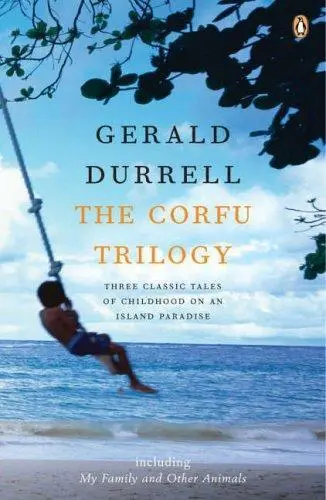
- Название:The Corfu Trilogy
- Автор:
- Издательство:Penguin Books
- Жанр:
- Год:2006
- ISBN:978–0–141–91113–7
- Рейтинг книги:4 / 5. Голосов: 3
-
Избранное:Добавить в избранное
- Отзывы:
-
Ваша оценка:
The Corfu Trilogy: краткое содержание, описание и аннотация
Предлагаем к чтению аннотацию, описание, краткое содержание или предисловие (зависит от того, что написал сам автор книги «The Corfu Trilogy»). Если вы не нашли необходимую информацию о книге — напишите в комментариях, мы постараемся отыскать её.
Durrell dedicated his life to the conservation of wildlife and it is through his efforts that creatures such as the Mauritius pink pigeon and the Mallorcan midwife toad have avoided extinction. Over his lifetime he wrote thirty-seven books, went on dozens of animal-collecting trips and presented numerous tv shows. He founded the Durrell Wildlife Conservation Trust in 1959 as a centre for the conservation of endangered species – of which his wife Lee is still Honorary Director. He was awarded the OBE in 1982.
The Corfu Trilogy
My Family and Other Animals
Birds, Beasts, and Relatives
The Garden of the Gods
The Corfu Trilogy — читать онлайн бесплатно полную книгу (весь текст) целиком
Ниже представлен текст книги, разбитый по страницам. Система сохранения места последней прочитанной страницы, позволяет с удобством читать онлайн бесплатно книгу «The Corfu Trilogy», без необходимости каждый раз заново искать на чём Вы остановились. Поставьте закладку, и сможете в любой момент перейти на страницу, на которой закончили чтение.
Интервал:
Закладка:
‘Ah,’ said Taki, ‘it’s only the spines. You cut those off. The flesh is sweet, as sweet as honey. I will give it to you to take home with you.’
He bent over his oars once more and we proceeded to squeak our way along the edge of the reef again. Presently he paused once more. Here the sea-bed was sandy with just a few scattered tufts of young green ribbon-weed. Again, he slowed the boat to a standstill and picked up his trident.
‘Look,’ he said. ‘Octopus.’
My stomach gave a clutch of excitement, for the only octopuses I had seen had been the dead ones on sale in the town, and these, I felt sure, bore no resemblance to the living creature. But peer as hard as I could, the sandy bottom appeared to be completely devoid of life.
‘There, there ,’ said Taki, lowering the trident gently into the water and pointing. ‘Can’t you see it? Did you leave your eyes behind? There, there . Look, I am almost touching it.’
Still I could not see it. He lowered the trident another foot.
‘Now can you see it, foolish one?’ he chuckled. ‘Just at the end of the prongs.’
And suddenly I could see it. I had been looking at it all the time, but it was so grey and sandlike that I had mistaken it for part of the sea-bed. It squatted on the sand in a nest of tentacles, and there under its bald, domed head its eyes, uncannily human, peered up at us forlornly.
‘It’s a big one,’ said Taki.
He shifted the trident slightly in his grasp, but the movement was incautious. Suddenly the octopus turned from a drab sandy colour to a bright and startling iridescent green. It squirted a jet of water out of its syphon, and projected by this, in a swirl of sand, it shot off the sea-bed. Its tentacles trailed out behind it, and as it sped through the water, it looked like a runaway balloon.
‘Ah, gammoto! ’ said Taki.
He threw the trident down and seizing the oars he rowed swiftly in the wake of the octopus. The octopus obviously possessed a touching faith in its camouflage, for it had come to rest on the sea-bed some thirty-five feet away.
Once again, Taki eased the boat up to it and once again he lowered the trident carefully into the water. This time he took no risks and made no incautious movements. When the pronged fork was within a foot of the octopus’s domed head, Taki strengthened his grip on the pole and plunged it home. Immediately the silver sand boiled up in a cloud as the octopus’s tentacles threshed and writhed and wound themselves round the trident. Ink spurted from its body and hung like a trembling curtain of black lace or coiled like smoke across the sand. Taki was chuckling now with pleasure. He hauled the trident up swiftly, and as the octopus came into the boat, two of its tentacles seized and adhered to the side. Taki gave a sharp tug and the tentacles were pulled free with a ripping, rasping noise that was like the sound of sticking plaster being removed, a thousand times magnified. Swiftly, Taki grabbed the round, slimy body of the octopus and deftly removed it from the prongs and then, to my astonishment, he lifted this writhing Medusa head and put it to his face so that the tentacles wound round his forehead, his cheeks, and his neck, the suckers leaving white impressions against his dark skin. Then, choosing his spot carefully, he suddenly buried his teeth in the very core of the creature with a snap and a sideways jerk, reminiscent of a terrier breaking the back of a rat. He had obviously bitten through some vital nerve-centre, for immediately the tentacles released their grip on his head and fell limply, only their very extremities twitching and curling slightly. Taki threw the octopus into the tin with the scorpion fish and spat over the side of the boat and then, reaching over, cupped a handful of sea-water and swilled his mouth out with it.
‘You have brought me luck,’ he said, grinning and wiping his mouth. ‘It is not many nights that I get an octopus and a scorpios.’
But apparently Taki’s luck stopped short at the octopus, for although we circled the reef several times, we caught nothing more. We did see the head of a moray eel sticking out of its hole in the reef, an extremely vicious-looking head the size of a small dog’s. But when Taki lowered the trident, the moray eel, very smoothly and with much dignity, retreated with fluid grace into the depths of the reef and we did not see him again. For myself, I was quite glad, for I imagined he must have been about six feet long, and to wrestle about in a dimly lit boat with a six-foot moray eel was an experience that even I, ardent naturalist though I was, felt I could do without.
‘Ah, well,’ said Taki philosophically. ‘Now let’s go and do your fishing.’
He rowed me out to the largest of the reefs and landed me with my gear on its flat top. Armed with my net, I prowled along the edge of the reef while Taki rowed the boat some six feet behind me, illuminating the smouldering beauty of the rocks. There was so much life that I despaired of being able to capture it all.
There were fragile blennies, decked out in gold and scarlet; tiny fish half the size of a match-stick with great black eyes and pillar-box red bodies; and others, the same size, whose colouring was a c ombination of deep Prussian- and pale powder-blue. There were blood-red starfish and purple, brittle starfish, their long, slender, spiky arms forever coiling and uncoiling. These had to be lifted in the net with the utmost delicacy, for the slightest shock and they would, with gay abandon, shed all their arms lavishly. There were slipper limpets that, when you turned them over, you found had half the underside covered by a neat flange of shell, so that the whole thing did look rather like a baggy, shapeless carpet-slipper designed for a gouty foot. Then there were cowries, some as white as snow and delicately ribbed, others a pale cream, heavily blotched and smudged with purple-black markings. Then there were the coat-of-mail shells, or chitons, some two and a half inches long, that clung to crannies in the rocks, looking like gigantic wood-lice. I saw a baby cuttlefish the size of match-box and almost fell off the edge of the reef in my efforts to capture him, but to my immense chagrin, he escaped. After only half an hour’s collecting I found that my jars, tins, and boxes were crammed to overflowing with life, and I knew that, albeit reluctantly, I would have to stop.
Taki, very good humouredly, rowed me over to my favourite bay and stood watching with amusement while I carefully emptied my jars of specimens into my rock pool. Then he rowed me back to the jetty below Menelaos’. Here he strung a cord through the gills of the now dead scorpion fish and handed it to me.
‘Tell your mother,’ he said, ‘to cook it with hot paprika and oil and potatoes and little marrows. It is very sweet.’
I thanked him for this and for the fact that he had been so patient with me.
‘Come fishing again,’ he said. ‘I shall be up here next week. Probably Wednesday or Thursday. I’ll send a message to you when I arrive.’
I thanked him and said I would look forward to it. He pushed the boat off and poled his way through the shallow waters heading in the direction of Benitses.
I shouted ‘Be happy’ after him.
‘ Pasto calo ,’ he answered. ‘Go to the good.’
I turned and trudged my way wearily up the hill. I discovered to my horror that it was half past two and I knew Mother would by now have convinced herself that I had been drowned or eaten by a shark or overtaken by some similar fate. However, I hoped that the scorpion fish would placate her.
3
The Myrtle Forests
About half a mile north of the villa the olive grove thinned out and there was a great flat basin, fifty or sixty acres in extent, on which no olives grew. Here was only a great green forest of myrtle bushes, interspersed with dry, stony grassland, decorated with the strange candelabras of the thistles, glowing a vivid electric blue, and the huge flaky bulb of squills. This was one of my favourite hunting grounds, for it contained a remarkable selection of insect life. Roger and I would squat in the heavily scented shade of the myrtle bushes and watch the array of creatures that passed us; at certain times of the day the branches were as busy as the main street of a town.
Читать дальшеИнтервал:
Закладка:
Похожие книги на «The Corfu Trilogy»
Представляем Вашему вниманию похожие книги на «The Corfu Trilogy» списком для выбора. Мы отобрали схожую по названию и смыслу литературу в надежде предоставить читателям больше вариантов отыскать новые, интересные, ещё непрочитанные произведения.




Обсуждение, отзывы о книге «The Corfu Trilogy» и просто собственные мнения читателей. Оставьте ваши комментарии, напишите, что Вы думаете о произведении, его смысле или главных героях. Укажите что конкретно понравилось, а что нет, и почему Вы так считаете.