Gerald Durrell - The Corfu Trilogy
Здесь есть возможность читать онлайн «Gerald Durrell - The Corfu Trilogy» весь текст электронной книги совершенно бесплатно (целиком полную версию без сокращений). В некоторых случаях можно слушать аудио, скачать через торрент в формате fb2 и присутствует краткое содержание. Год выпуска: 2006, ISBN: 2006, Издательство: Penguin Books, Жанр: Природа и животные, Биографии и Мемуары, на английском языке. Описание произведения, (предисловие) а так же отзывы посетителей доступны на портале библиотеки ЛибКат.
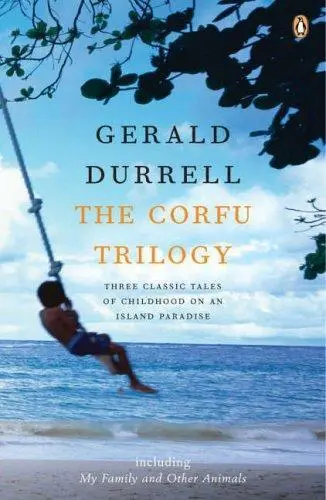
- Название:The Corfu Trilogy
- Автор:
- Издательство:Penguin Books
- Жанр:
- Год:2006
- ISBN:978–0–141–91113–7
- Рейтинг книги:4 / 5. Голосов: 3
-
Избранное:Добавить в избранное
- Отзывы:
-
Ваша оценка:
The Corfu Trilogy: краткое содержание, описание и аннотация
Предлагаем к чтению аннотацию, описание, краткое содержание или предисловие (зависит от того, что написал сам автор книги «The Corfu Trilogy»). Если вы не нашли необходимую информацию о книге — напишите в комментариях, мы постараемся отыскать её.
Durrell dedicated his life to the conservation of wildlife and it is through his efforts that creatures such as the Mauritius pink pigeon and the Mallorcan midwife toad have avoided extinction. Over his lifetime he wrote thirty-seven books, went on dozens of animal-collecting trips and presented numerous tv shows. He founded the Durrell Wildlife Conservation Trust in 1959 as a centre for the conservation of endangered species – of which his wife Lee is still Honorary Director. He was awarded the OBE in 1982.
The Corfu Trilogy
My Family and Other Animals
Birds, Beasts, and Relatives
The Garden of the Gods
The Corfu Trilogy — читать онлайн бесплатно полную книгу (весь текст) целиком
Ниже представлен текст книги, разбитый по страницам. Система сохранения места последней прочитанной страницы, позволяет с удобством читать онлайн бесплатно книгу «The Corfu Trilogy», без необходимости каждый раз заново искать на чём Вы остановились. Поставьте закладку, и сможете в любой момент перейти на страницу, на которой закончили чтение.
Интервал:
Закладка:
I woke at half past five and staggered out, half-asleep, to the veranda, where the family were having tea.
‘Good heavens,’ said Mother. ‘Have you been sleeping?’
I said, as casually as I could, that I thought a siesta a good thing that afternoon.
‘Are you feeling well, dear?’ she asked anxiously.
I said, yes, I felt fine. I had decided to have a siesta in order to prepare myself for that evening.
‘Why, what’s happening, dear?’ asked Mother.
I said, with all the nonchalance I could muster, that I was going out at ten o’clock with a fisherman who was going to take me night-fishing, for, as I explained, there were certain creatures that came out only at night and this was the best method of obtaining them.
‘I hope this does not mean,’ said Larry ominously, ‘that we’re going to have octopus and conger eels flopping around the floor. Better stop him, Mother. Before you know where you are the whole villa will look and smell like Grimsby.’
I replied, somewhat heatedly, that I did not intend to bring the specimens back to the villa, but to put them straight into my special rock pool.
‘Ten o’clock’s rather late , dear,’ said Mother. ‘What time will you be back?’
Lying valiantly, I said I thought I would be back at about eleven.
‘Well, mind you wrap up warmly,’ said Mother, who was always convinced that, in spite of the nights’ being warm and balmy, I would inevitably end up with double pneumonia if I did not wear a jersey. Promising faithfully to wrap up warmly, I finished my tea and then spent an exciting and satisfying hour or so in marshalling my collecting gear. There was my long-handled net, a long bamboo with three wire hooks on the end for pulling interesting clumps of seaweed nearer to one, eight wide-mouthed jam jars, and several tins and boxes for putting such things as crabs or shells in. Making sure that Mother was not around, I put on my bathing trunks under my shorts and hid a towel in the bottom of my collecting bag, for I felt sure that I might have to dive for some of the specimens. I knew that Mother’s fears of double pneumonia would increase a hundredfold if she thought I was going to do this.
Then at a quarter to ten I slung my bag on my back and, taking a torch, made my way down through the olive groves. The moon was a pale, smudged sickle in a star-lit sky, shedding only the feeblest light. In the black recesses among the olive roots, glow-worms gleamed like emeralds, and I could hear the scops owls calling ‘toink, toink’ to each other from the shadows.
When I reached the beach I found Taki squatting in his boat, smoking. He had already lighted the carbon lamp and it hissed angrily to itself and smelt strongly of garlic as it cast a brilliant circle of white light into the shallow water by the bows. Already I could see that a host of life had been attracted to it. Gobies and blennies had come out of their holes and were sitting on the seaweed-covered rocks, pouting and gulping expectantly like an audience in the theatre waiting for the curtain to go up. Shore-crabs scuttled to and fro, pausing now and then to pluck some seaweed delicately and stuff it carefully into their mouths; and everywhere there trundled top-shells, dragged by small, choleric-looking hermit-crabs, who now occupied the shells in place of their rightful owners.
I arranged my collecting gear in the bottom of the boat and sat down with a contented sigh. Taki pushed off and then, using the oar, punted us along through the shallow water and the beds of ribbon-weed that rustled and whispered along the side of the boat. As soon as we were in deeper water, he fixed both his oars and then rowed standing up. We progressed very slowly, Taki keeping a careful eye on the nimbus of light that illuminated the sea bottom for some twelve feet in every direction. The oars squeaked musically and Taki hummed to himself. Along one side of the boat lay an eight-foot pole ending in a five-pronged, savagely barbed trident. In the bow I could see the little bottle of olive oil, such a necessary accoutrement to the fisherman, for should a slight wind blow up and ruffle the waters, a sprinkling of oil would have a magically calming effect on the pleated surface of the sea. Slowly and steadily we crept out towards the black triangular silhouette of Pondikonissi to where the reefs lay. When we neared them Taki rested on his oars for a moment and looked at me.
‘We’ll go round and round for five minutes,’ he said, ‘so that I may catch what there is. Then after that I will take you round to catch the things that you want.’
I readily agreed to this, for I was anxious to see how Taki fished with his massive trident. Very slowly we edged our way round the biggest of the reefs, the light illuminating the strange submarine cliffs covered with pink and purple seaweeds that looked like fluffy oak trees. Peering down into the water, one felt as though one were a kestrel, floating smoothly on outstretched wings over a multi-coloured autumn forest.
Suddenly Taki stopped rowing and dug his oars gently into the water to act as a brake. The boat came to an almost complete standstill as he picked up the trident.
‘Look,’ he said, pointing to the sandy bottom under a great bulwark of submarine cliff. ‘Scorpios.’
At first glance I could see nothing then suddenly I saw what he meant. Lying on the sand was a fish some two feet long with a great filigree of sharp spines like a dragon’s crest along its back, and enormous pectoral fins spread out on the sand. It had a tremendously wide head with golden eyes and a sulky, pouting mouth. But it was the colours that astonished me, for it was decked out in a series of reds ranging from scarlet to wine, pricked out and accentuated here and there with white. It looked immensely sure of itself as it lay there, flamboyant, on the sand, and immensely dangerous, too.
‘This is good eating,’ whispered Taki to my surprise, for the fish, if anything, looked highly poisonous.
Slowly and delicately he lowered the trident into the water, easing the barbed fork inch by inch towards the fish. There was no sound except the peevish hissing of the lamp. Slowly, inexorably, the trident got closer and closer. I held my breath. Surely that great fish with its gold-flecked eyes must notice its approaching doom? A sudden flip of the tail, I thought, and a swirl of sand and it would be gone. But no. It just lay there gulping methodically and pompously to itself. When the trident was within a foot of it, Taki paused. I saw him gently shift his grip on the haft. He stood immobilc for a second, although it seemed an interminable time to me, and then suddenly, so speedily that I did not actually see the movement, he drove the five prongs swiftly and neatly through the back of the great fish’s head. There was a swirl of sand and blood and the fish twisted and writhed on the prongs, curling its body so that the spines along its back jabbed at the trident. But Taki had driven the trident home too skilfully and it could not escape. Quickly, hand over hand, he pulled in the pole, and the fish came over the side and into the boat, flapping and writhing. I came forward to help him get it off the prongs, but he pushed me back roughly.
‘Take care,’ he said, ‘the scorpios is a bad fish.’
I watched while, with the aid of the oar blade, he got the fish off the trident, and although to all intents and purposes it must have been dead, it still wriggled and flapped and tried to drive the spines on its back into the side of the boat.
‘Look, look,’ said Taki. ‘You see now why we call it scorpios. If he can stab you with those spines, Saint Spiridion, what pain you would have! You would have to go to the hospital quickly.’
With the aid of the oar and the trident, and a dexterous bit of juggling, he managed to lift the scorpion fish up and drop it into an empty kerosene tin where it could do no harm. I wanted to know why, if it was poisonous, it was supposed to be good eating.
Читать дальшеИнтервал:
Закладка:
Похожие книги на «The Corfu Trilogy»
Представляем Вашему вниманию похожие книги на «The Corfu Trilogy» списком для выбора. Мы отобрали схожую по названию и смыслу литературу в надежде предоставить читателям больше вариантов отыскать новые, интересные, ещё непрочитанные произведения.






Обсуждение, отзывы о книге «The Corfu Trilogy» и просто собственные мнения читателей. Оставьте ваши комментарии, напишите, что Вы думаете о произведении, его смысле или главных героях. Укажите что конкретно понравилось, а что нет, и почему Вы так считаете.