Gerald Durrell - The Corfu Trilogy
Здесь есть возможность читать онлайн «Gerald Durrell - The Corfu Trilogy» весь текст электронной книги совершенно бесплатно (целиком полную версию без сокращений). В некоторых случаях можно слушать аудио, скачать через торрент в формате fb2 и присутствует краткое содержание. Год выпуска: 2006, ISBN: 2006, Издательство: Penguin Books, Жанр: Природа и животные, Биографии и Мемуары, на английском языке. Описание произведения, (предисловие) а так же отзывы посетителей доступны на портале библиотеки ЛибКат.
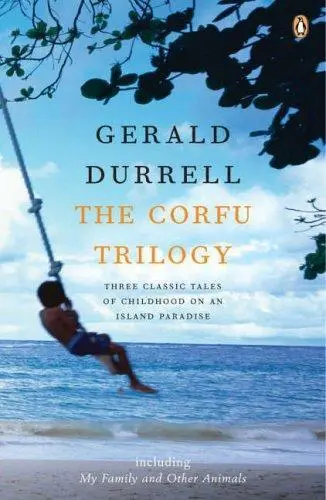
- Название:The Corfu Trilogy
- Автор:
- Издательство:Penguin Books
- Жанр:
- Год:2006
- ISBN:978–0–141–91113–7
- Рейтинг книги:4 / 5. Голосов: 3
-
Избранное:Добавить в избранное
- Отзывы:
-
Ваша оценка:
The Corfu Trilogy: краткое содержание, описание и аннотация
Предлагаем к чтению аннотацию, описание, краткое содержание или предисловие (зависит от того, что написал сам автор книги «The Corfu Trilogy»). Если вы не нашли необходимую информацию о книге — напишите в комментариях, мы постараемся отыскать её.
Durrell dedicated his life to the conservation of wildlife and it is through his efforts that creatures such as the Mauritius pink pigeon and the Mallorcan midwife toad have avoided extinction. Over his lifetime he wrote thirty-seven books, went on dozens of animal-collecting trips and presented numerous tv shows. He founded the Durrell Wildlife Conservation Trust in 1959 as a centre for the conservation of endangered species – of which his wife Lee is still Honorary Director. He was awarded the OBE in 1982.
The Corfu Trilogy
My Family and Other Animals
Birds, Beasts, and Relatives
The Garden of the Gods
The Corfu Trilogy — читать онлайн бесплатно полную книгу (весь текст) целиком
Ниже представлен текст книги, разбитый по страницам. Система сохранения места последней прочитанной страницы, позволяет с удобством читать онлайн бесплатно книгу «The Corfu Trilogy», без необходимости каждый раз заново искать на чём Вы остановились. Поставьте закладку, и сможете в любой момент перейти на страницу, на которой закончили чтение.
Интервал:
Закладка:
It was in this bay that I caught my first spider-crab, and I would have walked right past him, thinking him to be a weed-covered rock, if he had not made an incautious movement. His body was about the size and shape of a small flattened pear, and at the pointed end it was decorated with a series of spikes, ending in two hornlike protuberances over his eyes. His legs and his pincers were long, slender, and spindly. But the thing that intrigued me most about him was the fact that he was wearing, on his back and on his legs, a complete suit of tiny seaweeds, which appeared to be growing out of his shell. Enchanted by this weird creature, I carried him triumphantly along the beach to my rock pool and placed him in it. The firm grip with which I had had to hold him (for once having discovered that he was recognized as a crab, he made desperate efforts to escape) had rubbed off quite a lot of his seaweed suit by the time I got him to the pool. I placed him in the shallow, clear water, and lying on my stomach, watched him to see what he would do. Standing high on his toes, like a spider in a hurry, he scuttled a foot or so away from where I had put him and then froze. He sat like this for a long time, so long in fact that I was just deciding that he was going to remain immobile for the rest of the morning, recovering from the shock of capture, when he suddenly extended a long, delicate claw and very daintily, almost shyly, proceeded to pluck a tiny piece of seaweed that was growing on a near-by rock. He put the seaweed to his mouth and I could see him mumbling at it. At first I thought he was eating it, but I soon realized I was mistaken, for, with an angular grace, he placed his claw over his back, felt around in a rather fumbling sort of way, and then proceeded to plant the tiny piece of weed on his carapace. I presumed that he had been making the base of the weed sticky with saliva or some similar substance to make it adhere to his back. As I watched him, he trundled slowly round the pool, collecting a variety of seaweed with the assiduous dedication of a professional botanist in a hitherto unexplored jungle. Within an hour or so his back was covered with such a thick layer of growth that, if he sat still and I took my eyes off him for a moment, I had difficulty in knowing exactly where he was.
Being intrigued by this cunning form of camouflage, I searched the bay carefully until I found another spider-crab. For him I built a special small pool with a sandy floor, completely devoid of weed. I put him in and he settled down quite happily. The following day I returned, carrying with me a nail brush (which subsequently, rather unfortunately, turned out to be Larry’s) and taking up the unfortunate spider-crab, I scrubbed him vigorously until not an atom of weed remained upon his back or legs. Then I dropped into his pool a variety of things: a number of tiny top-shells and some broken fragments of coral, some small sea anemones and some minute bits of bottle-glass that had been sandpapered by the sea so that they looked like misty jewels. Then I sat down to watch.
The crab, when returned to his pool, sat quite still for several minutes, obviously recovering from the indignity of the scrubbing I had given him. Then, as if he could not quite believe the terrible fate that had overtaken him, he put his two pincers over his head and proceeded to feel his back with the utmost delicacy, presumably hoping against hope that at least one frond of seaweed remained. But I had done my task well and his back was shining and bare. He walked a few paces tentatively and then squatted down and sulked for half an hour. Then he roused himself out of his gloom and walked over to the edge of the pond, where he endeavoured to wedge himself under a dark ridge of rock. There he sat brooding miserably over his lack of camouflage until it was time for me to go home.
I returned very early the following morning, and to my delight, I saw that the crab had been busy while I had been away. Making the best of a bad job, he had decorated the top of his shell with a number of the ingredients that I had left for him. He looked extremely gaudy and had an air of carnival about him. Striped top-shells had been pasted on, interspersed with bits of coral, and up near his head he was wearing two beadlet anemones, like an extremely saucy bonnet with ribbons. I thought, as I watched him crawling about the sand, that he looked exceedingly conspicuous, but, curiously enough, when he went over and squatted by his favourite overhang of rock, he turned into what appeared to be a little pile of shell and coral debris, with a couple of anemones perched on top of it.
To the left of the little bay, a quarter of a mile or so from the shore, lay an island called Pondikonissi, or Mouse Island. It was shaped not unlike an isosceles triangle and was thick with elderly cypress trees and oleander bushes, which guarded a small snow-white church and tiny living quarters adjoining it. This island was inhabited by an elderly and extremely verminous monk, with long black robes and a stove-pipe hat, whose major function in life appeared to be ringing the bell in the match-box-size church at intervals and rowing slowly over to a neighbouring headland in the evening, where there was a small nunnery, inhabited by three ancient nuns. Here he would partake of ouzo and a cup of coffee and discuss, presumably, the state of sin in the world today, and then, as the sun set and turned the calm waters round his island to a multi-coloured sheet of shot-silk, he would row back again, like a hunched black crow, in his creaking, leaking boat.
Margo, having discovered that constant sun-bathing, if anything, inflamed her acne, now decided on another of Mother Nature’s cures – sea-bathing. Every morning she would get up at about half past five, rout me out of bed, and together we would make our way down to the shore and plunge into the clear water, still chilly from the moon’s gaze, and then swim slowly and languidly across to Pondikonissi. Here Margo would drape herself on a rock and I would potter happily in the rock pools on the shore. Unfortunately, our visitations to the island seemed to have a detrimental effect upon the monk, for no sooner had Margo landed and arranged herself attractively on a rock than he would come stamping down the long flight of stone steps that led up to the church, shaking his fist at her, and mouthing incomprehensible Greek from the depths of his long, unkempt beard. Margo would always greet him with a bright smile and a cheerful wave of her hand, and this generally made him almost apoplectic with rage. He would stamp to and fro, his black robes swishing, pointing one dirty and trembling finger at the heavens above and another at Margo. After this had happened on numerous occasions, I managed to commit to memory several of the monk’s favourite phrases, for his vocabulary was not an extensive one. I then asked my friend Philemon what they meant. Philemon was convulsed with laughter. He laughed so much that he was almost incapable of explaining to me, but I at length understood that the monk had several derogatory terms that he used for Margo, the mildest of these being ‘white witch’.
When I related this to Mother, she was, to my astonishment, considerably shocked.
‘Really,’ she said, ‘we ought to report him to somebody. They’d never be able to carry on like that in the Church of England.’
Eventually, however, the whole thing became a sort of game. When Margo and I swam across, we would take some cigarettes over for the monk and he would come flying down the stone steps, shaking his fist and threatening us with the wrath of God, and then, having done his duty, as it were, he would hitch up his robes, squat on the wall, and with great good humour smoke the cigarettes we had brought him. Occasionally he would even trot back to the church to bring us a handful of figs from his tree or a few almonds, milky and fresh, which we would crack between the smooth stones on the beach.
Читать дальшеИнтервал:
Закладка:
Похожие книги на «The Corfu Trilogy»
Представляем Вашему вниманию похожие книги на «The Corfu Trilogy» списком для выбора. Мы отобрали схожую по названию и смыслу литературу в надежде предоставить читателям больше вариантов отыскать новые, интересные, ещё непрочитанные произведения.






Обсуждение, отзывы о книге «The Corfu Trilogy» и просто собственные мнения читателей. Оставьте ваши комментарии, напишите, что Вы думаете о произведении, его смысле или главных героях. Укажите что конкретно понравилось, а что нет, и почему Вы так считаете.