Gerald Durrell - The Corfu Trilogy
Здесь есть возможность читать онлайн «Gerald Durrell - The Corfu Trilogy» весь текст электронной книги совершенно бесплатно (целиком полную версию без сокращений). В некоторых случаях можно слушать аудио, скачать через торрент в формате fb2 и присутствует краткое содержание. Год выпуска: 2006, ISBN: 2006, Издательство: Penguin Books, Жанр: Природа и животные, Биографии и Мемуары, на английском языке. Описание произведения, (предисловие) а так же отзывы посетителей доступны на портале библиотеки ЛибКат.
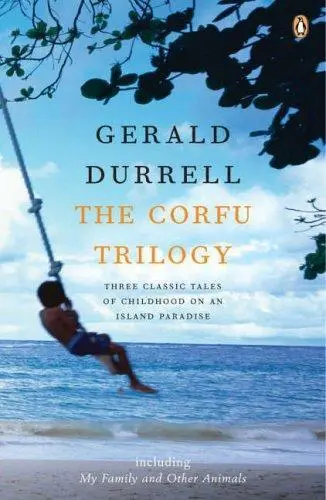
- Название:The Corfu Trilogy
- Автор:
- Издательство:Penguin Books
- Жанр:
- Год:2006
- ISBN:978–0–141–91113–7
- Рейтинг книги:4 / 5. Голосов: 3
-
Избранное:Добавить в избранное
- Отзывы:
-
Ваша оценка:
The Corfu Trilogy: краткое содержание, описание и аннотация
Предлагаем к чтению аннотацию, описание, краткое содержание или предисловие (зависит от того, что написал сам автор книги «The Corfu Trilogy»). Если вы не нашли необходимую информацию о книге — напишите в комментариях, мы постараемся отыскать её.
Durrell dedicated his life to the conservation of wildlife and it is through his efforts that creatures such as the Mauritius pink pigeon and the Mallorcan midwife toad have avoided extinction. Over his lifetime he wrote thirty-seven books, went on dozens of animal-collecting trips and presented numerous tv shows. He founded the Durrell Wildlife Conservation Trust in 1959 as a centre for the conservation of endangered species – of which his wife Lee is still Honorary Director. He was awarded the OBE in 1982.
The Corfu Trilogy
My Family and Other Animals
Birds, Beasts, and Relatives
The Garden of the Gods
The Corfu Trilogy — читать онлайн бесплатно полную книгу (весь текст) целиком
Ниже представлен текст книги, разбитый по страницам. Система сохранения места последней прочитанной страницы, позволяет с удобством читать онлайн бесплатно книгу «The Corfu Trilogy», без необходимости каждый раз заново искать на чём Вы остановились. Поставьте закладку, и сможете в любой момент перейти на страницу, на которой закончили чтение.
Интервал:
Закладка:
The silence during the ceremony had been almost complete, broken only by the odd, drowsy chuckle of a hen or the shrill, and instantly repressed, squall of a baby; but now the stern part of the ceremony was over and the party blossomed once again. The band dug down into its repertoire and produced gayer and more sprightly tunes. Laughter and raucous badinage arose on every side. The wine flowed guggling from the bottles and the guests danced round and round and round, flushed and happy, as inexorably as the hands on a clock face.
The party did not end till well after twelve. All the older guests had already made their way homewards on drooping donkeys. The great fires, with the remains of the sheep carcasses over them, had died in a shroud of grey ash with only a sprinkling of garnet embers winking in it. We took a last glass of wine with Katerina and Stephanos and then made our way sleepily through the olive groves, silvered by a moon as large and as white as a magnolia blossom. The scops owls chimed mournfully to each other, and the odd firefly winked emerald-green as we passed. The warm air smelled of the day’s sunshine, of dew, and of a hundred aromatic leaf scents. Mellow and drugged with wine, walking between the great hunched olives, their trunks striped with cool moonlight, I think we all felt we had arrived, that we had been accepted by the island. We were now, under the quiet, bland eye of the moon, christened Corfiotes. The night was beautiful, and tomorrow, we knew, another tiger-golden day lay ahead of us. It was as though England had never really existed.
2
The Bay of Olives
As you left the villa and walked down through the olive groves, you eventually reached the road with its thick coating of white dust, as soft as silk. If you walked along this for half a mile or so, you came to a goat track which led down a steep slope through the olives and then you reached a small half-moon bay, rimmed with white sands and great piles of dried ribbon-weed that had been thrown up by the winter storms and lay along the beach like large, badly made birds’ nests. The two arms of the bay were composed of small cliffs, at the base of which were innumerable rock pools, filled with the glint and glitter of sea life.
As soon as George realized that to incarcerate me every morning of the week in the villa impaired my concentration, he instituted the novel educational gambit of ‘outdoor lessons’. The sandy beach and the shaggy piles of weed soon became scorching deserts or impenetrable jungles, and with the aid of a reluctant crab or sand-hopper to play the part of Cortez or Marco Polo, we would explore them diligently. Geography lessons done under these circumstances I found had immense charm. We once decided, with the aid of rocks, to do a map of the world along the edge of the sea, so that we had real sea. It was an immensely absorbing task, for, to begin with, it was not all that easy to find rocks shaped like Africa or India or South America, and sometimes two or three rocks had to be joined together to give the required shape to the continent. Then, of course, when you were obtaining a rock, you turned it over very carefully and found a host of sea life underneath it which would keep us both happily absorbed for a quarter of an hour or so, till George realized with a start that this was not getting on with our map of the world.
This little bay became one of my favourite haunts, and nearly every afternoon while the family were having their siesta, Roger and I would make our way down through the breathless olive groves, vibrating with the cries of the cicadas, and pad our way along the dusty road, Roger sneezing voluptuously as his great paws stirred up the dust, which went up his nose like snuff. Once we reached the bay, whose waters in the afternoon sun were so still and transparent they did not seem to be there at all, we would swim for a while in the shallows and then each of us would go about his own particular hobbies.
For Roger, this consisted of desperate and unsuccessful attempts to catch some of the small fish that flicked and trembled in the shallow water. He would stalk along slowly, muttering to himself, his ears cocked, gazing down into the water. Then, suddenly, he would plunge his head beneath the surface, and you heard his jaws clop together and he would pull his head out, sneeze violently, and shake the water off his fur, while the goby or blenny that he had attempted to catch would flip a couple of yards farther on and squat on a rock pouting at him and trembling its tail seductively.
For me the tiny bay was so full of life that I scarcely knew where to begin my collecting. Under and on top of the rocks were the chalky white tunnels of the tube-worms, like some swirling and complicated pattern of icing on a cake, and in the slightly deeper water there were stuck in the sand what appeared to be lengths of miniature hose pipe. If you stood and watched carefully, a delicate, feathery, flowerlike cluster of tentacles would appear at the ends of the hose pipes – tentacles of iridescent blue and red and brown that would revolve slowly round and round. These were the bristle-worms; a rather ugly name, I felt, for such a beautiful creature. Sometimes there would be little clusters of them and they looked like a flower-bed whose flowers could move. You had to approach them with infinite caution, for should you move your feet too rapidly through the water you would set up currents that telegraphed your approach and the tentacles would bunch together and dive with incredible speed back into the tube.
Here and there on the sandy floor of the bay were half-moons of black, shiny ribbon-weed, looking like dark feather boas, anchored to the sand, and in these you would find pipefish, whose heads looked extraordinarily like elongated seahorses, perched on the end of a long, slender body. The pipe fishes would float upright among the ribbon-weeds, which they resembled so closely it required a lot of concentrated searching to find them.
Along the shore, under the rocks, you could find tiny crabs or beadlet anemones like little scarlet-and-blue jewelled pincushions, or the snakelocks anemones, their slender, coffee-coloured stalks and long, writhing tentacles giving them a hair style that Medusa might well have envied. Every rock was encrusted with pink or white or green coral, fine forests of minute seaweeds, including a delicate growth of acetabularia mediterranea with slender threadlike stalks, and perched on the top of each stalk something that looked like a small green parasol turned inside out by some submarine wind. Occasionally a rock would be encrusted with a great black lump of sponge covered with gaping, protuberant mouths like miniature volcanoes. You could pull these sponges off the rocks and split them open with a razor blade, for sometimes, inside, you would find curious forms of life; but the sponge, in retaliation, would coat your hands with a mucus that smelt horribly of stale garlic and took hours to wear off.
Scattered along the shore and in the rock pools, I would find new shells to add to my collection; half the delight of collecting these was not only the beautiful shapes of the shells themselves, but the extraordinary evocative names that had been given to them. A pointed shell like a large winkle, the lip of whose mouth had been elongated into a series of semi-webbed fingers, was, I discovered to my delight, called the pelican’s foot. An almost circular, white, conical, limpet-like shell went under the name of Chinaman’s hat. Then there were the ark-shells, and the two sides of these strange, boxlike shells, when separated, did look (if one used a modicum of imagination) like the hulks of two little arks. Then there were the tower-shells, twisted and pointed as a narwhal’s horn, and the top-shells, gaily striped with a zigzag pattern of scarlet, black, or blue. Under some of the bigger rocks, you would find keyhole limpets, each one of which had, as the name implied, a strange keyhole-like aperture in the top of the shell, through which the creature breathed. And then, best of all, if you were lucky, you would find the flattened ormers, scaly grey with a row of holes along one side; but if you turned it over and extracted its rightful occupant, you would find the whole interior of the shell glowing in opalescent, sunset colours, magical in their beauty. I had at that time no aquariums, so I was forced to construct for myself, in one corner of the bay, a rock pool some eight feet long by four feet wide. Into this I would put my various captures so that I could be almost certain of knowing where they were on the following day.
Читать дальшеИнтервал:
Закладка:
Похожие книги на «The Corfu Trilogy»
Представляем Вашему вниманию похожие книги на «The Corfu Trilogy» списком для выбора. Мы отобрали схожую по названию и смыслу литературу в надежде предоставить читателям больше вариантов отыскать новые, интересные, ещё непрочитанные произведения.





Обсуждение, отзывы о книге «The Corfu Trilogy» и просто собственные мнения читателей. Оставьте ваши комментарии, напишите, что Вы думаете о произведении, его смысле или главных героях. Укажите что конкретно понравилось, а что нет, и почему Вы так считаете.