Gerald Durrell - The Corfu Trilogy
Здесь есть возможность читать онлайн «Gerald Durrell - The Corfu Trilogy» весь текст электронной книги совершенно бесплатно (целиком полную версию без сокращений). В некоторых случаях можно слушать аудио, скачать через торрент в формате fb2 и присутствует краткое содержание. Год выпуска: 2006, ISBN: 2006, Издательство: Penguin Books, Жанр: Природа и животные, Биографии и Мемуары, на английском языке. Описание произведения, (предисловие) а так же отзывы посетителей доступны на портале библиотеки ЛибКат.
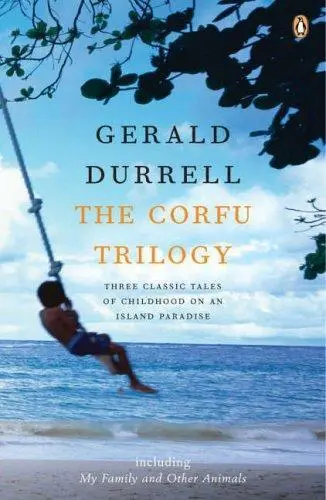
- Название:The Corfu Trilogy
- Автор:
- Издательство:Penguin Books
- Жанр:
- Год:2006
- ISBN:978–0–141–91113–7
- Рейтинг книги:4 / 5. Голосов: 3
-
Избранное:Добавить в избранное
- Отзывы:
-
Ваша оценка:
The Corfu Trilogy: краткое содержание, описание и аннотация
Предлагаем к чтению аннотацию, описание, краткое содержание или предисловие (зависит от того, что написал сам автор книги «The Corfu Trilogy»). Если вы не нашли необходимую информацию о книге — напишите в комментариях, мы постараемся отыскать её.
Durrell dedicated his life to the conservation of wildlife and it is through his efforts that creatures such as the Mauritius pink pigeon and the Mallorcan midwife toad have avoided extinction. Over his lifetime he wrote thirty-seven books, went on dozens of animal-collecting trips and presented numerous tv shows. He founded the Durrell Wildlife Conservation Trust in 1959 as a centre for the conservation of endangered species – of which his wife Lee is still Honorary Director. He was awarded the OBE in 1982.
The Corfu Trilogy
My Family and Other Animals
Birds, Beasts, and Relatives
The Garden of the Gods
The Corfu Trilogy — читать онлайн бесплатно полную книгу (весь текст) целиком
Ниже представлен текст книги, разбитый по страницам. Система сохранения места последней прочитанной страницы, позволяет с удобством читать онлайн бесплатно книгу «The Corfu Trilogy», без необходимости каждый раз заново искать на чём Вы остановились. Поставьте закладку, и сможете в любой момент перейти на страницу, на которой закончили чтение.
Интервал:
Закладка:
‘Well, I expect they find it useful, dear,’ said Mother vaguely.
‘I trust you’re not hoping to smuggle some into the house?’ Larry inquired. ‘I refuse to live in a villa whose decor consists of balls of dung all over the floor.’
‘No, no, dear, I’m sure he won’t,’ said Mother peaceably and untruthfully.
‘Well, I’m just warning you, that’s all,’ said Larry. ‘As it is, he appears to have all the more dangerous insects out of the garden closeted in his bedroom.’
‘They probably want it for warmth,’ said Leslie, who had been giving the matter of dung-beetles some thought. ‘Very warm stuff, dung. Ferments.’
‘Should we, at any time, require central heating,’ said Larry, ‘I’ll bear that in mind.’
‘They probably eat it,’ said Margo.
‘Margo, dear,’ said Mother. ‘Not while we’re having lunch.’
As usual, my family’s lack of biological knowledge had let me down.
‘What you want to read,’ said Larry, absentmindedly helping himself to another plateful of stew, which he had just described to Mother as being lacking in flavour, ‘what you want to read is some Fabre.’
I inquired what or who Fabre was, more out of politeness than anything else, because, as the suggestion had come from Larry, I was convinced that Fabre would turn out to be some obscure medieval poet.
‘Naturalist,’ said Larry, his mouth full, waving his fork at me. ‘Wrote about insects and things. I’ll try and get you a copy.’
Overwhelmed with such unlooked-for magnanimity on the part of my elder brother, I made a point of being very careful within the next two or three days not to do anything to incur his wrath; but the days passed and no book appeared and eventually I forgot about it and devoted my time to the other insects in the garden.
But the word ‘why’ pursued and frustrated me on every hand. Why did the carpenter-bees cut out little circular pieces from the rose leaves and fly away with them? Why did the ants conduct what appeared to be passionate love affairs with the massed battalions of green fly that infested many of the plants in the garden? What were the strange, amber, transparent insect corpses or shells that I found sticking to grass stalks and to olive trees? They were the empty skins, as fragile as ash, of some creature with a bulbous body, bulbous eyes, and a pair of thick, well-barbed forelegs. Why did each of these shells have a split down its back? Had they been attacked and had all their life juices sucked out of them? If so, what had attacked them and what were they? I was a bubbling cauldron of questions which the family were unable to answer.
I was in the kitchen when Spiro arrived one morning some days later, as I was showing Mother my latest acquisition, a long, thin, caramel-coloured centipede which I was insisting, in spite of her disbelief, glowed with a white light at night. Spiro waddled into the kitchen, sweating profusely, looking, as he always did, truculent and worried.
‘I’ve broughts yours mails, Mrs Durrells,’ he said to Mother, and then, glancing at me, ‘Mornings, Masters Gerrys.’
Thinking, in my innocence, that Spiro would share my enthusiasm for my latest pet, I pushed the jam jar under his nose and urged him to feast his eyes upon it. He took one swift look at the centipede, now going round and round in the bottom of the jar like a clock-work train, dropped the mail on the floor, and retreated hurriedly behind the kitchen table.
‘Gollys, Masters Gerrys,’ he said, ‘what’s you doing with thats? ’
I explained it was only a centipede, puzzled at his reaction.
‘Thems bastards are poisonous, Mrs Durrells,’ said Spiro earnestly, to Mother. ‘Honest to Gods Masters Gerrys shouldn’t have things like thats.’
‘Well, perhaps not,’ said Mother vaguely. ‘But he’s so interested in all these things. Take it outside, dear, where Spiro can’t see it.’
‘Makes me scarce,’ I heard Spiro say as I left the kitchen with my precious jar. ‘Honest to Gods, Mrs Durrells, makes me scarce what that boy finds .’
I managed to get the centipede into my bedroom without meeting any other members of the family and I bedded him down in a small dish, tastefully decorated with moss and bits of bark. I was determined that the family should appreciate the fact that I had found a centipede that glowed in the dark. I had planned that night to put on a special pyrotechnic display after dinner. However, all thoughts of the centipede and his phosphorescence were completely driven from my mind, for in with the mail was a fat, brown parcel which Larry, having glanced at, tossed across to me while we were eating lunch.
‘Fabre,’ he said succinctly.
Forgetting my food, I tore the parcel open, and there inside was a squat, green book entitled The Sacred Beetle and Others by Jean Henri Fabre. Opening it, I was transported by delight, for the frontispiece was a picture of two dung-beetles, and they looked so familiar they might well have been close cousins of my own dung-beetles. They were rolling a beautiful ball of dung between them. Enraptured, savouring every moment, I turned the pages slowly. The text was charming. No erudite or confusing tome, this. It was written in such a simple and straightforward way that even I could understand it.
‘Leave the book till later, dear. Eat your lunch before it gets cold,’ said Mother.
Reluctantly I put the book on my lap and then attacked my food with such speed and ferocity that I had acute indigestion for the rest of the afternoon. This in no way detracted from the charm of delving into Fabre for the first time. While the family siestaed, I lay in the garden in the shade of the tangerine trees and devoured the book, page by page, until by tea-time – to my disappointment – I had reached the end. But nothing could describe my elation. I was now armed with knowledge. I knew, I felt, everything there was to know about dung-beetles. Now they were not merely mysterious insects crawling ponderously throughout the olive groves – they were my intimate friends.
About this time another thing that extended and encouraged my interest in natural history – though I cannot say that I appreciated it at the time – was the acquisition of my first tutor, George. George was a friend of Larry’s, tall, lanky, brown-bearded and bespectacled, possessed of a quiet and sardonic sense of humour. It is probable that no tutor has ever had to battle with such a reluctant pupil. I could see absolutely no reason for having to learn anything that was not connected with natural history, and so our early lessons were fraught with difficulty. Then George discovered that, by correlating such subjects as history, geography, and mathematics with zoology, he could get some results, and so we made fair progress. However, the best thing as far as I was concerned was that one morning a week was devoted exclusively to natural history, when George and I would peer earnestly at my newly acquired specimens and endeavour to identify them and work out their life histories. A meticulous diary was kept which contained a large number of flamboyant and somewhat shaky pictures, purporting to be of the specimens in question, done by me in a variety of coloured inks and water-colours.
Looking back, I have a sneaking feeling that George enjoyed the mornings devoted to natural history as much as I did. It was, for example, the only morning during the week that I would go to meet him. I would amble through the olive groves half-way to the tiny villa that he occupied, and then Roger and I would conceal ourselves in a clump of myrtle and await his approach. Presently he would appear, clad in nothing but a pair of sandals, faded shorts, and a gigantic, tattered straw hat, carrying under one arm a pile of books and swinging a long, slender walking-stick in the other hand. The reason for going to meet George, I regret to say, was of an entirely mercenary nature. Roger and I would squat in the sweet-scented myrtles and lay bets with each other as to whether or not, on this particular morning, George was going to fight an olive tree.
Читать дальшеИнтервал:
Закладка:
Похожие книги на «The Corfu Trilogy»
Представляем Вашему вниманию похожие книги на «The Corfu Trilogy» списком для выбора. Мы отобрали схожую по названию и смыслу литературу в надежде предоставить читателям больше вариантов отыскать новые, интересные, ещё непрочитанные произведения.


Обсуждение, отзывы о книге «The Corfu Trilogy» и просто собственные мнения читателей. Оставьте ваши комментарии, напишите, что Вы думаете о произведении, его смысле или главных героях. Укажите что конкретно понравилось, а что нет, и почему Вы так считаете.