James Jenkins - The Valancourt Book of World Horror Stories. Volume 1
Здесь есть возможность читать онлайн «James Jenkins - The Valancourt Book of World Horror Stories. Volume 1» весь текст электронной книги совершенно бесплатно (целиком полную версию без сокращений). В некоторых случаях можно слушать аудио, скачать через торрент в формате fb2 и присутствует краткое содержание. Город: Richmond, Год выпуска: 2020, Издательство: Valancourt Books, Жанр: Ужасы и Мистика, на английском языке. Описание произведения, (предисловие) а так же отзывы посетителей доступны на портале библиотеки ЛибКат.
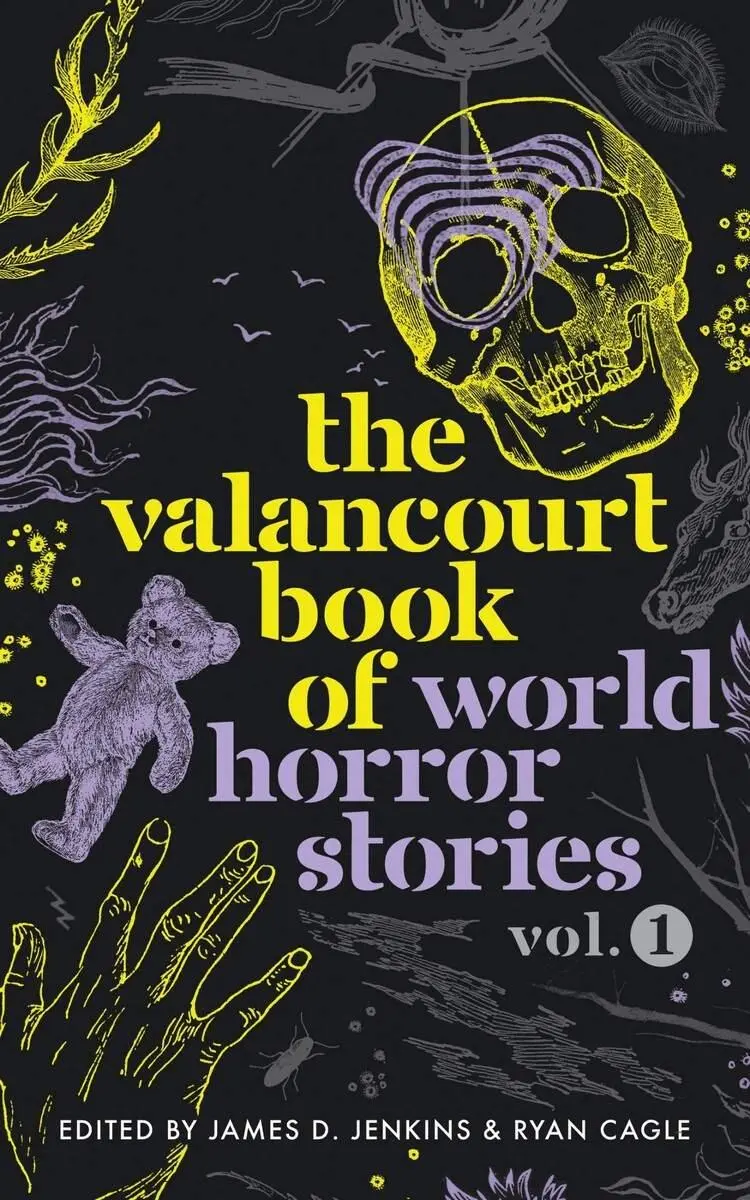
- Название:The Valancourt Book of World Horror Stories. Volume 1
- Автор:
- Издательство:Valancourt Books
- Жанр:
- Год:2020
- Город:Richmond
- ISBN:нет данных
- Рейтинг книги:4 / 5. Голосов: 1
-
Избранное:Добавить в избранное
- Отзывы:
-
Ваша оценка:
The Valancourt Book of World Horror Stories. Volume 1: краткое содержание, описание и аннотация
Предлагаем к чтению аннотацию, описание, краткое содержание или предисловие (зависит от того, что написал сам автор книги «The Valancourt Book of World Horror Stories. Volume 1»). Если вы не нашли необходимую информацию о книге — напишите в комментариях, мы постараемся отыскать её.
The Valancourt Book of World Horror Stories. Volume 1 — читать онлайн бесплатно полную книгу (весь текст) целиком
Ниже представлен текст книги, разбитый по страницам. Система сохранения места последней прочитанной страницы, позволяет с удобством читать онлайн бесплатно книгу «The Valancourt Book of World Horror Stories. Volume 1», без необходимости каждый раз заново искать на чём Вы остановились. Поставьте закладку, и сможете в любой момент перейти на страницу, на которой закончили чтение.
Интервал:
Закладка:
During this time I unfortunately sometimes peed in my bed again. My therapist says that’s normal, it’s called regression, an emotional reaction which entails going back to a former stage of development. After a while, I stopped sleeping with Vili because I didn’t want to stain his fur. My mother was not very happy with the bedwetting, and I was well aware that it was a sign of weakness. My mother would shake her head impatiently and sigh heavily to express her discontent, and I would stand in the middle of my room in shame, shaking in the coldness of dawn, but Vili’s voice gave me comfort even then.
Then things took a turn for the worse.
One day I came home from school and found Vili on the floor, the thread broken on his side and the white stuffing pouring out of him. My heart sank. I thought Vili had died while I was at school. But I could hear his voice, very quiet, weary with pain, but still clear. Vili was alive. I took him carefully in my shaking hands, which only caused him to lose even more stuffing, my throat went dry from panic, I could hardly breathe. I laid Vili on my bed and tried to hold his wound together. I couldn’t sew, and I despised myself for that. Eventually, I applied super glue to the edges of the wound and held the material together while I whispered to Vili that everything was going to be all right, although I knew that nothing was ever going to be all right.
The next day it turned out that the others had had similar experiences as well. One of my friends, the boy who always wore black-framed glasses, told us about the deterioration of his plush toy named Nyinyi. My bespectacled friend’s thinking was a bit slow and dim – a year or two later he was sent to another school because his learning difficulties had become too severe.
There is a chance – but not a certainty, because I didn’t stop to talk to him, I simply walked by as if he was a thrown-away soda can or a cigarette butt on the cold concrete – that I passed by my friend a couple of years ago, now an adult. My friend apparently lived on the streets, he had a thick blanket wrapped around his waist. There was a tin can by his feet with some coins in it. My friend kept staring straight ahead like someone who had stopped counting the minutes and days long ago and let time flow effortlessly through him. He was still wearing the black-framed glasses, which he kept sparkling clean just like in his childhood. I didn’t turn towards him, and I didn’t give him money. I wanted to get this miserable man out of my sight as quickly as possible. Maybe it wasn’t even my friend, just someone who looked like him.
When my friend was still a kid, he told me how Nyinyi’s condition took a turn for the worse. Under Nyinyi’s tiny, fluffy tail a hole opened up – it was not even the thread but the fabric itself that loosened, allowing Nyinyi’s freshly torn anus to eject thick red fiber onto the floor. My friend tried to push the yarn back, but he only made the hole bigger. My other two friends, the boy and the girl, listened in shock first to the account of my bespectacled friend, and then to mine. Later that week their own plush toys started to deteriorate as well. One morning the girl found her toy Ferkó with a severed arm – his right arm had detached from his body during the night. The other boy’s plush toy, Egyes, went into paralysis. We didn’t quite understand what this meant, since we all knew that plush toys don’t move by themselves, only when we move them or imagine them to be moving. Well, my friend’s toy didn’t move anymore. He didn’t die, my friend told me; he was one hundred percent alive, only disabled. Soon after, the stuffing started to pour out of Egyes’ mouth – the sickness made him vomit up his own guts.
We were all faced with the situation that our plush toys were losing their vital filling, and our knowledge taken from movies made it clear to us that such an excessive loss leads to certain death. We needed a transfusion to keep our toys alive, and for this we had to find other, still living plush toys.
I fished out some of my old toys from the toybox, those I hadn’t played with for a long time – Szilvio, a plush bunny who was given to me by distant relatives for a Christmas years past (I didn’t give him this name, it was written on the funny bow he was wearing); a Disney-franchise plush based on one of their current movie’s side characters, which I named Gyuri for reasons unknown, and finally a female fox, Anni, who used to be my favorite toy for a long time, until I didn’t find her fur soft enough anymore, so upon mutual agreement I had retired her into the toybox. Now I spread them out one by one on the floor. I could hear their voices as well, those old voices they used to talk to me in when I still played with them. But Vili’s voice drowned theirs out. He was begging me not to do this, that these toys didn’t deserve it – but by then Vili had another hole in his body and the stuffing needed urgent replacement. I also knew that no matter how brave Vili wanted me to see him, he was terrified; I felt it. At this time Vili often talked to me in his sleep. I don’t think he was conscious, his words were too confused, too out of character – he was whining in his sleep, often mumbling obscenities; every word reeked of fear.
I smuggled a knife and a pair of scissors from the kitchen and I started with Gyuri, the Disney toy. I never considered him to be too clever, nor very sensitive; on the other hand he was made of an excellent material manufactured somewhere in China. He didn’t get sick though, and I was angry at him for this. He didn’t deserve to be so lucky. I made an incision with the knife on Gyuri’s abdomen – I could hear him screaming in pain, then begging for his life. But at that point there was no turning back. I slipped the scissors into his wound and cut through his skin. Gyuri was screaming, and I was screaming with him, or instead of him because he didn’t have a mouth or throat to scream out loud. I wanted to give him an actual voice in his final minutes.
My mother asked me during dinner why I was shouting in my room. I told her I was doing surgeries, dissections in order to prolong Vili’s life expectancy. My mother was drinking red wine, I recall this because her teeth were black when she smiled. Good , she said, I’m glad that you’re taking responsibility.
That made me happy. My therapist says this is normal, children always want to live up to their parents’ expectations, and my mother’s expectations were always quite high. She took out a box of ice cream from the freezer and carved out a slice of the delicacy for me. This happened very rarely, only on festive occasions. She placed the bowl full of ice cream in front of me and took another sip of the red wine. She kissed the top of my head, another evident sign of motherly love, which nonetheless scared me at that moment. My hair got sticky from drool and wine. It’s important , she said, that we take care of our loved ones, that we’re by their side even in times of hardship.
I didn’t notice it as a child, but my father says my mother was drinking too much in that period, usually right before bedtime. This made my father unwilling to share the bed with her, bothered by the smell of alcohol. Now he drinks too, of course. Apart from that night I still remember my mother as a sober person though.
My father later also told me, and this gives a special context to my mother’s behavior that night, that my mother had abandoned her own mother in the final hours of the latter’s life. Or final days. Or final weeks. All in all, my mother kept her distance in the physical, geographical, and emotional sense as well. My grandmother died alone. That night my mother obviously projected her desire to have done it differently onto me. I was, of course, not aware of this at that time. I ate my ice cream and in the following days I butchered my remaining plush toys, screaming and whimpering to vocalize their death throes under the edge of my scissors.
Читать дальшеИнтервал:
Закладка:
Похожие книги на «The Valancourt Book of World Horror Stories. Volume 1»
Представляем Вашему вниманию похожие книги на «The Valancourt Book of World Horror Stories. Volume 1» списком для выбора. Мы отобрали схожую по названию и смыслу литературу в надежде предоставить читателям больше вариантов отыскать новые, интересные, ещё непрочитанные произведения.





Обсуждение, отзывы о книге «The Valancourt Book of World Horror Stories. Volume 1» и просто собственные мнения читателей. Оставьте ваши комментарии, напишите, что Вы думаете о произведении, его смысле или главных героях. Укажите что конкретно понравилось, а что нет, и почему Вы так считаете.